• Home
  • About Us
    • Physics Administration
    • Directions
    • Awards
    • Student Awards
    • Make a Donation
    • News
      • Research News
      • Department News
      • Newsletters
    • PTK Policy
  • People
    • All
    • Faculty
      • Current
      • Emeritus
      • Adjunct
      • Affiliate
      • Research Professors
    • Research Scientists
    • Postdocs
    • Staff
    • Lecturers
    • Visitors
    • Graduate Students
  • Research
    • Research Areas
      • AI and Physical Sciences
      • Astro Metrology
      • Atomic, Molecular & Optical
      • Biophysics
      • Chemical Physics
      • Condensed Matter Experiment
      • Condensed Matter Theory
      • Cosmic Ray Physics
      • Elementary Particles
      • Gravitation Experiment
      • Gravitational Theory
      • High Energy Physics
      • Nonlinear Dynamics, Chaos and Complex Systems
      • Nuclear Physics
      • Particle Astrophysics
      • Physics Education Research
      • Plasma Physics
      • Plasma Theory
      • Quantum Science and Technology
      • Quarks, Hadrons and Nuclei
      • Space Physics
    • Centers & Institutes
  • Academics
    • OSES Home (Student Services)
    • OSES News
    • Undergraduate Program
      • Prospective Students
      • Apply Now
      • Degree Requirements and Policies
      • Scholarships
      • Undergraduate Research
      • Advising
      • Undergraduate Forms
      • Undergraduate Events
      • Departmental Honors
      • Society of Physics Students
      • FAQ
      • Undergraduate Student Committee
    • Graduate Program
      • Prospective Students
      • Open House
      • Degree Requirements
      • Graduate Resources
      • Deadlines and Forms
      • PhD Defenses
        • PhD Defenses 2026
        • PhD Defenses 2025
        • PhD Defenses 2024
        • PhD Defenses 2023
        • PhD Defenses 2022
        • PhD Defenses 2021
        • PhD Defenses 2020
        • PhD Defenses 2019
        • PhD Defenses 2018
        • PhD Defenses 2017
        • PhD Defenses 2016
      • Events
      • Scholarships & Awards
      • Qualifier
      • Graduate Student Organizations
      • FAQ
    • Student Opportunities
      • GRAD-MAP
      • Graduate Student Organizations
      • Outreach Volunteering
      • Society of Physics Students
      • NSF S-STEM Program
      • Undergraduate Research
      • The Noether Physics Society
      • Undergraduate Quantum Association
    • Courses
    • Academic Support
    • NSF S-STEM Program
    • Teaching Assistants
  • Events
    • Calendar
    • Physics Colloquia
    • W.J. Carr Lecture
    • Research Interaction Team (RIT) Math/Physics
    • Mechanick Quantum Biology Lecture
    • Irving and Renee Milchberg Endowed Lectureship
    • Charles W. Misner Endowed Lectureship in Gravitational Physics
    • Charles W. Misner Memorial Symposium
    • John S. Toll Endowed Lecture
    • Prange Prize Lecture
    • Maryland Day
    • Outreach
      • Outreach Home
      • Physics is Phun
      • Discovery Days
    • Summer Programs
      • Physics Makers Camp
      • Physics of Quidditch
      • Science Discovery Camp
      • Advanced Physics Summer Program
      • Toolkit for Success
    • CUWiP
    • Vortex Makerspace
    • QURiSE Conference
  • Services
    • Building Access Requests
    • Computing Services
    • Conference Room Reservations
    • Department Operations Directory
    • Electronic and Mechanical Development
    • Hiring Procedures
    • Lecture Demo
    • Mental Health Resources
    • Parking
    • Physics Ombudspersons
    • Printing Services
      • Poster Print Request
    • Proposal Submissions
    • Purchase Order
    • Suggestion Box
    • Textbook Information
  • Give
  1. Home
  2. About Us
  3. News
  4. Department News

Written on 06 October 2026.

University of Maryland Physicists Play Essential Role in Nobel Prize-Winning Discovery of High-Energy Cosmic Neutrinos

They helped design and build the IceCube Neutrino Observatory’s data storage, analysis and real-time alert systems, and they currently play a major role in operating the observatory and analyzing the data.

Francis Halzen, a professor of physics at the University of Wisconsin–Madison, was awarded the 2026 Nobel Prize in physics on October 6, "for decisive contributions to the IceCube Neutrino Observatory and the discovery of high-energy neutrinos of astrophysical origin." Halzen proposed using the deep Antarctic ice under the South Pole as a neutrino detector in 1988 and has led the effort since. In announcing the prize, the Nobel Committee noted that he "has led an international team of researchers and engineers."

That team now includes about 450 scientists from 14 countries and 58 institutions, including the University of Maryland. The Maryland IceCube team joined the collaboration 25 years ago, before IceCube’s construction began, and hosts one of its largest collaborating groups. The group currently includes faculty members Greg Sullivan, Kara Hoffman, Erik Blaufuss, Michael Larson and Brian Clark; software engineer Don La Dieu; postdoctoral scholars Bennett Brinson and Rachel Procter-Murphy; and graduate students Taylor St Jean, Emma Tintinger and Aishwarya Vijai. Over the years, the group has advised 17 graduate students.
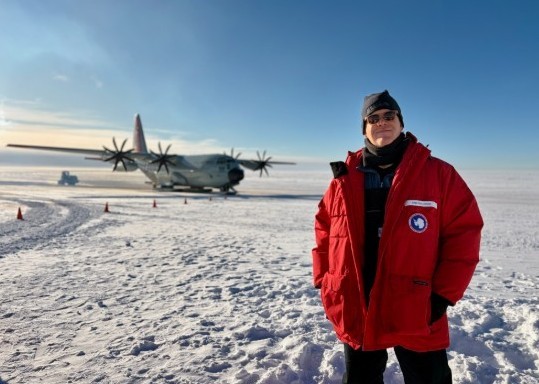
Erik Blaufuss (above) and Rachel Procter-Murphy (below) at South Pole station, Antarctica this past season (Dec 2025 - Feb 2026) Credit: E. BlaufussErik Blaufuss (above) and Rachel Procter-Murphy (below) at South Pole station, Antarctica this past season (Dec 2025 - Feb 2026) Credit: E. Blaufuss

UMD physicists helped lead the design and construction of IceCube’s computer data systems, developed the software used to analyze the data and built an alert system that allows telescopes worldwide to make coordinated observations of interesting events within minutes. They currently play a major role in operating the observatory and lead a major share of the collaboration's data analysis.

“This year's Nobel Prize in physics recognizes a transformative vision that opened a new window on the universe. I congratulate Francis Halzen and the entire IceCube team on this well-deserved honor,” said Amitabh Varshney, dean of UMD’s College of Computer, Mathematical, and Natural Sciences. “We are proud of the University of Maryland researchers who contributed to this vision over a quarter century and continue to advance neutrino astronomy and deepen our understanding of the cosmos’s most powerful phenomena.”

Running the detector
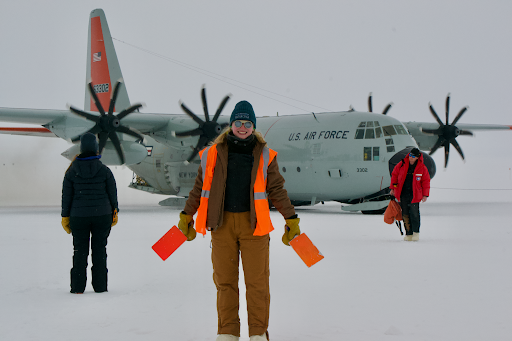
The IceCube Neutrino Observatory consists of a cubic kilometer of Antarctic ice with more than 5,000 light sensors, buried up to 2.5 kilometers deep. It has recorded data nearly continuously since its completion in 2011. A National Science Foundation-funded maintenance and operations program keeps it that way, covering everything from the computers at the South Pole to the software that turns raw flashes of light into usable data. To support this effort, the Maryland group maintains several core software systems responsible for the analysis, filtering and simulation of IceCube data.  UMD has the largest role in this effort, outside of the University of Wisconsin, with Physics Professor Greg Sullivan as the Maryland lead for maintenance and operations since 2010 and Physics Research Scientist Erik Blaufuss recently assuming that role. Sullivan also served as IceCube's spokesperson as the completed detector began operating and the collaboration made its first observation of cosmic neutrinos. 

“This recognition for Francis is very well deserved,” Sullivan said. “There is no question that without his vision and perseverance there would be no field of neutrino astronomy. I always recall the time about 35 years ago when I first met Francis at a workshop and he was advocating for building a neutrino telescope of one cubic kilometer in scale in the South Pole ice. At first blush, I thought to myself he was crazy! But, fortunately for me, after talking with him over time, he convinced me of his vision. I joined as the lead scientist from UMD at the start of the formal IceCube project over two decades ago. I am very grateful to his leadership and vision, which have benefited so many of us, including a large IceCube group that has grown at UMD.”

Physics Assistant Research Scientist Michael Larson is now the collaboration's technical lead, responsible for the detector's technical operation across all member institutions. 

"IceCube is a unique instrument,” Larson said. "The bulk of our detector is frozen into the Antarctic glacier, so we can’t easily fix the sensors if things go wrong; everything must work the first time and continue working for years. Researchers around the world are constantly working together to keep the detector running in these extreme conditions and hundreds more are working to improve the science we can do with it every day."

Doing the science

Kara Hoffman, Professor and Chair of UMD’s Department of Physics, is the principal investigator of the collaboration's current analysis program, which supports the work of turning billions of recorded events into published results. Her research ranges from gamma-ray burst searches to next-generation detection techniques.

“The science reach of IceCube has far exceeded its original design goals,” Hoffman said. “Not only have we discovered astrophysical neutrinos, but we are making world-competitive measurements of neutrino oscillations and, thanks to the alert program developed at UMD, we are playing an essential role in astronomy.”

Blaufuss led the creation of IceCube's real-time alerts, which notify telescopes worldwide, usually within a minute, when the detector sees a likely cosmic neutrino. On September 22, 2017, one of those alerts led observatories to a flaring blazar, TXS 0506+056. IceCube then searched its archive and found an earlier burst of neutrinos from the same direction. The two results, published in the journal Science in 2018, made TXS 0506+056 the first strong candidate source of high-energy cosmic neutrinos. Blaufuss was also lead author on the 2019 expansion of the alert program, and the alerts are now a routine part of multimessenger astronomy.

“Notifying the physics community quickly when IceCube detects an astrophysical neutrino enables other telescopes to make the observations that will be critical in identifying and understanding the cosmic sources of these neutrinos,” Blaufuss said.

Physics Assistant Professor Brian Clark previously led the collaboration's diffuse working group, which measures the flux of astrophysical neutrinos at the center of this year's prize. He now chairs IceCube's speakers committee, which decides who presents the collaboration's results at conferences worldwide.

"Measuring the neutrino flux is hard because the signal is faint and spread across the whole sky” Clark said. “You have to understand your detector well enough to trust a teeny signal over a large background. That took years of careful work from many people, and our group is proud to have been part of it."

Maryland's science contributions are broad. Blaufuss chaired IceCube's gamma-ray burst working group when the collaboration searched about 300 bursts and found no neutrinos, contradicting 15 years of predictions. That 2012 result published in the journal Nature, which drew on a UMD graduate thesis, ruled out gamma-ray bursts as a major source of cosmic rays. UMD researchers have also contributed to IceCube's measurements of neutrino oscillations with DeepCore, the detector's densely instrumented inner core. Recent work from the group has focused on finding multi-messenger counterparts to neutrinos by searching for neutrinos coincident with TeV gamma-ray sources, bright optical flashes and tidal disruption events. They have also searched for the yet-undiscovered flux of extremely high-energy neutrinos, above the PeV scale, which was named to Physical Review Letters “Collection of the Year” in 2025.

What's next

The IceCube collaboration finished deploying the IceCube Upgrade early this year. The first major expansion since 2011, it adds hundreds of new sensors in a dense cluster at the center of the IceCube array. It will sharpen IceCube's understanding of the glacial ice properties and of low-energy neutrinos, and it is a step toward the proposed IceCube-Gen2, roughly eight times larger than the current IceCube detector. Maryland also contributed to that work on the ice: Blaufuss and Rachel Procter-Murphy, then a Ph.D. student, traveled to the South Pole to help bring the Upgrade online.

Maryland is also helping develop IceCube-Gen2 itself, the proposed next-generation observatory that would take neutrino astronomy to the next level. Gen2 would combine a much larger optical array with a radio array spread across the ice surface, built to catch rare neutrinos at energies far beyond IceCube's reach. UMD is a leader in that radio technique. Hoffman pioneered the technique on the Askaryan Radio Array (ARA) at the South Pole, and Clark works on both ARA and the Radio Neutrino Observatory in Greenland (RNO-G).
Adil Hassam

Written on 02 October 2026.

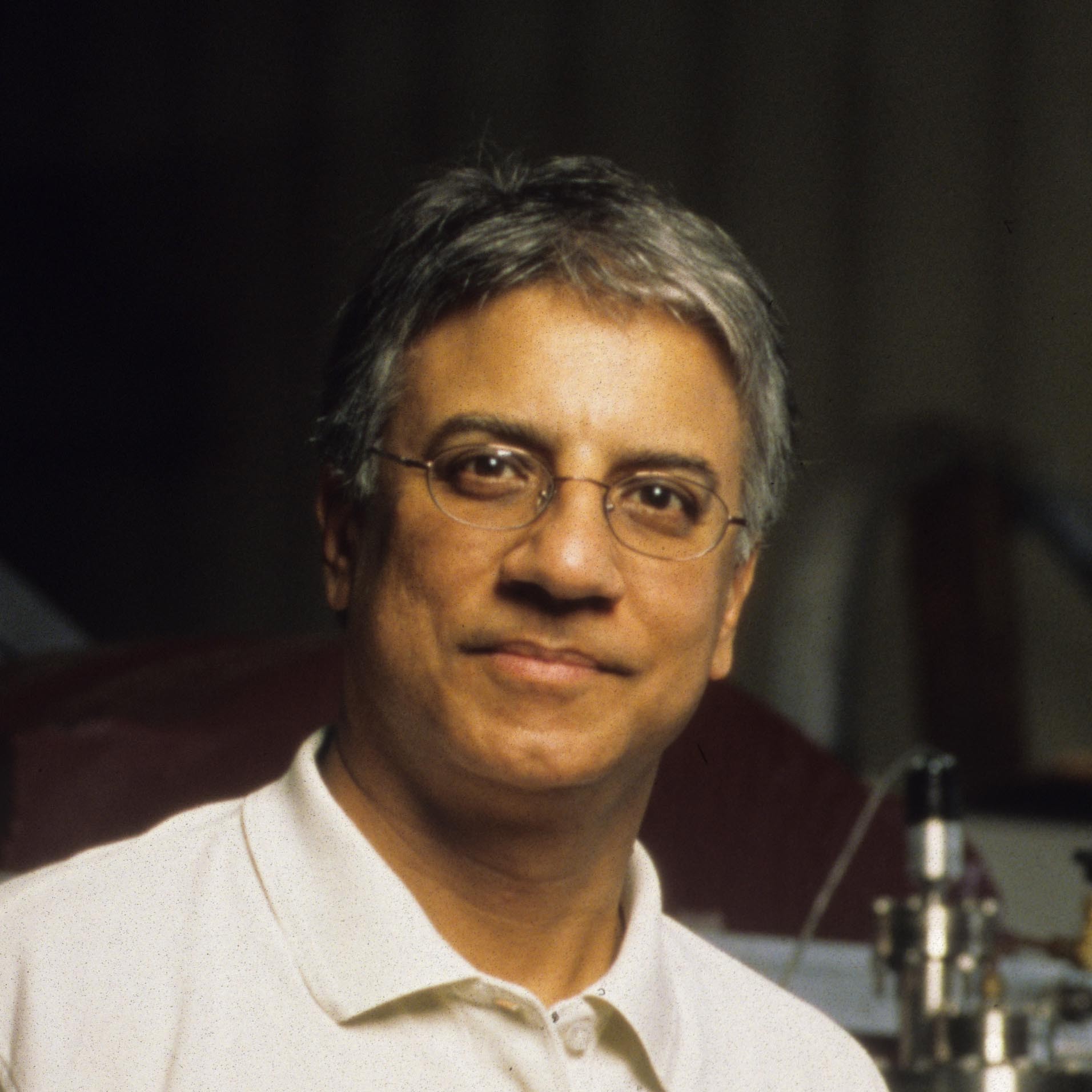
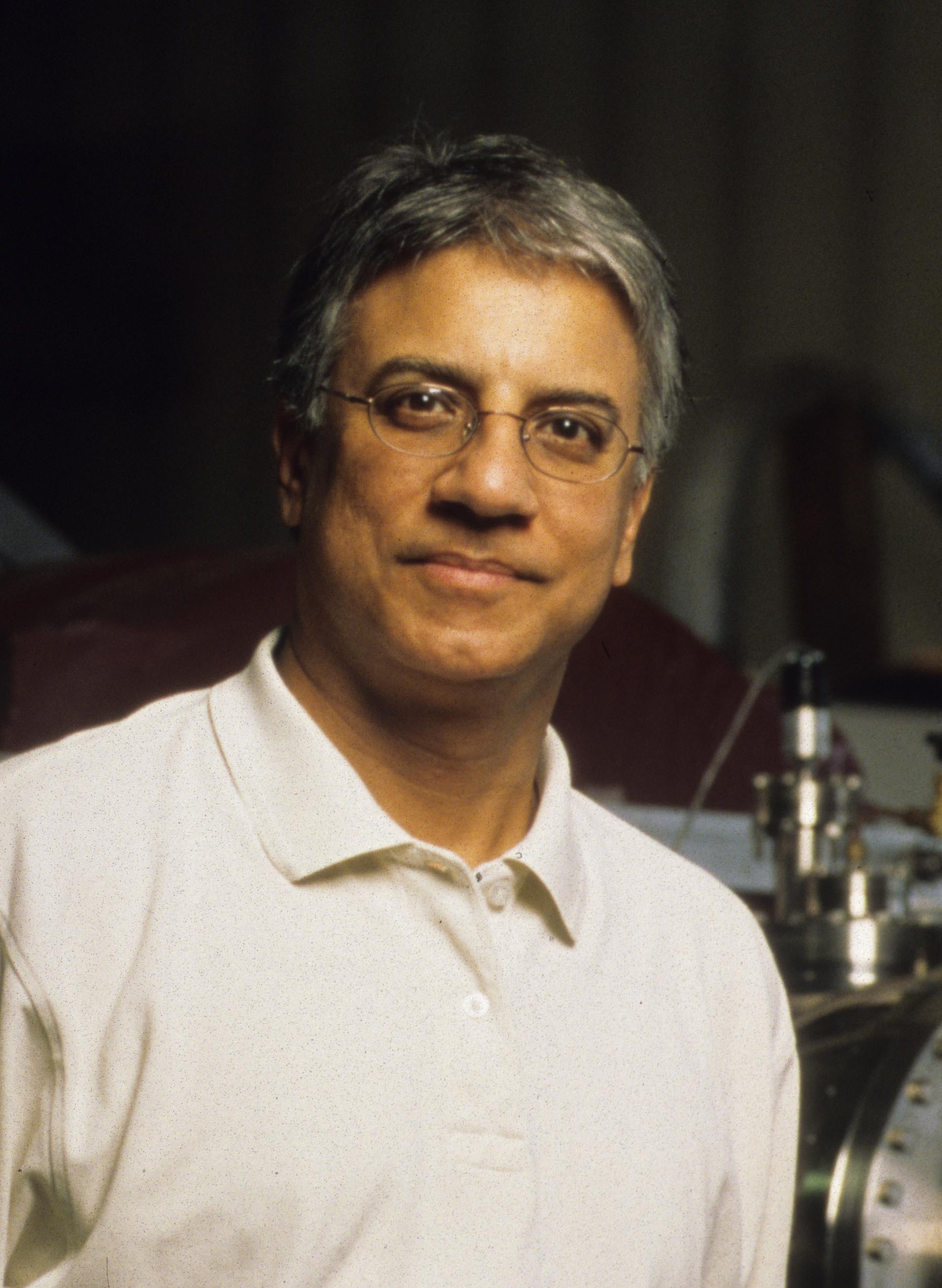
Adil Hassam, 1950-2026

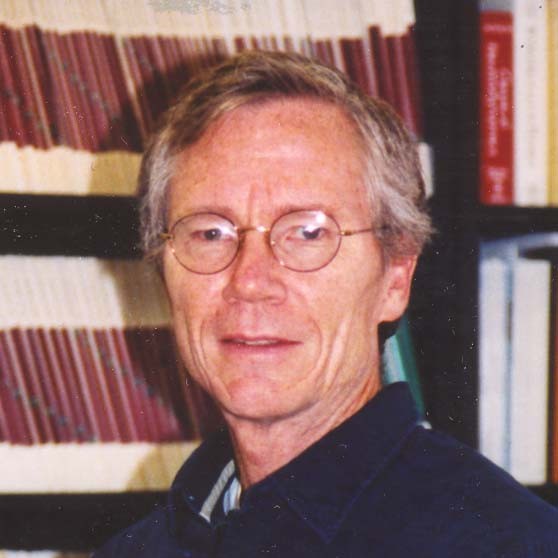
Adil HassamAdil Hassam

Professor Emeritus Adil Hassam died on September 30, 2026. 

Hassam was a distinguished theoretical plasma physicist whose research advanced understanding of plasma confinement, magnetohydrodynamics, controlled thermonuclear fusion, and solar-terrestrial plasmas.

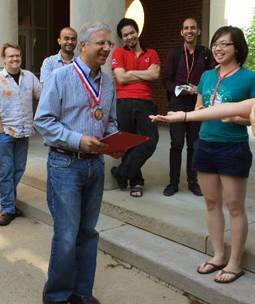
Adil Hassam was honored as the department's Outstanding Advisor in 2015.Adil Hassam was honored as the department's Outstanding Advisor in 2015.

He earned his B.S. and M.S. degrees in physics from the Massachusetts Institute of Technology and his Ph.D. in astrophysical sciences from Princeton University.  He joined the University of Maryland in 1978 as a postdoc and rose through the ranks to full professor, while building a long and productive career as a researcher, mentor, and teacher. His work on magnetic and centrifugal confinement contributed to the broader effort to develop practical fusion energy, and he published extensively in plasma physics and related fields. A Fellow of the American Physical Society, Hassam was also recognized for his commitment to teaching and mentoring students. In 2015, he was named an outstanding graduate advisor in the Department of Physics. 

Hassam was a devoted and talented classroom teacher, consistently receiving superlative praise from students, e.g., Professor Hassam was a phenomenal professor, and he should teach all courses always; The teaching style was flawless; and I DONT KNOW HOW IT COULD GET BETTER.

Through his scholarship, collegiality, and dedication to physics, he made lasting contributions to the University of Maryland community and to the field of plasma physics.

Services will be held on October 7 in Carrollton, TX.


Zohreh Davoudi

Written on 23 September 2026.

Zohreh Davoudi Named 2026 Schmidt Polymath

University of Maryland Associate Professor of Physics Zohreh Davoudi is one of eight academics around the globe named a 2026 Schmidt Polymath. 

Founded in 2021, the Schmidt Sciences Polymath Program recognizes risky, cross-disciplinary work undertaken by researchers who push the boundaries of their fields to achieve scientific breakthroughs. Davoudi and the other awardees will each receive up to $2.5 million over five years to support their research. 

“The flexibility and freedom offered by this award is a dream come true,” Davoudi said. “It allows one to explore the wildest ideas and not be afraid of crossing traditional boundaries set within institutions and funding agencies.” 

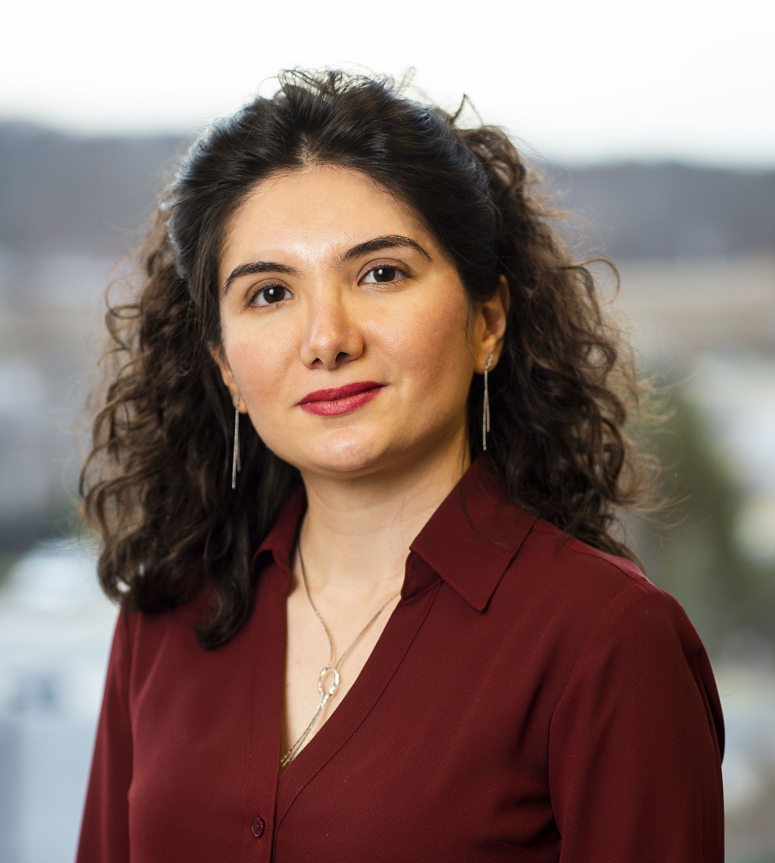
To date, the Polymath award has been awarded to 43 researchers at 31 institutions across nine countries.Zohreh Davoudi. Credit: Riley Sims.Zohreh Davoudi. Credit: Riley Sims.

“We are elated to hear of this prestigious and well-deserved acknowledgment of Dr. Davoudi’s considerable talent,” said Kara Hoffman, chair of UMD’s Department of Physics. “We are proud of her accomplishments and look forward to hearing about the many findings that this generous award will enable.”

Since joining UMD in 2017, Davoudi has worked at the intersection of nuclear physics, particle physics, and computer science. Her research explores how to build the universe from the bottom up: physicists have a good description of nature’s basic ingredients, but translating those fundamental equations into concrete predictions—about the structure of an atomic nucleus or the matter inside a neutron star—is enormously difficult. 

“Most researchers specialize in one or a few tools to close that gap,” Davoudi said. “But my approach has always been that I would pick any means that would help me solve these problems.”

Davoudi began her career as a pure theorist, working through equations with analytical methods. Her results showed how real-world quantities—the fusion reactions that power the sun and a rare nuclear decay that would prove our current theory of physics incomplete—could be extracted from numerical calculations. Then, Davoudi moved on to results obtained from supercomputers, helping to produce some of the first calculations of nuclear interactions, reactions and structure derived from first principles. But she concluded that even these large, powerful computing machines would never be enough.

“No matter how large these computers are, eventually they will come to a point where they can’t solve certain problems for us,” Davoudi said. 

That realization led her to quantum computing. Unlike classical computers, which store information as simple on/off switches, quantum computers exploit the strange rules of quantum mechanics to process certain types of problems far more efficiently. Davoudi is now considered a pioneer in the subfield that applies quantum computing to nuclear and particle physics.

When physicists try to simulate how large numbers of subatomic particles interact and evolve, the amount of information involved grows faster than any classical computer can handle. That bottleneck affects research connected to some of the world's leading facilities, including the Large Hadron Collider and the Relativistic Heavy Ion Collider, where particles are smashed together at extreme energies to reveal the fundamental nature of matter. Davoudi's work is building the tools to run those simulations on quantum computers instead.

“I develop theoretical foundations, quantum algorithms, and experimental proposals for simulating quantum systems that increasingly resemble the subatomic systems we ultimately like to simulate. This endeavor has put me in the sphere of several amazing theoretical and experimental researchers from across physics, computer sciences, and engineering at the UMD and beyond, and turned my research into an exciting multidisciplinary journey,” Davoudi said.

For Davoudi, the Polymath award will help support her next ventures into uncharted territory. She plans to bring tools she has never used before—quantum sensing and artificial intelligence—into her research, and to apply her existing expertise to fields she has not yet explored, including cosmology and even bioscience.

Davoudi sees a hidden thread connecting some of the most extreme environments in science, from the universe in its earliest moments to collisions inside particle accelerators to even the chemistry of living cells. At each scale, quantum mechanics governs the underlying physics. But at some point, those quantum effects give way to the ordinary rules of classical physics. Davoudi believes that this transition holds untapped scientific potential.

“Can we trace the ‘quantumness’ in these systems? Can we leverage it to discover new phenomena and new applications?" Davoudi said. “New simulation and sensing strategies can reach far beyond what scientists consider possible today, and artificial intelligence could accelerate that process beyond our imagination. It’s exciting to think about these directions and discover both answers and new questions in the process.”

The Polymath award will allow Davoudi to build new collaborations with scientists in quantum sensing, artificial intelligence, cosmology and beyond, and to launch new activities alongside the talent this award will support.

“I’m not an expert in any of these fields. But I am an expert in nuclear and particle physics and its intersections with quantum information science. And I am passionate about seeking answers from many different angles. That’s what I bring to the table,” Davoudi said. “I am grateful to Schmidt Sciences for placing their trust in researchers like me to explore freely in pursuit of science.”

Original story by Georgia Jiang: University of Maryland Physicist Zohreh Davoudi Named 2026 Schmidt Polymath | College of Computer, Mathematical, and Natural Sciences | University of Maryland

Written on 23 September 2026.

James Drake Selected for John Adam Fleming Medal

Distinguished University Professor James F. Drake has been selected for the John Adam Fleming Medal of the American Geophysical Union (AGU). The medal is awarded for original research and technical leadership in geomagnetism, atmospheric electricity, aeronomy, space physics, and/or related sciences. Drake was cited for pioneering theoretical investigations of space plasmas leading to discovery of fundamental properties and effects of magnetic reconnection.

James DrakeJames Drake

Drake received his Ph.D. from the University of California, Los Angeles, and held appointments there before joining the University of Maryland as a postdoctoral associate in 1978. He became a full professor in 1990, jointly with the Institute for Physical Sciences and Technology. At UMD, he has served as co-director of the Joint Space-Science Institute, a research partnership between the UMD Astronomy and Physics departments and NASA Goddard Space Flight Center. He was named a UMD Distinguished University Professor in 2014.  

Drake is a Fellow of the AGU and the American Physical Society, and in 2010, received the APS James Clerk Maxwell Prize for Plasma Physics for pioneering investigations of plasma instabilities in magnetically-confined, astrophysical and laser-driven plasmas; in particular, explication of the fundamental mechanism of fast reconnection of magnetic fields in plasmas; and leadership in promoting plasma science.

He has also received the Popular Writing Award of the Solar Physics Division of the American Astronomical Society.

During his career, Drake has investigated many aspects of plasma physics, including the solar corona, the earth's magnetosphere and ionosphere, magnetically confined plasma, and the interaction of intense lasers with plasma. He is now a co-Principal Investigator on the NASA Parker Solar Probe (PSP) mission, which in 2024 came within 10 solar radii of the sun. Data from the PSP will help scientists determine the mechanism that heats the solar corona and drives the solar wind. Drake is also active in the NASA Magnetospheric Multiscale Mission, which is a four-satellite effort launched in 2015 to explore the physics of magnetic reconnection at exceedingly small spatial scales.

The Fleming Medal honors geophysicist John Adam Fleming (1877–1956), who made notable contributions to the establishment of magnetic standards. It will be awarded in December at the AGU’s annual meeting in San Francisco, California.

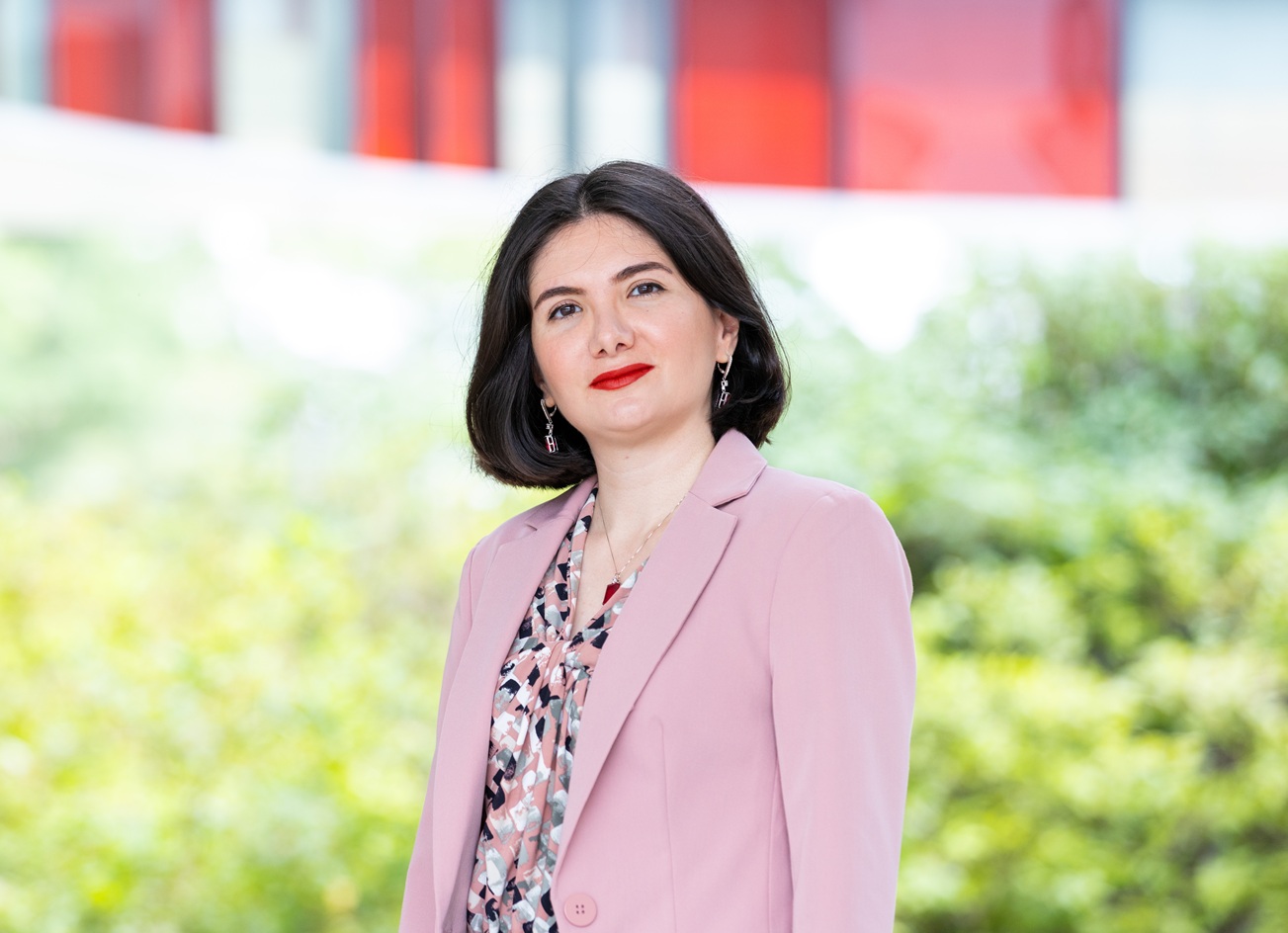
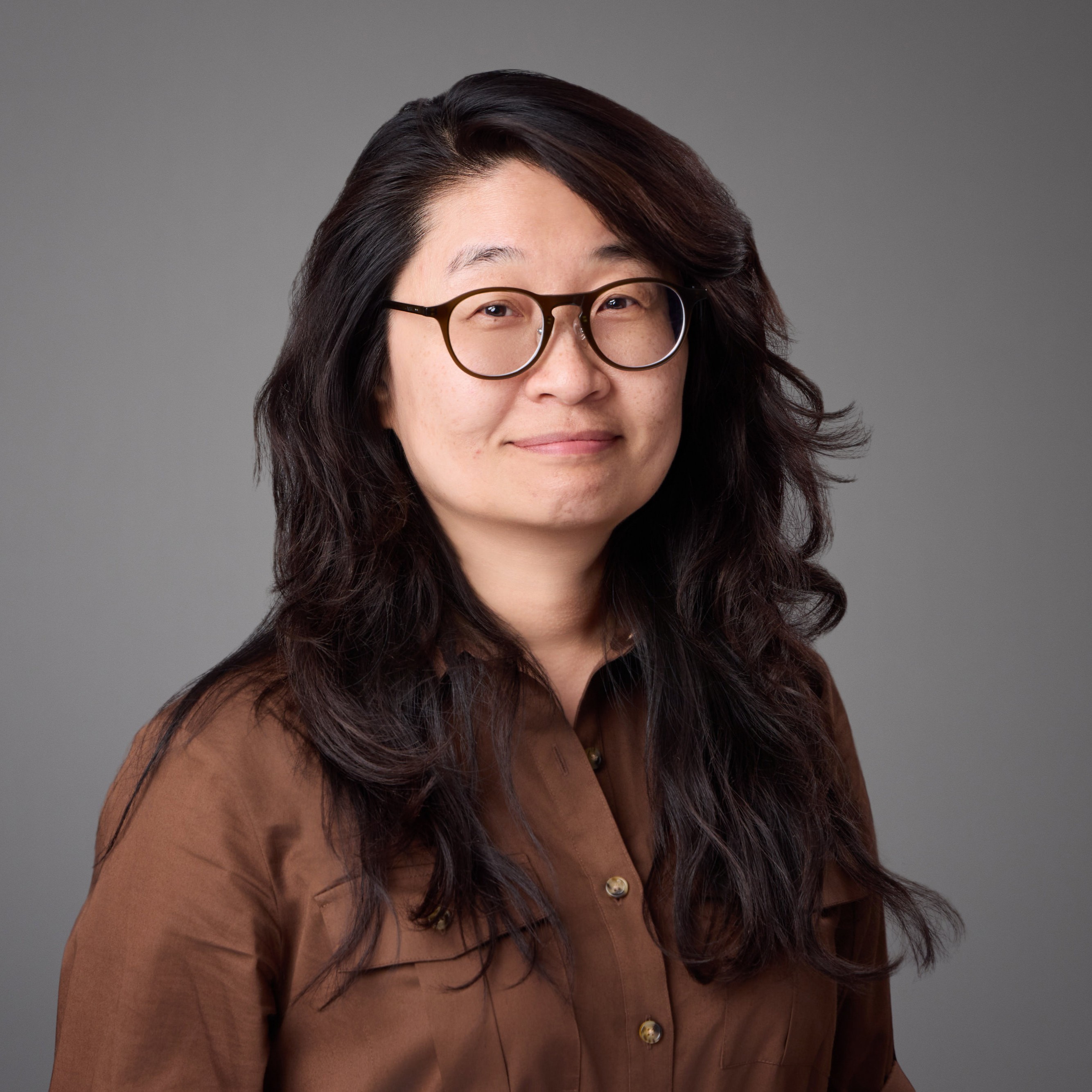
Hanhee Paik (M.S. ’05, Ph.D. ’07, physics) helped pioneer the transmon qubit and built IBM’s first 16-qubit quantum computer. Photo courtesy of Hanhee Paik

Written on 21 September 2026.

Hanhee Paik Helps to Shape the Future of Quantum Computing at IBM

If you use a leading quantum computer today, you probably have Hanhee Paik (M.S. ’05, Ph.D. ’07, physics) to thank. 

The University of Maryland alum helped pioneer the transmon, a superconducting qubit that many quantum computing companies use today. For the past two decades, she’s been a quantum computing physicist, working on quantum processors and systems development—including helping build IBM’s first 16-qubit quantum computer in 2017. Hanhee Paik (M.S. ’05, Ph.D. ’07, physics) helped pioneer the transmon qubit and built IBM’s first 16-qubit quantum computer. Photo courtesy of Hanhee PaikHanhee Paik (M.S. ’05, Ph.D. ’07, physics) helped pioneer the transmon qubit and built IBM’s first 16-qubit quantum computer. Photo courtesy of Hanhee Paik

Now, as IBM’s superconducting quantum computers have surpassed 100 qubits, Paik leads initiatives to help researchers find impactful ways to use them. In March 2025, she became a director of IBM’s Quantum Algorithm Centers and Academic Collaboration Program at IBM Research, where she works with universities and research institutions around the world to develop new ways to use quantum computers to solve challenging computational problems. These scientific algorithms and applications are already yielding breakthroughs that seemed impossible a decade ago. 

“The IBM Quantum team's mission is to build a useful quantum computer. This year, IBM announced three examples of quantum advantage we achieved with our partners, which show the current state-of-the-art quantum computing systems solving some scientific problems faster, cheaper or easier.” Paik said. “For certain scientific computations, quantum computers are already useful right now.” 

From superconductivity to quantum computers

When Paik first arrived at UMD from South Korea, she didn’t plan to study quantum physics. She came to research superconductivity with Physics Professors Emeriti Frederick Wellstood and Christopher Lobb.

Around that time, Wellstood and Lobb began researching how to use superconductors to build qubits—the basic unit of computation for quantum computers. Quantum computers process information using quantum properties—like the ability to exist in a “superposition” of multiple states, or “entanglement,” where two or more qubits become deeply interconnected so that each qubit state cannot be described independently—making them powerful.

Paik became interested in the work, and her dissertation at UMD tackled a central challenge in the field called decoherence—a process in which the outside environment causes qubits to lose their quantum properties. For quantum computers to be useful, coherence is key: The longer qubits can maintain their quantum states, the more time users have to perform calculations. Paik’s Ph.D. research at UMD developed new designs and materials to improve coherence time for superconducting qubits. 

She continued that work as a postdoctoral researcher at the Laboratory for Physical Sciences and Yale University. At Yale, she helped improve the coherence of the transmon qubit—which was a superconducting qubit with one of the longest coherence times at the time but still too short for useful quantum computation.

Paik’s research revealed that transmons decohered quickly because they lost energy to surfaces and interfaces. She engineered a new transmon qubit architecture that lessened this energy loss by tweaking where energy is stored and improved transmon coherence times 100-fold. That qubit architecture became—and remains—the standard for quantum computers built by major companies, including IBM.

“That was the jumping-out-of-the-box moment for quantum computing,” Paik said. “That design is still the canonical design that everyone uses for transmons today.” 

Building a ‘useful’ quantum computer at IBM 

Shortly after her postdoctoral appointment ended at Yale, Paik joined IBM in 2014 as a senior research scientist, where she continued transmon qubit research. She helped construct the company’s first 16-qubit computer in 2017. Named ibm_albatross, this was the first superconducting quantum processor of more than 10 qubits. 

As quantum computers grew larger and more powerful, Paik saw another challenge emerging: to discover algorithms for the use of quantum computers. 

“I’d been building quantum computers for almost my entire career, and now that they were becoming more and more useful for addressing scientific problems, I thought I’d really like to try using them,” Paik said. “Even if you build one of the best computers in the world, if no one knows how to use it—if you don’t have algorithms to use your computing system in the best way—it’s not very useful.”

So, Paik joined the office of then-vice president of IBM Quantum and quantum algorithms expert Jay Gambetta as chief of staff, supporting the technical and business side of his operations. She further developed her business skills as a technical business development executive in 2023 and then moved to Japan for an assignment to organize the IBM Quantum Japan team in 2024 before assuming her current role in Chicago.

Progress has surged since then. This year, researchers at Cleveland Clinic, IBM and RIKEN successfully modeled a 12,635-atom protein complex—the largest ever simulated by quantum computers—using a hybrid approach of integrated quantum and high-performance computing (HPC). Known as quantum-centric supercomputing, this new computing architecture allows each form of computing to perform the tasks it does best. The researchers say it’s a promising advancement that will allow breakthroughs in many practical problems such as drug discovery, and for Paik, it signals an exciting future integrating quantum and HPC. 

“That’s what’s most exciting to me at the moment,” Paik said. “It’s quantum-centric supercomputing and its potential to solve many of the most challenging computational problems that are currently intractable.” 

As Paik helps to advance IBM’s quantum technology and business toward that future, she’s tapping back into lessons from UMD. For her, the most cherished learnings from graduate school weren’t technical skills, but values. She credits her Ph.D. advisors for modeling persistence, thoroughness and sincerity—qualities she brings to her own work and mentorship. 

“I learned a lot from both Fred and Chris that helped me become a good scientist,” Paik said. “I am living their legacy, trying to represent what I learned from them.”

She also seeks to recreate the sense of community she experienced at UMD, where students could interact freely and casually with researchers at the forefront of physics. She still remembers Nobel Laureate William Phillips having lunch with students after Joint Quantum Institute seminars—making a connection that left a lasting impression.

“At UMD, people were so nice and supportive. They provided unwavering support to help young students unleash their full potential.” Paik said. “That sense of community is really important to experience at an early age—especially as a student. It sets your view on life. I treasure those values and want to live them out.”


Original story by Jason P. Dinh: UMD Alum Hanhee Paik Helps to Shape the Future of Quantum Computing at IBM | College of Computer, Mathematical, and Natural Sciences | University of Maryland

More Articles …

  1. Sensing Innovations
  2. Three UMD Physics Adjunct Faculty Members Receive Federal Recognition
  3. A Gravitational Gift for the Future
  4. Assembling a Multi-Purpose Tool for Materials Science Research
  5. NSF Renews Maryland-Led Quantum Simulation Institute’s Funding

Page 1 of 155

  • 1
  • 2
  • 3
  • 4
  • 5
  • 6
  • 7
  • 8
  • 9
  • 10
  • Physics Administration
  • Directions
  • Awards
  • Student Awards
  • Make a Donation
  • News
    • Research News
    • Department News
    • Newsletters
  • PTK Policy

College and Department Links

Department of Physics

Physical Sciences Complex
4296 Stadium Dr
College Park, MD 20742
Phone: 301.405.3401

Information

  • Campus Directory
  • Undergraduate Research
  • Scholarships
  • Prospective Undergraduates
  • Directions & Transit
  • Web Accessibility
© 2026 University of Maryland - Department of Physics
Top
  • Home
  • About Us
    • Physics Administration
    • Directions
    • Awards
    • Student Awards
    • Make a Donation
    • News
      • Research News
      • Department News
      • Newsletters
    • PTK Policy
  • People
    • All
    • Faculty
      • Current
      • Emeritus
      • Adjunct
      • Affiliate
      • Research Professors
    • Research Scientists
    • Postdocs
    • Staff
    • Lecturers
    • Visitors
    • Graduate Students
  • Research
    • Research Areas
      • AI and Physical Sciences
      • Astro Metrology
      • Atomic, Molecular & Optical
      • Biophysics
      • Chemical Physics
      • Condensed Matter Experiment
      • Condensed Matter Theory
      • Cosmic Ray Physics
      • Elementary Particles
      • Gravitation Experiment
      • Gravitational Theory
      • High Energy Physics
      • Nonlinear Dynamics, Chaos and Complex Systems
      • Nuclear Physics
      • Particle Astrophysics
      • Physics Education Research
      • Plasma Physics
      • Plasma Theory
      • Quantum Science and Technology
      • Quarks, Hadrons and Nuclei
      • Space Physics
    • Centers & Institutes
  • Academics
    • OSES Home (Student Services)
    • OSES News
    • Undergraduate Program
      • Prospective Students
      • Apply Now
      • Degree Requirements and Policies
      • Scholarships
      • Undergraduate Research
      • Advising
      • Undergraduate Forms
      • Undergraduate Events
      • Departmental Honors
      • Society of Physics Students
      • FAQ
      • Undergraduate Student Committee
    • Graduate Program
      • Prospective Students
      • Open House
      • Degree Requirements
      • Graduate Resources
      • Deadlines and Forms
      • PhD Defenses
        • PhD Defenses 2026
        • PhD Defenses 2025
        • PhD Defenses 2024
        • PhD Defenses 2023
        • PhD Defenses 2022
        • PhD Defenses 2021
        • PhD Defenses 2020
        • PhD Defenses 2019
        • PhD Defenses 2018
        • PhD Defenses 2017
        • PhD Defenses 2016
      • Events
      • Scholarships & Awards
      • Qualifier
      • Graduate Student Organizations
      • FAQ
    • Student Opportunities
      • GRAD-MAP
      • Graduate Student Organizations
      • Outreach Volunteering
      • Society of Physics Students
      • NSF S-STEM Program
      • Undergraduate Research
      • The Noether Physics Society
      • Undergraduate Quantum Association
    • Courses
    • Academic Support
    • NSF S-STEM Program
    • Teaching Assistants
  • Events
    • Calendar
    • Physics Colloquia
    • W.J. Carr Lecture
    • Research Interaction Team (RIT) Math/Physics
    • Mechanick Quantum Biology Lecture
    • Irving and Renee Milchberg Endowed Lectureship
    • Charles W. Misner Endowed Lectureship in Gravitational Physics
    • Charles W. Misner Memorial Symposium
    • John S. Toll Endowed Lecture
    • Prange Prize Lecture
    • Maryland Day
    • Outreach
      • Outreach Home
      • Physics is Phun
      • Discovery Days
    • Summer Programs
      • Physics Makers Camp
      • Physics of Quidditch
      • Science Discovery Camp
      • Advanced Physics Summer Program
      • Toolkit for Success
    • CUWiP
    • Vortex Makerspace
    • QURiSE Conference
  • Services
    • Building Access Requests
    • Computing Services
    • Conference Room Reservations
    • Department Operations Directory
    • Electronic and Mechanical Development
    • Hiring Procedures
    • Lecture Demo
    • Mental Health Resources
    • Parking
    • Physics Ombudspersons
    • Printing Services
      • Poster Print Request
    • Proposal Submissions
    • Purchase Order
    • Suggestion Box
    • Textbook Information
  • Give