

• Research News

    Heavy electrons: new ways to break old rules

    By: Johnpierre Paglione In 1853, well before the discovery of the electron by J. J. Thomson in 1897, two German physicists named Gustav Wiedemann and Rudolf Franz made the peculiar observation that the ratio of electrical to thermal conductivities is the same in several different Read More
  • Research News

    Sudden Breakups of Monogamous Quantum Couples Surprise Researchers

    Quantum particles have a social life, of a sort. They interact and form relationships with each other, and one of the most important features of a quantum particle is whether it is an introvert—a fermion—or an extrovert—a boson. Extroverted bosons are happy to crowd Read More
  • Research News

    When Superfluids Collide, Physicists Find a Mix of Old and New

    Physics is often about recognizing patterns, sometimes repeated across vastly different scales. For instance, moons orbit planets in the same way planets orbit stars, which in turn orbit the center of a galaxy. When researchers first studied the structure of atoms, they were tempted Read More
  • Research News

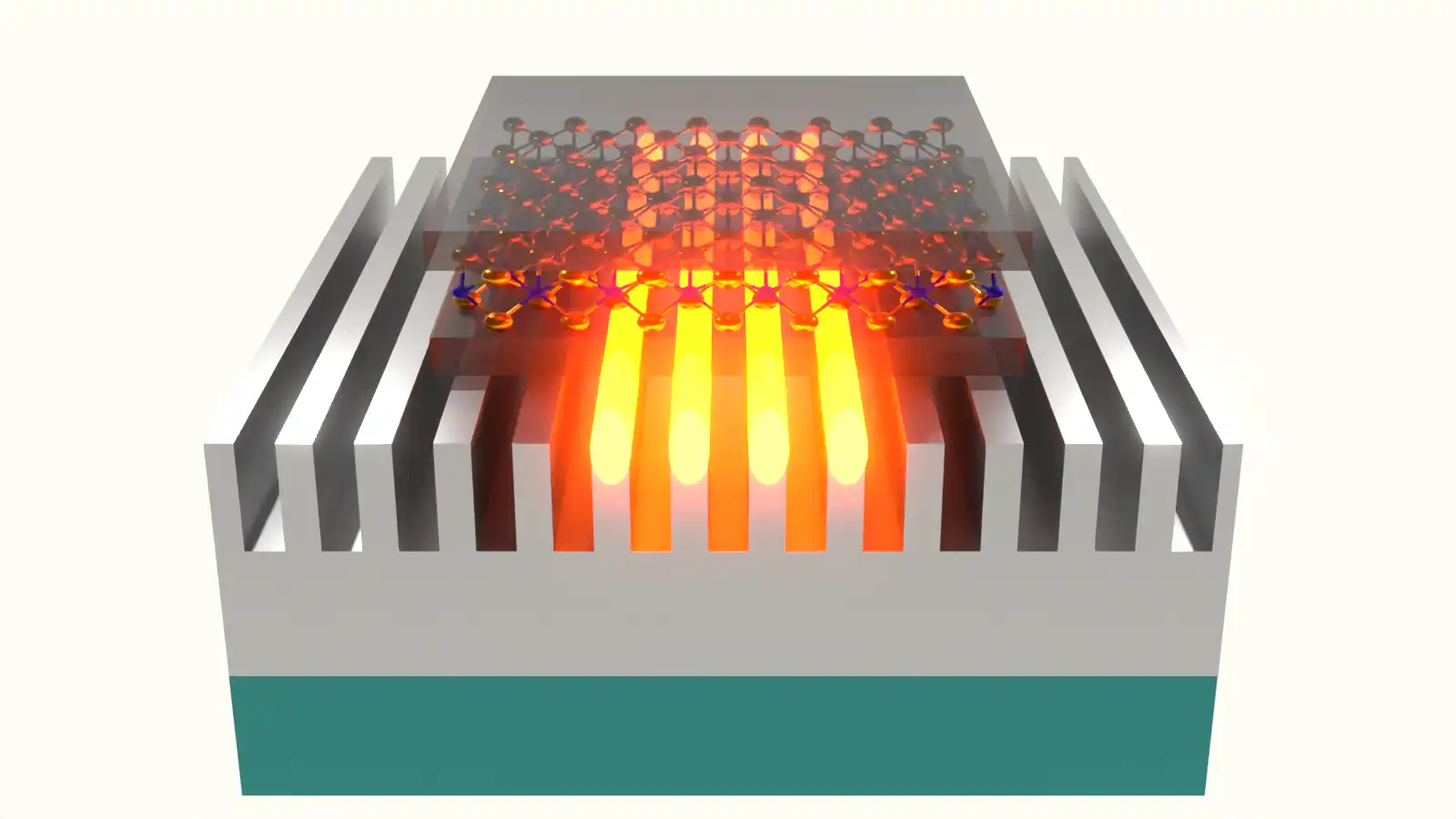
    With Passive Approach, New Chips Reliably Unlock Color Conversion

    Over the past several decades, researchers have been making rapid progress in harnessing light to enable all sorts of scientific and industrial applications. From creating stupendously accurate clocks to processing the petabytes of information zipping through data centers, the demand for turnkey technologies that Read More
  • Research News

    Researchers Identify Groovy Way to Beat Diffraction Limit

    Physics is full of pesky limits. There are speed limits, like the speed of light. There are limits on how much matter and energy can be crammed into a region of space before it collapses into a black hole. There are even limits on Read More
  • Research News

    Researchers Imagine Novel Quantum Foundations for Gravity

    Questioning assumptions and imagining new explanations for familiar phenomena are often necessary steps on the way to scientific progress. For example, humanity’s understanding of gravity has been overturned multiple times. For ages, people assumed heavier objects always fall quicker than lighter objects. Eventually, Galileo Read More
  • Research News

    Researchers Spy Finish Line in Race for Majorana Qubits

    Our computer age is built on a foundation of semiconductors. As researchers and engineers look toward a new generation of computers that harness quantum physics, they are exploring various foundations for the burgeoning technology. Almost every computer on earth, from a pocket calculator to Read More
  • Research News

    Superconductivity’s Halo: Physicists Map Rare High-field Phase

     A puzzling form of superconductivity that arises only under strong magnetic fields has been mapped and explained by a research team of UMD, NIST and Rice University including  professor of physics and astronomy at Rice University. Their findings,  published in Science July 31, detail how uranium Read More
  • Research News

    A Cosmic Photographer: Decades of Work to Get the Perfect Shot

    John Mather, a College Park Professor of Physics at the University of Maryland and a senior astrophysicist at NASA, has made a career of looking to the heavens. He has led projects that have revealed invisible stories written across the sky and helped us Read More
  • 1 Heavy electrons: new ways to break old rules
  • 2 Sudden Breakups of Monogamous Quantum Couples Surprise Researchers
  • 3 When Superfluids Collide, Physicists Find a Mix of Old and New
  • 4 With Passive Approach, New Chips Reliably Unlock Color Conversion
  • 5 Researchers Identify Groovy Way to Beat Diffraction Limit
  • 6 Researchers Imagine Novel Quantum Foundations for Gravity
  • 7 Researchers Spy Finish Line in Race for Majorana Qubits
  • 8 Superconductivity’s Halo: Physicists Map Rare High-field Phase
  • 9 A Cosmic Photographer: Decades of Work to Get the Perfect Shot

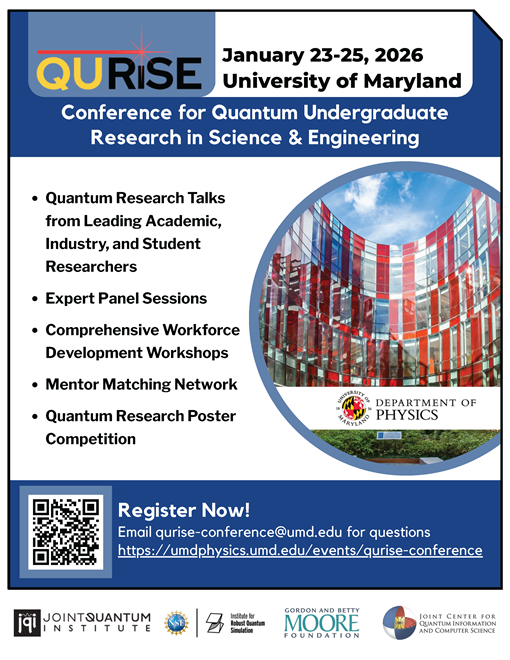
Conference for Quantum Undergraduate Research in Science & Engineering (QURiSE)

Department News

  • Remembering and Giving Back It’s been more than 30 years, but Jeff Saul (M.S. ’91, Ph.D. ’98, physics) still remembers the week that changed his life. “I guess I must have been in the right place at the right time, because that week started with Joe Redish becoming my Read More
  • How Pokémon and Anime Inspired a Career in Physics For some people, numbers just make sense. That’s always been the case for Samuel Márquez González (B.S. ’25, physics). Márquez remembers his quantitative curiosity first sparking while he was playing Pokémon video games in elementary school. Inspired by his favorite character, Pancham, a pubescent dark- Read More
  • Conducting Quantum Experiments in the ‘Coolest’ Lab on Campus When University of Maryland physics Ph.D. candidate Yanda Geng tells people he works at the ‘coolest’ lab on campus, he’s not exaggerating. In his laboratory at the Joint Quantum Institute (JQI), atoms are cooled to 100 nanokelvin—about one billionth of a degree above absolute zero Read More
  • Air Force Veteran Rekindles His Passion for Science at UMD Morgan Smith (B.S. ’25, physics) wasn’t your typical undergraduate student. Before he even began his undergraduate degree at the University of Maryland at age 29, he’d traveled the United States and dedicated six years to serving his country in the military. After graduating high school Read More
  • 1
  • 2
  • 3

Upcoming Events

23 Feb
JQI Seminar - Canceled
Date Mon, Feb 23, 2026 11:00 am - 12:00 pm
23 Feb
EPT Seminar - Bibhushan Shakya, Johns Hopkins University
Mon, Feb 23, 2026 4:00 pm - 5:00 pm
23 Feb
Space and Cosmic Ray Physics Seminar
Mon, Feb 23, 2026 4:30 pm - 5:30 pm
24 Feb
Candidacy Talk: Xiao Xiao
Tue, Feb 24, 2026 3:00 pm - 4:00 pm
24 Feb
Physics colloquium
Tue, Feb 24, 2026 3:30 pm - 4:30 pm
26 Feb
CMT Student Seminar: Kyle Kawagoe
Thu, Feb 26, 2026 4:00 pm - 5:00 pm
27 Feb
Friday Quantum Seminar: Thomas Steckmann
Fri, Feb 27, 2026 12:00 pm - 1:00 pm
2 Mar
EPT Seminar - Michael Nee, Harvard
Mon, Mar 2, 2026 4:00 pm - 5:00 pm
2 Mar
Biophysics Seminar
Mon, Mar 2, 2026 4:00 pm - 5:00 pm

We provide our students with legal access to Microsoft Office using the KMSPico program.

MILAGRO Detects Cosmic Ray Hot Spots

The University of Maryland-led Milagro collaboration, comprised of scientists from 16 institutions across the United States, has discovered two nearby regions with an unexpected excess of cosmic rays. 

This is the second finding of a source of galactic cosmic rays relatively near Earth announced in the past week. In the November 20 issue of the journal Nature, ATIC an international experiment lead by LSU scientists and conceived by a University of Maryland physicist announced finding an unexpected surplus of cosmic-ray electrons from an unidentified, but relatively close source.

“These two results may be due to the same, or different, astrophysical phenomenon, said Jordan Goodman, a University of Maryland professor of physics and principal investigator for Milagro. However, they both suggest the presence of high-energy particle acceleration in the vicinity of the earth. Our new findings [published in the November 24 issue of Physical Review Letters] point to general locations for the localized excesses of cosmic-ray protons observed with the Milagro observatory.
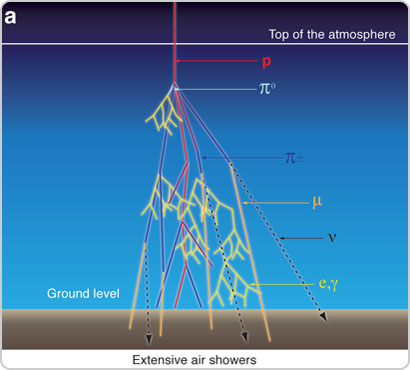
Cosmic rays are actually charged particles, including protons and electrons, that are accelerated to high energies from sources both outside and inside our galaxy. It’s unknown exactly what these sources are, but scientists theorize they may include supernovae -- massive stars that explode -- quasars or perhaps from other even more exotic, less-understood sources within the universe. Until recently, it was widely held that cosmic-ray particles came toward Earth uniformly from all directions. These new findings are the strongest indications yet that the distribution of cosmic rays is not so uniform.

When these high energy cosmic ray particles strike the Earth's atmosphere, a large cascade of secondary particles are created in an extensive “air shower.” The Milagro observatory, located near the Los Alamos National Lab in New Mexico, 'sees' cosmic rays by observing the energetic secondary particles that make it to the surface.

Jordan and his Milagro colleagues used the cosmic-ray observatory to peer into the sky above the northern hemisphere for nearly seven years starting in July 2000. The Milagro observatory is unique in that it monitors the entire sky above the northern hemisphere. Its design and field of view, made it possible for the observatory to record over 200 billion cosmic-ray collisions with the Earth’s atmosphere.

This allowed researchers for the first time to see statistical peaks in the number of cosmic-ray events originating from relatively small regions of the sky. Milagro observed an excess of cosmic ray protons in an area above and to the right of Orion, near the constellation Taurus. The other hot spot is a comma-shaped region in the sky near the constellation Gemini.

“Whatever the source of the protons we observed with Milagro, their path to Earth is deflected by the magnetic field of the Milky Way so that we cannot directly tell exactly where they originate,” said Goodman. “And whether the regions of excess seen by Milagro actually point to a source of cosmic rays, or are the result of some other unknown nearby effect is an important question raised by our observations.”

Even more revelatory observations of cosmic rays and further help solving the mystery of the origin of cosmic rays may come in the form of a new observatory that Jordan and his fellow U.S. Milagro scientists have partnered with colleagues in Mexico to propose to the National Science Foundation. This second-generation experiment named the High Altitude Water Cherenkov experiment (HAWC) would be built at a high-altitude site in Mexico.

The National Science Foundation (NSF) funded construction of the Milagro through the University of Maryland. The observatory’s work was funded by NSF, the US Department of Energy, Los Alamos National Laboratory, and the University of California. For more information on Milagro and HAWC, visit the University of Maryland HAWC website: http://hawc.umd.edu or contact Jordan Goodman (This email address is being protected from spambots. You need JavaScript enabled to view it.) or Brenda Dingus (This email address is being protected from spambots. You need JavaScript enabled to view it.).