
The Physics Major
The Physics Major
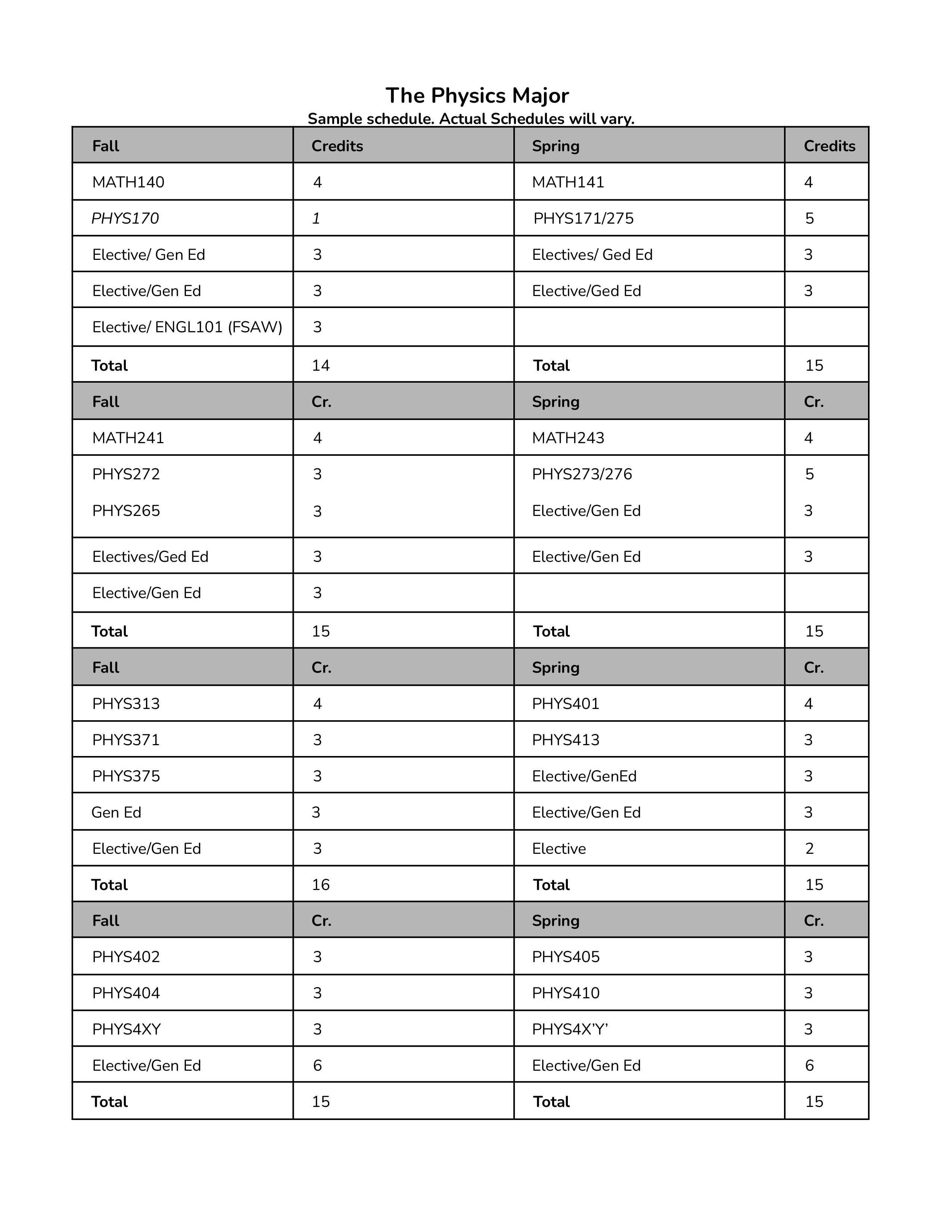
Physics majors are required to take the following courses. In addition, students must complete all necessary GenEd requirements. Sample graudation plans for each specilaization are avaiable here.
For more information on these courses, or question about degree requiremetns, contact an advisor.
Introductory Courses (17 credits)
PHYS170 (1): Professional Physics Seminar
PHYS171 (3): Introductory Physics: Mechanics
PHYS265 (3): Introduction to Scientific Programming
PHYS272 (3): Introductory Physics: Fields
PHYS275 (2): Experimental Physics I: Mechanics and Waves
PHYS273 (3): Introductory Physics: Oscillations and Waves
PHYS276 (2): Experimental Physics II: Electricity and Magnetism
Supporting Mathematics Courses (16 - 19 credits)
MATH140 (4): Calculus I
MATH141 (4): Calculus II
MATH241 (4): Calculus III
And one of the following options:
1) MATH243 (4): Introduction to Linear Algebra and Differential Equation, or
2) MATH240 (4): Introduction to Linear Algebra and MATH246 (3): Differential Equations for Scientists and Engineers
Upper-Level Courses (35 credits)
PHYS313 (4): Electricity and Magnetism I
PHYS371 (3): Modern Physics
PHYS375 (3): Experimental Physics III: Waves, Optics and Modern Physics
PHYS401 (4): Quantum Physics I
PHYS402 (3): Quantum Physics II
PHYS404 (3): Introduction to Statistical Thermodynamics
PHYS405 (3): Advanced Experiments lab
Or PHYS407 (3): Undergraduate Experimental Research
PHYS410 (3): Classical Mechanics
PHYS413 (3): Electricity and Magnetism II
PHYS4XX (3): Advanced Physics Elective
PHYS4XY (3): Advanced Physics Elective
Students who matriculated at the university prior to Fall 2024 should click here for a list of Physics major requirements.
Physics Education
Physics Major - Education Specialization
The Education Physics area of concentration is designed to accommodate students obtaining a teaching certificate through the College of Education. However, completing all the courses in the Education Physics area of concentration does not in itself satisfy all requirements for obtaining a teaching certificate. Students pursuing the Education Physics area of concentration who want to also obtain a teaching certificate in secondary education must first apply and be admitted to the Secondary Education Program in the College of Education and then complete additional courses in that program.
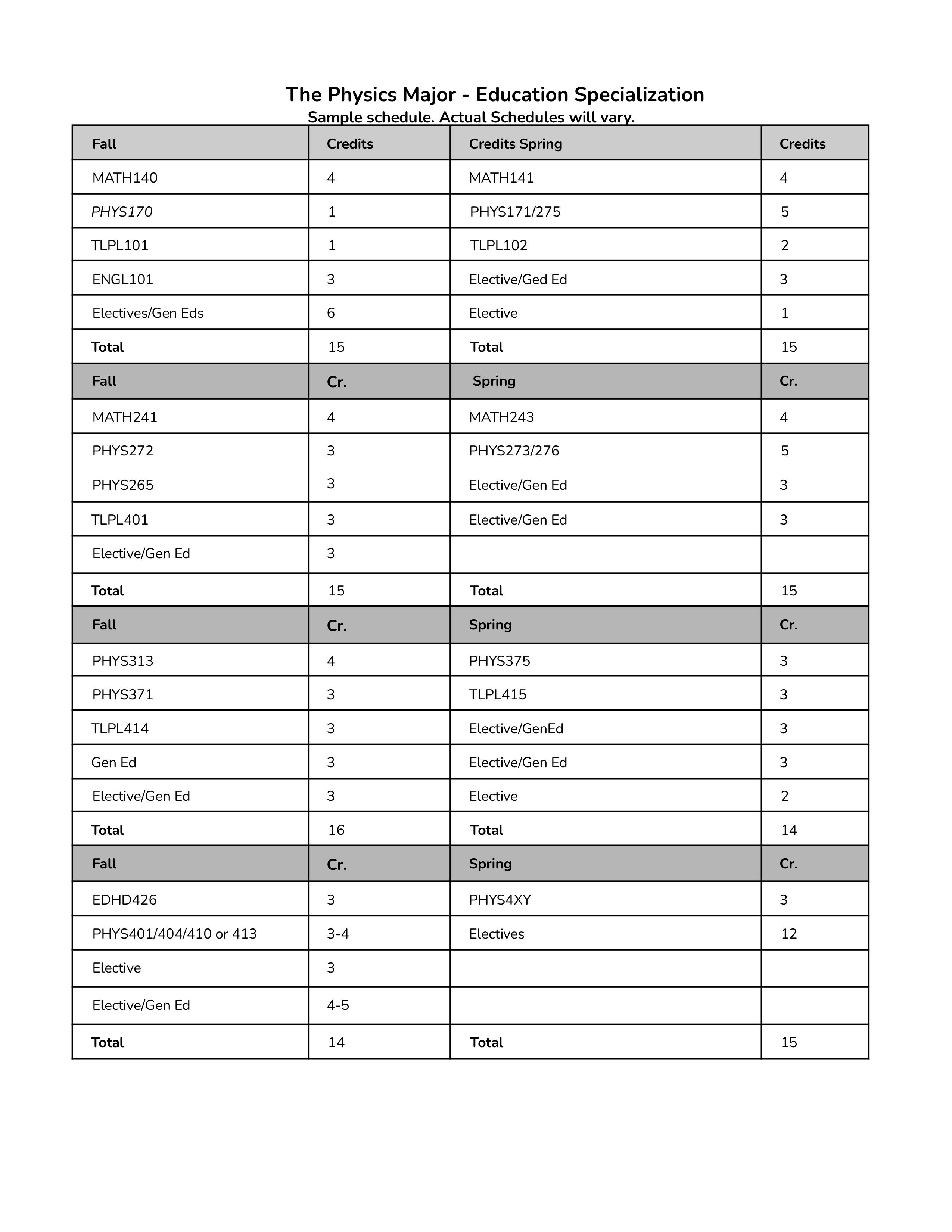
Physics Education majors are required to take the following courses. In addition, students must complete all necessary GenEd requirements. Sample graudation plans for each specilaization are avaiable here.
For more information on these courses, or question about degree requiremetns, contact an advisor.
Introductory Courses (20 credits)
PHYS170 (1): Professional Physics Seminar
PHYS171 (3): Introductory Physics: Mechanics
PHYS265 (3): Introduction to Scientific Programming
PHYS272 (3): Introductory Physics: Fields
PHYS275 (2): Experimental Physics I: Mechanics and Waves
PHYS273 (3): Introductory Physics: Oscillations and Waves
PHYS276 (2): Experimental Physics II: Electricity and Magnetism
TLPL101 (1): Inquiry Teaching of STEM in Elementary School
TLPL102 (2): Inquiry Teaching of STEM in Middle School
Supporting Mathematics Courses (16 - 19 credits)
MATH140 (4): Calculus I
MATH141 (4): Calculus II
MATH241 (4): Calculus III
And one of the following options:
1) MATH243 (4): Introduction to Linear Algebra and Differential Equation, or
2) MATH240 (4): Introduction to Linear Algebra and MATH246 (3): Differential Equations for Scientists and Engineers
Upper-Level Requirements (28 - 29 credits)
EDHD426 (3): Cognitive and Motivational Literacy Content
TLPL401 (3): Student-Centered Curriculum Instruction
TLPL414 (3): Knowing and Learning in Mathematics and Science
TLPL415 (3): Perspectives in Science
PHYS371 (3): Modern Physics
PHYS313 (4): Electrostatics
PHYS375 (3): Experimental Physics III: Waves, Optics and Modern Physics*
PHYS4XY (3): Advanced Physics Elective
One of the following (3-4):
PHYS401 (4): Quantum Physics I
PHYS404 (3): Introduction to Statistical Thermodynamics
PHYS410 (3): Classical Mechanics
PHYS413 (3): Electricity and Magnetism II
*PHYS375 may be replaced by an additional, non-seminar, 400-level approved Physics course of 3-4 credits not being used to satisfy another requirement.
Applied Physics
Physics Major - Applied Specialization
The Applied Physics specialization is designed for students who aim to enter the workforce in technical or scientific roles immediately after graduation or those who plan to pursue further studies in applied physics at the graduate level. This specialization focuses on practical applications of physics principles, equipping students with hands-on experience and problem-solving skills relevant to technology and research industries. By blending theoretical knowledge with practical training, the Applied Physics specialization prepares students to tackle real-world challenges and innovate in their chosen fields.
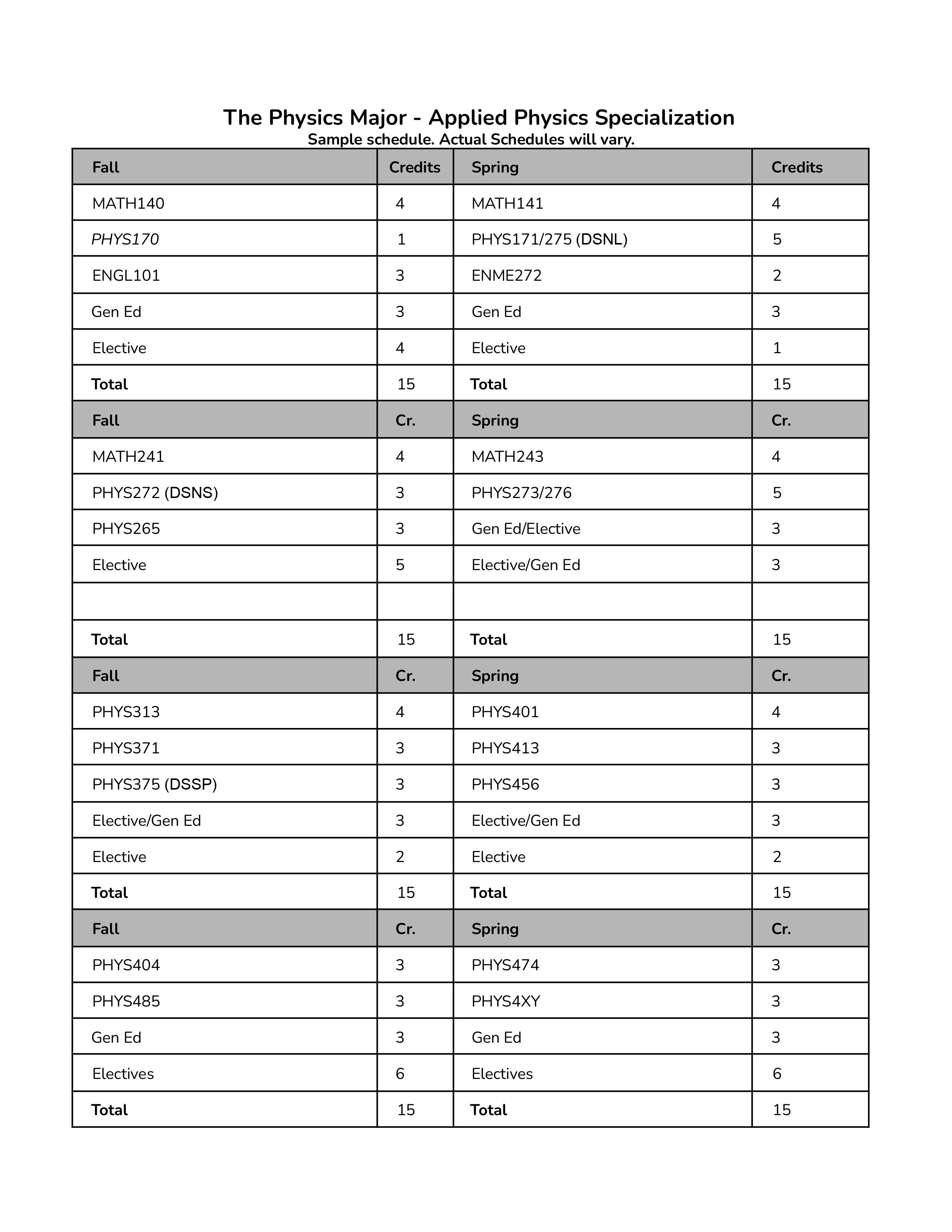
Applied Physics majors are required to take the following courses. In addition, students must complete all necessary GenEd requirements. Sample graudation plans for each specilaization are avaiable here.
For more information on these courses, or question about degree requiremetns, contact an advisor.
Introductory Courses (19 credits)
PHYS170 (1): Professional Physics Seminar
PHYS171 (3): Introductory Physics: Mechanics
PHYS265 (3): Introduction to Scientific Programming
PHYS272 (3): Introductory Physics: Fields
PHYS275 (2): Experimental Physics I: Mechanics and Waves
PHYS273 (3): Introductory Physics: Oscillations and Waves
PHYS276 (2): Experimental Physics II: Electricity and Magnetism
ENME272 (2): Introduction to Computer Aided Design
Supporting Mathematics Courses (16 - 19 credits)
MATH140 (4): Calculus I
MATH141 (4): Calculus II
MATH241 (4): Calculus III
One of the following options (4 - 7):
1) MATH243 (4): Introduction to Linear Algebra and Differential Equation, or
2) MATH240 (4): Introduction to Linear Algebra and MATH246 (3): Differential Equations for Scientists and Engineers
Upper-Level Courses (32 credits)
PHYS313 (4): Electricity and Magnetism I
PHYS371 (3): Modern Physics
PHYS375 (3): Experimental Physics III: Waves, Optics and Modern Physics
PHYS401 (4): Quantum Physics I
PHYS404 (3): Introduction to Statistical Thermodynamics
PHYS413 (3): Electricity and Magnetism II
PHYS456 (3): Making Physics Experiments
PHYS474 (3): Computational Physics
PHYS4XY (3): Advanced Physics Elective
One of the following:
PHYS485 (3): Electronic Circuits
PHYS487 (3): Computerized Instrumentation
Bio-Physics
Physics Major - Bio-Physics Specialization
The Biophysics specialization is designed for students interested in exploring the intersection of physics and biology. It serves those who aim to study biophysics in graduate school and those who seek a strong physics foundation while preparing for the MCAT and medical school. This specialization provides a comprehensive understanding of biological and physical systems, offering insights into the physical principles underlying biological processes. Students will gain valuable analytical and problem-solving skills, making them well-prepared for advanced studies in biophysics, medical research, or a career in the health sciences.
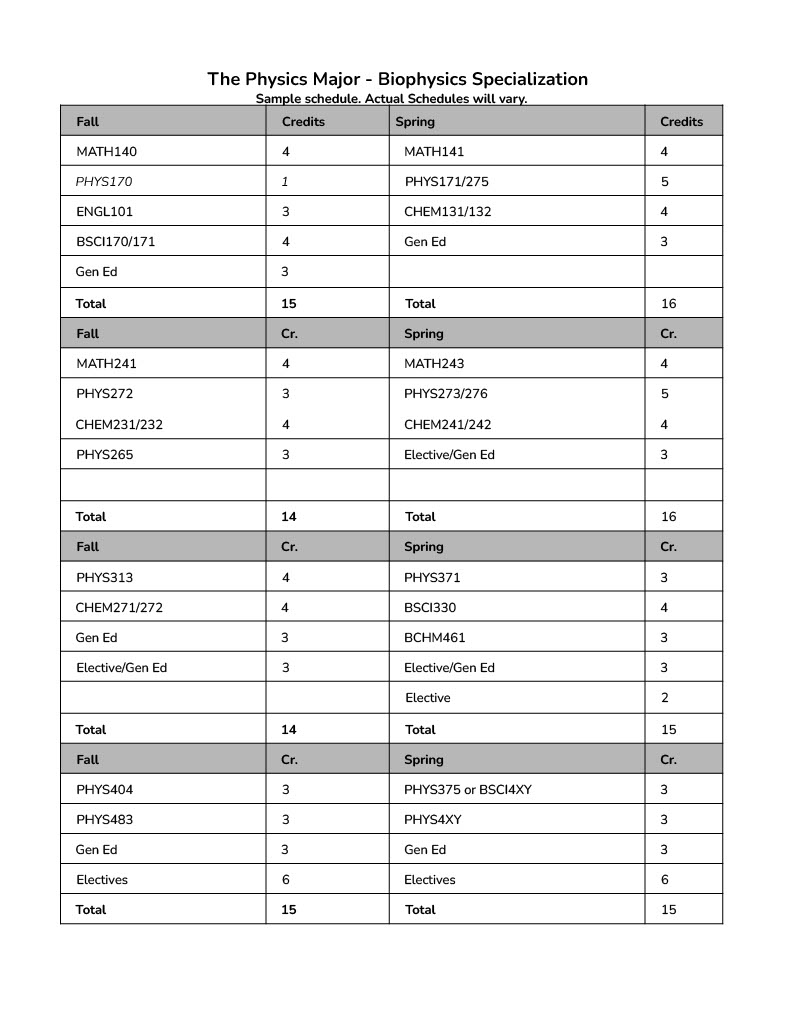
Bio-Physics Physics majors are required to take the following courses. In addition, students must complete all necessary GenEd requirements. Sample graudation plans for each specilaization are avaiable here.
For more information on these courses, or question about degree requiremetns, contact an advisor.
Introductory Courses (37 credits)
PHYS170 (1): Professional Physics Seminar
PHYS171 (3): Introductory Physics: Mechanics
PHYS265 (3): Introduction to Scientific Programming
PHYS272 (3): Introductory Physics: Fields
PHYS275 (2): Experimental Physics I: Mechanics and Waves
PHYS273 (3): Introductory Physics: Oscillations and Waves
PHYS276 (2): Experimental Physics II: Electricity and Magnetism
BSCI170 (3): Principles of Molecular & Cellular Biology
BSCI171 (1): Principles of Molecular & Cellular Biology Laboratory
CHEM131 (3): Chemistry I - Fundamentals of General Chemistry
CHEM132 (1): General Chemistry I Laboratory
CHEM231 (3): Organic Chemistry I
CHEM232 (1): Organic Chemistry Laboratory I
CHEM241 (3): Organic Chemistry II
CHEM242 (1): Organic Chemistry Laboratory II
CHEM271 (2): General Chemistry and Energetics
CHEM272 (2): General Bioanalytical Chemistry Laboratory
Supporting Mathematics Courses (16 - 19 credits)
MATH140 (4): Calculus I
MATH141 (4): Calculus II
MATH241 (4): Calculus III
And one of the following options:
1) MATH243 (4): Introduction to Linear Algebra and Differential Equation, or
2) MATH240 (4): Introduction to Linear Algebra and MATH246 (3): Differential Equations for Scientists and Engineers
Upper-Level Courses (26 - 27 credits)
BSCI330 (4): Cell Biology and Physiology
BCHM461 (3): Biochemistry I
PHYS313 (4): Electricity and Magnetism I
PHYS371 (3): Modern Physics
PHYS404 (3): Introduction to Statistical Thermodynamics
PHYS483 (3): Biophysics
PHYS4XY (3): Advanced Physics Elective
One of the following:
PHYS375 (3): Experimental Physics III: Waves, Optics and Modern Physics
BSCI4XY (3-4): An Approved Advanced BSCI Elective
Note: Students interested in medical school should consult a pre-med advisor (prehealth.umd.edu) for additional course recommendations.
Physics Minor
The Physics Minor
The Physics Minor requirements are listed on the Physics Minor Declaration Sheet
Note: Students may only use a total of 7 cr from their minor to complete major requirements. As a result, Astronomy majors can not minor in Physics. Engineering majors must be selective on which courses apply to both their minor and major, but can still easily minor in Physics.
For more information on these courses, or question about degree requirements, contact an advisor.
Minor Requirements for students who matriculated BEFORE Fall 2025
Introductory Courses (17 credits)
One of the following:
PHYS261 (1): General Physics: Mechanics, Vibrations, Waves, Heat (Laboratory)
PHYS271 (1): General Physics: Electrodynamics, Light, Relativity and Modern Physics (Laboratory)
PHYS 272 (3): Introductory Physics: Fields OR
PHYS260: General Physics: Vibration, Waves, Heat, Electricity and Magnetism
PHYS 273 (3): Introductory Physics: Waves
OR PHYS270: General Physics: Electrodynamics, Light, Relativity and Modern Physics
Potential "Hidden" Pre-requisite classes (19 - 21 credits)
PHYS171 (3): Introductory Physics: Mechanics
MATH140 (4): Calculus I
MATH141 (4): Calculus II
MATH241 (4): Calculus III
And one of the following options:
1) MATH243 (4): Introduction to Linear Algebra and Differential Equation, or
2) MATH240 (4): Introduction to Linear Algebra and MATH246 (3): Differential Equations for Scientists and Engineers
3 courses from the following list of Upper-Level Courses (9-11cr)
PHYS313 (4): Electricity and Magnetism I
PHYS371 (3): Modern Physics
PHYS401 (4): Quantum Physics I
PHYS402 (3): Quantum Physics II
PHYS404 (3): Introduction to Statistical Thermodynamics
PHYS410 (3): Classical Mechanics
PHYS413 (3): Electricity and Magnetism II
**other 400 level courses may be applied with approval from a physics advisor