
|
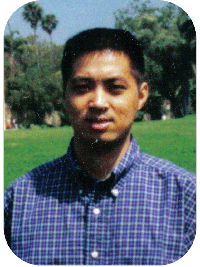
Associate Professor Min Ouyang has received one of the five Scialog Awards sponsored by the Research Corporation for Science Advancement The Scialog (short for science dialog) awards support innovative research in the area of solar energy conversion. Ouyang is attempting to understand certain aspects of an unusual phenomenon, generally known as plasmonics, as they occur in exceptionally tiny objects called nanostructures. His proposal was titled, "Probing Fundamental Light-Matter Interactions in Colloidal Hybrid Quantum Structures for Novel Plasmon-Enhanced Solar Energy Conversion." |
|
Renowned University of Maryland theoretical physicist Sylvester James "Jim" Gates, Jr., Ph.D., has been awarded the 2013 Mendel Medal by Villanova University in recognition of his influential work in supersymmetry, supergravity and string theory, as well as his advocacy for science and science education in the United States and abroad. The Mendel Medal, established in 1928 by the Board of Trustees of Villanova University, honors pioneering scientists who have demonstrated, by their lives and their standing before the world as scientists, that there is no intrinsic conflict between science and religion.
Professor Sylvester James Gates, Jr. will appear on C-SPAN's Q & A this Sunday, May 19, 2013. The program airs at 8pm and 11pm ET and then reairs Monday morning at 6am ET.
There will be two new additions to the department: Katharine B. Gebbie and Gloria Lubkin. Both will hold the title of Visiting Senior Research Scholar.
Katharine Gebbie has just retired as the Director of the Physical Measurement Laboratory of the National Institute of Standards and Technology after a truly stellar career. She graduated from Bryn Mawr College with a degree in physics and subsequently received a bachelor’s degree in astronomy and a Ph.D. in physics from University College London.
She arrived at NIST (then known as the National Bureau of Standards) in 1968, working in areas including nebulae, atomic spectra and supergranular velocity fields. In addition to her scientific acumen, she has demonstrated administrative prowess and an unflinching determination to provide scientists the freedom and resources to do great things. The results are truly impressive: in 1997, 2001, 2005 and 2012, NIST physicists were winners of the Nobel Prize.
Much credit goes to Katharine for nurturing JILA into a first rate institute, in playing a huge role in building the NIST Advanced Measurement Lab (AML), a precursor to our own PSC, and in initiating and supporting the Joint Quantum Institute, the terrifically successful NIST-UMD partnership that is illuminating many areas of atomic, molecular and optical physics and the ever-fascinating world of quantum information.
Gloria Lubkin has enjoyed a truly remarkable career as a science journalist and historian, notably as the longtime editor of Physics Today. She holds degrees in physics from Temple University and Boston University, and worked as a mathematician and physicist in the private sector before joining the physics department at Sarah Lawrence College. In 1963, she started as an associate editor of Physics Today. She retired as Editor Emerita in 2009.
Gloria is a fellow of the American Physical Society and the American Association for the Advancement of Science. She was awarded a Nieman journalism fellowship at Harvard University in 1974-75, and has served on the selection committee for MIT’s Knight Science Writing Fellowships. She is a founding member of the Committee on the Status of Women in Physics and has held several key posts on the APS’ History of Physics forum. The Gloria Becker Lubkin Professorship of Theoretical Physics was established in her honor at the University of Minnesota in 1990. Gloria has truly had a ringside seat for much of the developments in physics since the 1960s, is a wealth of information and perspective, and will be working on a book.
We are grateful and honored that Katharine and Gloria have accepted appointments with us. Having two people with such a wealth of knowledge and perspective is an incredibly wonderful opportunity.
|
JQI fellow and University of Maryland physics professor Victor Galitski has been awarded a Simons Foundation Investigator grant, entailing a million-dollar unrestricted research fund to be used over a ten-year period. The university and its physics department will also receive funds for overhead maintenance. Prof Galitski’s area of research is theoretical condensed matter physics. One example of his recent work is to show how one can take a conventional semiconductor and endow it with topological properties without subjecting the material to extreme environmental conditions or fundamentally changing its solid state structure (the work appearing online in Nature Physics March 13, 2011). |
|
More Articles …
Page 171 of 206