
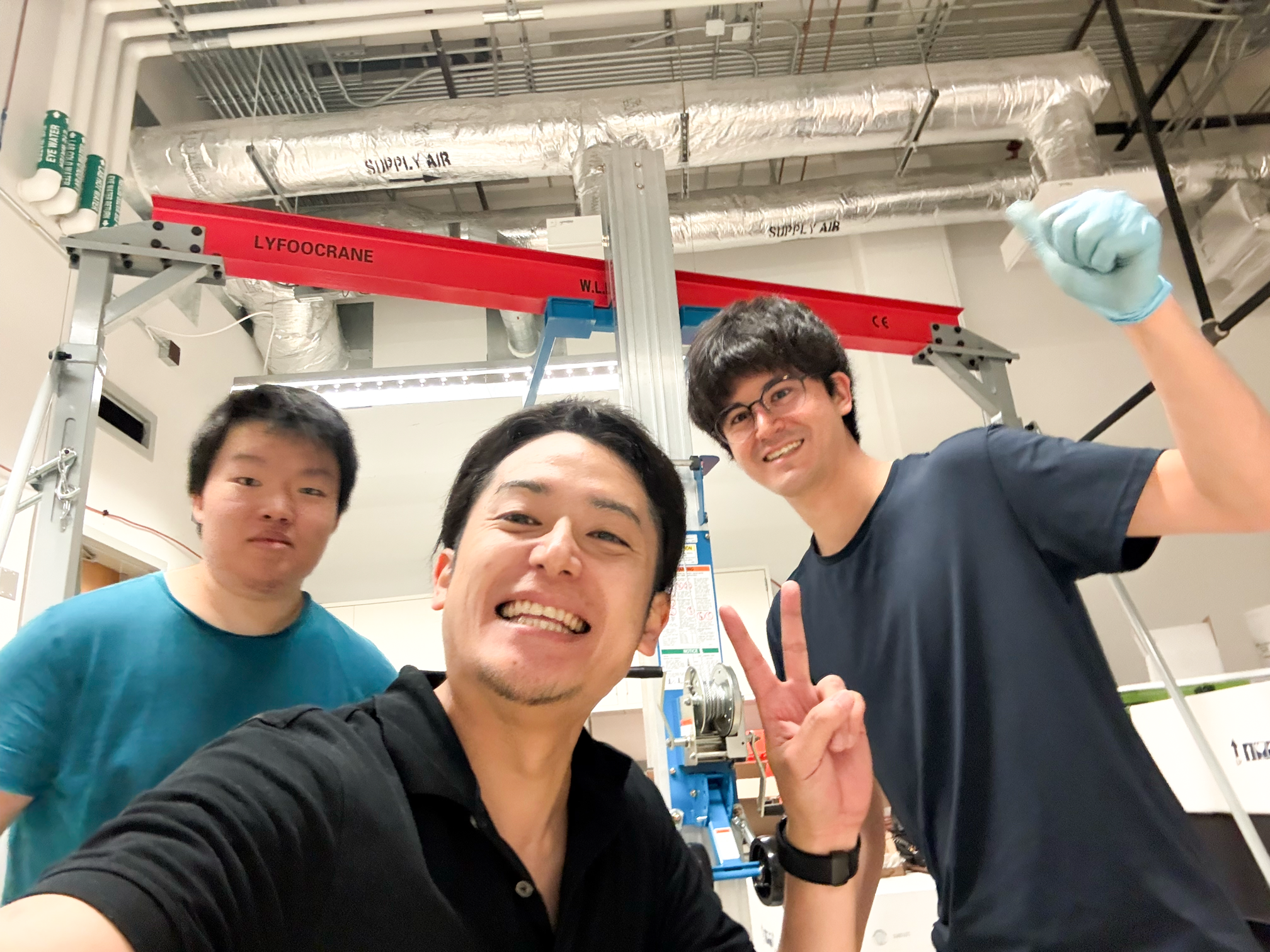
 Undergraduate student Raymond Qin (left), Ryo Mori (center) and postdoctoral researcher Kaishu Kawaguchi (right) after assembling a gantry crane system in Mori’s new lab.
Ryo Mori was intimidated by quantum physics when he took a quantum chemistry class as an undergraduate in Japan. He was studying applied physics, which he found more approachable, and thought he would stick to that. However, when he learned about quantum computing during his senior year, it gave him a taste of quantum physics that has drawn him into a career studying the intricate quantum behaviors underlying exotic material properties.
After graduating from Keio University in Japan, Mori went to the University of California, Berkeley, where he pursued a Ph.D. in applied science and technology. He initially worked in a lab studying how imperfections in diamonds could be used to manipulate quantum information.
“I was not a serious physics guy back then, and this quantum information group actually belonged to the chemistry department,” Mori said.
After a couple of years, he wasn’t hooked on quantum information and began looking around for a different research focus. He was drawn to the vibrant, symmetric data being produced by a lab studying quantum materials using a technique called angle-resolved photoemission spectroscopy, or ARPES for short.
“ARPES data looks really beautiful,” Mori said. “It's really visual. I really couldn't believe that nature itself, especially in just a normal material, shows this type of beautiful, symmetric data.”
The data was produced by the group of Alassandra Lanzara, a physics professor at the University of California, Berkeley, who had pioneered a new way to extract extra data during ARPES measurements. Mori decided to join her group, which required taking additional classes and basically starting his graduate journey over from scratch.
In her group, he learned that the beautiful data reflected the beauty of the underlying physics, and the tools used to observe it gave him a grounded, practical way to engage with the world of quantum physics that he initially found so intimidating.
“It turned out this ‘data looks like art’ or ‘data looks so beautiful’ was not a bad story for the experiment technique,” Mori said. “My path was not linear, and I found ARPES itself beautiful before I truly understood it.”
In 2025, Mori joined UMD as the Alford L. Ward Assistant Professor of physics and a member of the Quantum Materials Center. At UMD, he is building on his research experience and working to combine a variety of techniques into an experimental platform that can provide an expansive look at quantum materials. His research goes beyond interesting quantum effects, like superconductivity, that naturally arise in materials. It also explores ways that researchers can produce and control quantum states and properties by shining a light on a material or adjusting a material’s structure, such as by stretching it or sticking two layers together in different ways.
A Bright Idea
As a member of Lanzara’s group, Mori learned both the basics of ARPES and the range of flavors that it comes in. ARPES uses the natural way light interacts with the surface of materials. Light with enough energy can knock electrons out of the surface of a material, and researchers can collect them. After capturing the ejected electrons, ARPES becomes a game of energetic accounting.
The researchers know how much energy and momentum they injected into the material using light, and they measure how much comes out with the ejected electron. With a little balancing of the books, they can do the math and determine how much energy and momentum the electron was carrying around before they forced it out of the material. With enough data, researchers paint a picture of the momentum carried by electrons in the material—crucial information for describing its electrical properties.
“ARPES measures the electrons as a function of energy and momentum,” Mori said. “And electrons' natural language is actually that—the momentum and energy. So ARPES matches very well to the natural language of the electrons, and electrons are involved in some exotic phenomena in quantum materials. That's why I think an ARPES group is very important for a strong research university.”
ARPES has evolved over time into a few different forms that specialize in revealing additional details of what electrons are doing inside of materials. For example, researchers can observe the behaviors of electrons during transitions by triggering a change in a material using one pulse of light and then ejecting an electron a fixed amount of time later with a different light pulse. Piecing together several different delays between pulses produces a time-lapse-like video of how the electron behavior changes over time—a process dubbed time- and angle-resolved photoelectron spectroscopy (trARPES).
In another variation called spin-resolved ARPES, researchers add sensors that allow them to also measure the spin of ejected electrons. Spin indicates the magnetic orientation of ejected electrons and is crucial for understanding many quantum properties of materials, including superconductivity.
In Lanzara’s Lab, Mori refined his skills at using ARPES techniques and began to look for new behaviors in materials that had already been well-studied using other approaches. He went through many materials looking for interesting results. In multiple materials, he and his colleagues found interesting things happening with excitons—quasiparticles made from an electron partnered with a hole, the positive charge left behind when an electron abandons its spot in a material’s structure. For example, Mori and his colleagues used time-resolved ARPES to observe excitons form in a material and used combined time- and spin-resolved ARPES to study how spins behave in an excitonic state created by light in another material.
After completing his Ph.D. at the University of California, Berkeley, Mori continued his research there as a postdoctoral researcher before moving to the Institute for Solid State Physics at the University of Tokyo. Now that Mori has joined UMD and is building his own lab, he plans to continue using ARPES, and he is designing his equipment to give him a more complete picture of each sample.
“What I'm trying to build at UMD is a combination of all these three techniques: ARPES, spin-resolved ARPES, and time-resolved ARPES,” Moris said.
The equipment he is assembling will take up a lot of space in his new lab. It not only needs to include equipment to perform the various ARPES measurements but also requires a bulky vacuum chamber to keep the samples isolated from the air. Often a reaction with oxygen or other molecules changes the properties of a sample’s surface and can ruin an experiment.
Mori is also designing his equipment with a host of other convenient tricks in addition to the trio of ARPES techniques. For example, he plans to install multiple optical windows that will allow additional ways to study how a sample interacts with light, such as measuring how much light is reflected from a material.
Combining his tools into one experimental setup will reduce the chances of misalignment or the sample being damaged or altered as it is moved between devices. Each measurement will reflect the same sample, in the same position, within a fixed environment, which will let the data tell a clearer story. The new experiments will be able to provide an even richer picture than the initial data that originally caught Mori’s eye.
A Growing Lab
Mori is gradually recruiting students and post-docs to his group and is ordering all the equipment that is needed to construct his versatile ARPES setup.
He expects that once the lab is set up, combining insights from the host of tools will reveal new features of materials—even ones that have already been studied extensively. As the experiments explore new research territory, phenomena related to things like magnetism and how spin influences the behaviors of electrons may be uncovered that eventually prove relevant to quantum information science.
Mori said that UMD is one of the top schools in his field of quantum materials and offers many professional and personal advantages, from multiple airports for when he needs to travel for his research and expert colleagues to collaborate with to convenient places to hike in nature and all the things for his family to do in DC.
“I think UMD is in a good location and a very good community,” Mori said. “I think this is for sure one of the best places in the world—not in the states—in the world.”
Written by Bailey Bedford