
Fifty years ago, long before he gained international recognition and “hero” status for his contributions to gravitational wave theory and the game-changing Laser Interferometer Gravitational-wave Observatory (LIGO), Richard Isaacson (Ph.D. ’67, physics) had one of his most memorable adventures as a Ph.D. student at the University of Maryland: traveling to his first scientific conference and “surviving the experience” of giving his first research talk to an audience of legendary scientists.
“I knew I was going to be talking to some noteworthy scientists. One of the people who was there was Peter Bergmann, a physicist who was an assistant to Albert Einstein, and he was very influential in the field. I knew all these people were going to ask me about my little calculations. Could I withstand the questions, the probing from every wild direction? It was my first big exposure,” Isaacson recalled. “I had gone and sat in the audience at conferences before, but that was very different from this. And, you know, it wasn't terrifying; it was an incredibly valuable experience.”
Now half a century later, Isaacson is supporting a new generation of graduate students taking on the challenges of gravitational physics while honoring the mentor whose “encouragement, enthusiasm, intellectual breadth, mathematical analytic facilities and vision [provided] the intellectual foundations and audacity” for his success. With a generous gift, Isaacson established the Richard Isaacson Graduate Student Travel Award in Gravitational Physics in memory of Physics Professor Charles Misner, the gravitational theorist who inspired Isaacson—and an entire generation of physics students—at UMD.
“Misner was awfully impressive. He had a joy of doing research and of probing the unknown and learning about it that he communicated to his students, and he was enormously helpful and influential,” Isaacson said. “My own reaction was that I held him in awe. I think he would be delighted that I’m remembering him this way, and I think he would certainly approve.”
Isaacson’s gift supports Forward: The University of Maryland Campaign for the Fearless, a $2.5 billion fundraising initiative that aims to expand access to UMD’s world-class education, accelerate groundbreaking research and build stronger communities.
His philanthropy also leverages the college's Bequest Legacy Challenge, an incentive program that provides an immediate cash match for donors who document new or increased planned commitments to the College of Computer, Mathematical, and Natural Sciences.
“The department is very proud of our foundational role in the development of gravitational wave theory and its experimental confirmation. I was delighted to learn of the role one of our alumni, Dr. Isaacson, played in that discovery,” said Kara Hoffman, professor and chair of the Department of Physics. “Charlie Misner was certainly a luminary, and I can’t think of a more appropriate way to honor his memory. We are humbled by this gift.”
For Isaacs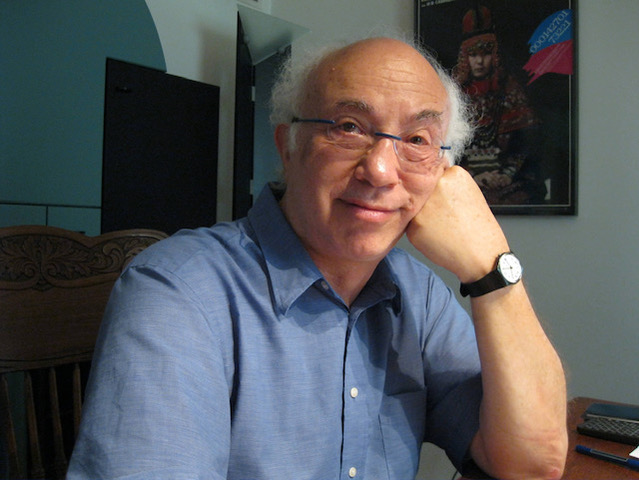 Richard Isaacsonon, it’s all about giving something back to the place that gave so much to him.
“I’m at a stage of life where I think things now have a different perspective and priority. So, I started thinking about that, and I realized that I'd like to pay back a bit, for the experience that changed my life at Maryland,” he explained. “I'm not in the multi-millionaire or billionaire class, but I thought that in today’s uncertain and rapidly changing environment for basic research I could do something, at least, that could help students out in a field which is now flourishing, and I think will do so for the next 50 years.”
Making academic dreams a reality
Isaacson came from a working-class family, and support from scholarships and graduate fellowships helped make his academic dreams a reality. His generous gift to UMD will support graduate students studying gravitational physics, funding travel awards that will allow them to attend scientific meetings and conferences, present their research and expand their graduate experience.
“It's not just to give them the enjoyment of going to a conference. It's to enable them to do something to help their career, to get out and meet people and spread the word about what they're doing, and so it gives them a little extra push,” he said. “That was something I appreciated as a graduate student, and I think I'd like to continue the tradition.”
When Isaacson began his Ph.D. research on gravitational waves, inspired by some of Einstein’s most fascinating theories, he had no idea where the work would take him. What he did know was that UMD was a widely recognized leader in the field, one of a very few U.S. institutions where gravitational work was being done both theoretically and experimentally. With Misner’s support and mentorship, Isaacson studied how gravitational waves behave and how they might be measured, answering some critical questions along the way.
“I think my thesis contributed to making it very simple and clear how these waves propagated and how in many ways they were like light,” he said. “So, it opened up a new experimental realm and made clear that this was going to be an interesting way to explore the universe.”
Advancing science ‘by a hundred years’
Isaacson went on to teach at the Illinois Institute of Technology. Then in 1973 he became the founding program director of the National Science Foundation’s (NSF) gravitational physics program, where he was soon reviewing the plan for the massive LIGO project, a bold experiment aimed at detecting gravitational waves using lasers. For decades, Isaacson worked tirelessly, securing funding and support to make sure LIGO became a reality.
“You know, it was just this extraordinary opportunity, and I was crazy enough not to know what would be involved,” Isaacson reflected. “I'm one of an army of a thousand scientists who were involved in the project, and we had a totally different Congress that had a view of the future and could take risks and were willing to go for it,” Isaacson said. “I think Einstein said something like ‘You have to choose a problem outside of your reach—not outside of your grip, but not beyond your reach.’ This was definitely a stretch, but it was a miraculous time, and we could do that stretch.”
On September 14, 2015, two LIGO facilities did something that had never been done before—they succeeded in detecting gravitational waves resulting from the collision of two black holes. Since then, the project has yielded a host of other groundbreaking discoveries in the U.S. and around the world.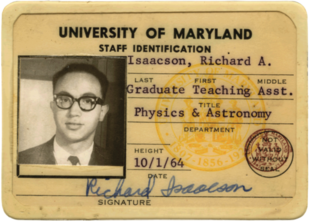 Richard Isaacson's UMD ID card from the 1960s.
“I certainly knew that as soon as they got something working to detect these gravitational waves and even more spectacularly, prove the existence of black holes, it would change everything,” Isaacson said. “We advanced science by a hundred years.”
Isaacson was honored by the American Physical Society in 2018 with the establishment of the Richard A. Isaacson Award in Gravitational-Wave Science, recognizing outstanding contributions in gravitational-wave physics, gravitational-wave astrophysics and the technologies that enable this science. Meanwhile, UMD’s influence in gravitational research continues today, with alumni and faculty members engaged in the LIGO project and related work. Looking ahead, Isaacson hopes his gift can help take gravitational physics—and the students who study it—into the future.
“Supporting students in the gravitational physics group, that's the highest priority of this, to keep this field strong. Every brick that you can put in helps build the wall,” Isaacson said. “I hope I can help these young students, pay something back for the opportunities I’ve had and keep science alive.”
Written by Leslie Miller