• Home
  • About Us
    • Physics Administration
    • Directions
    • Awards
    • Student Awards
    • Make a Donation
    • News
      • Research News
      • Department News
      • Newsletters
    • PTK Policy
  • People
    • All
    • Faculty
      • Current
      • Emeritus
      • Adjunct
      • Affiliate
      • Research Professors
    • Research Scientists
    • Postdocs
    • Staff
    • Lecturers
    • Visitors
    • Graduate Students
  • Research
    • Research Areas
      • AI and Physical Sciences
      • Astro Metrology
      • Atomic, Molecular & Optical
      • Biophysics
      • Chemical Physics
      • Condensed Matter Experiment
      • Condensed Matter Theory
      • Cosmic Ray Physics
      • Elementary Particles
      • Gravitation Experiment
      • Gravitational Theory
      • High Energy Physics
      • Nonlinear Dynamics, Chaos and Complex Systems
      • Nuclear Physics
      • Particle Astrophysics
      • Physics Education Research
      • Plasma Physics
      • Plasma Theory
      • Quantum Science and Technology
      • Quarks, Hadrons and Nuclei
      • Space Physics
    • Centers & Institutes
  • Academics
    • OSES Home (Student Services)
    • OSES News
    • Undergraduate Program
      • Prospective Students
      • Apply Now
      • Degree Requirements and Policies
      • Scholarships
      • Undergraduate Research
      • Advising
      • Undergraduate Forms
      • Undergraduate Events
      • Departmental Honors
      • Society of Physics Students
      • FAQ
      • Undergraduate Student Committee
    • Graduate Program
      • Prospective Students
      • Open House
      • Degree Requirements
      • Graduate Resources
      • Deadlines and Forms
      • PhD Defenses
        • PhD Defenses 2026
        • PhD Defenses 2025
        • PhD Defenses 2024
        • PhD Defenses 2023
        • PhD Defenses 2022
        • PhD Defenses 2021
        • PhD Defenses 2020
        • PhD Defenses 2019
        • PhD Defenses 2018
        • PhD Defenses 2017
        • PhD Defenses 2016
      • Events
      • Scholarships & Awards
      • Qualifier
      • Graduate Student Organizations
      • FAQ
    • Student Opportunities
      • GRAD-MAP
      • Graduate Student Organizations
      • Outreach Volunteering
      • Society of Physics Students
      • NSF S-STEM Program
      • Undergraduate Research
      • The Noether Physics Society
      • Undergraduate Quantum Association
    • Courses
    • Academic Support
    • NSF S-STEM Program
    • Teaching Assistants
  • Events
    • Calendar
    • Physics Colloquia
    • W.J. Carr Lecture
    • Research Interaction Team (RIT) Math/Physics
    • Mechanick Quantum Biology Lecture
    • Irving and Renee Milchberg Endowed Lectureship
    • Charles W. Misner Endowed Lectureship in Gravitational Physics
    • John S. Toll Endowed Lecture
    • Prange Prize Lecture
    • Maryland Day
    • Outreach
      • Outreach Home
      • Physics is Phun
      • Discovery Days
    • Summer Programs
      • Physics Makers Camp
      • Physics of Quidditch
      • Science Discovery Camp
      • Advanced Physics Summer Program
      • Toolkit for Success
    • CUWiP
    • Vortex Makerspace
    • QURiSE Conference
  • Services
    • Building Access Requests
    • Computing Services
    • Conference Room Reservations
    • Department Operations Directory
    • Electronic and Mechanical Development
    • Hiring Procedures
    • Lecture Demo
    • Mental Health Resources
    • Parking
    • Physics Ombudspersons
    • Printing Services
      • Poster Print Request
    • Proposal Submissions
    • Purchase Order
    • Suggestion Box
    • Textbook Information
  • Give
  1. Home
  2. About Us
  3. News
  4. Research News

Written on 02 July 2010.

UM Scientists Advance Quantum Computing & Energy Conversion Tech

Using a unique hybrid nanostructure, University of Maryland researchers have shown a new type of light-matter interaction and also demonstrated the first full quantum control of qubit spin within very tiny colloidal nanostructures (a few nanometers), thus taking a key step forward in efforts to create a quantum computer.

Published in the July 1 issue of Nature, their research builds on work by the same Maryland research team published in March in the journal Science (3-26-10). According to the authors and outside experts, the new findings further advance the promise these new nanostructures hold for quantum computing and for new, more efficient, energy generation technologies (such as photovoltaic cells), as well as for other technologies that are based on light-matter interactions like biomarkers. Read More


Written on 14 June 2010.

CREAM Team Finds Surprising Features in Cosmic Ray Energy Spectra

In May a University of Maryland-led team of scientists reported previously unknown features in the energy spectra of cosmic ray nuclei. Their findings contradict aspects of a prevailing model for how cosmic rays from outside our solar system may be accelerated to their very high energies by the expanding shock waves generated when massive stars explode as supernovas. Read More


Written on 25 May 2010.

JQI in The Washingtonian

An article, about Joint Quantum Institute Scientists unlocking the mysteries of atoms, appears in The Washingtonian magazine. The article, entitled Quantum Leap, can be found in the publication's June 2010 issue.

Written on 07 May 2010.

Kara Hoffman Receives NSF MRI-R2 Grant

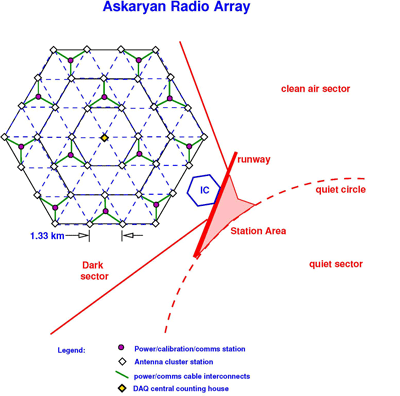
Kara Hoffman, a professor in our particle astrophysics group, has recently been awarded a Major Research Instrumentation-Recovery and Reinvestment (MRI-R2) grant from the National Science Foundation (NSF). MRI grants are for funding the purchase or development of new scientific instrumentation, and this special solicitation, funded through the Recovery and Reinvestment Act, allowed for larger and more expensive initiatives to be considered. Hoffman received $1,477,750 in NSF funding for her proposal entitled "Collaborative Research: MRI-R2 Instrument Development of the Askaryan Radio Array, a Large-scale Radio Cherenkov Detector at the South Pole".

The Askaryan Radio Array (ARA), when realized, will be comprised of radio frequency antennas embedded in 200 m deep boreholes in the South Polar ice cap, encompassing an area of 80 square kilometers. These antennas will be used to monitor the ice for radio frequency impulses which occur when ultra high energy particles called neutrinos are captured in the ice. The very cold ice at the South Pole, which averages 2 miles in depth and temperatures of -60 degrees Fahrenheit near its surface, is extremely transparent to radio frequency emissions, allowing neutrinos interactions to be detected by antennas from several miles away. Neutrinos are interesting because they are fundamental particles that travel through the Universe unimpeded since they have virtually no mass and experience only weak interactions with matter. Some of them may propagate from their origin for billions of years, allowing them to form images of how the Universe may have appeared in the very distant past. They may also carry information about the cataclysmic processes at the dense cores of the astrophysical objects in which they are born. Neutrinos may also shed light on the enigmatic cosmic rays which constantly bombard our Earth's atmosphere, and will also provide a sensitive probe of particle physics and quantum gravity.

Prof. Hoffman's collaborators at the University of Wisconsin simultaneously submitted a linked collaborative proposal, for which they were awarded $1,317,885. These NSF grants, together with required contributions from their institutions, as well as foreign collaborators, gives them a total of 4 million dollars for the first phase of the project, which will span three years. They will commence construction at the South Pole in the coming austral summer, and Professor Hoffman expects to travel to the South Pole for the construction. She has previously visited the South Pole to work on her other project, IceCube, which is also a "neutrino telescope", but it uses light to detect neutrinos rather than radio waves.

Written on 01 April 2010.

For UM and the World, LHC Starts Off with a Bang

On Tuesday, March 30, the Large Hadron Collider (LHC) at CERN, did for the first time what it was created to do, smash together beams of elementary particles at extremely high levels of energy.

Scientists at the LHC collided two proton beams, each with energies of 3.5 TeV (trillion electron volts)- the highest energies ever achieved by a man-made particle accelerator!

Read More


More Articles …

  1. Revolutionary New Solution for Semiconductor; Nano Materials
  2. International Masterclasses Expose High School Students to Particle Physics
  3. LIGO Listens for Gravitational Echoes of the Birth of the Universe
  4. A Tabletop Source of Strong Terahertz Radiation
  5. Long-Distance Teleportation Between Atoms

Page 49 of 51

  • 42
  • 43
  • 44
  • 45
  • 46
  • 47
  • 48
  • 49
  • 50
  • 51
  • Physics Administration
  • Directions
  • Awards
  • Student Awards
  • Make a Donation
  • News
    • Research News
    • Department News
    • Newsletters
  • PTK Policy

College and Department Links

Department of Physics

Physical Sciences Complex
4296 Stadium Dr
College Park, MD 20742
Phone: 301.405.3401

Information

  • Campus Directory
  • Undergraduate Research
  • Scholarships
  • Prospective Undergraduates
  • Directions & Transit
  • Web Accessibility
© 2026 University of Maryland - Department of Physics
Top
  • Home
  • About Us
    • Physics Administration
    • Directions
    • Awards
    • Student Awards
    • Make a Donation
    • News
      • Research News
      • Department News
      • Newsletters
    • PTK Policy
  • People
    • All
    • Faculty
      • Current
      • Emeritus
      • Adjunct
      • Affiliate
      • Research Professors
    • Research Scientists
    • Postdocs
    • Staff
    • Lecturers
    • Visitors
    • Graduate Students
  • Research
    • Research Areas
      • AI and Physical Sciences
      • Astro Metrology
      • Atomic, Molecular & Optical
      • Biophysics
      • Chemical Physics
      • Condensed Matter Experiment
      • Condensed Matter Theory
      • Cosmic Ray Physics
      • Elementary Particles
      • Gravitation Experiment
      • Gravitational Theory
      • High Energy Physics
      • Nonlinear Dynamics, Chaos and Complex Systems
      • Nuclear Physics
      • Particle Astrophysics
      • Physics Education Research
      • Plasma Physics
      • Plasma Theory
      • Quantum Science and Technology
      • Quarks, Hadrons and Nuclei
      • Space Physics
    • Centers & Institutes
  • Academics
    • OSES Home (Student Services)
    • OSES News
    • Undergraduate Program
      • Prospective Students
      • Apply Now
      • Degree Requirements and Policies
      • Scholarships
      • Undergraduate Research
      • Advising
      • Undergraduate Forms
      • Undergraduate Events
      • Departmental Honors
      • Society of Physics Students
      • FAQ
      • Undergraduate Student Committee
    • Graduate Program
      • Prospective Students
      • Open House
      • Degree Requirements
      • Graduate Resources
      • Deadlines and Forms
      • PhD Defenses
        • PhD Defenses 2026
        • PhD Defenses 2025
        • PhD Defenses 2024
        • PhD Defenses 2023
        • PhD Defenses 2022
        • PhD Defenses 2021
        • PhD Defenses 2020
        • PhD Defenses 2019
        • PhD Defenses 2018
        • PhD Defenses 2017
        • PhD Defenses 2016
      • Events
      • Scholarships & Awards
      • Qualifier
      • Graduate Student Organizations
      • FAQ
    • Student Opportunities
      • GRAD-MAP
      • Graduate Student Organizations
      • Outreach Volunteering
      • Society of Physics Students
      • NSF S-STEM Program
      • Undergraduate Research
      • The Noether Physics Society
      • Undergraduate Quantum Association
    • Courses
    • Academic Support
    • NSF S-STEM Program
    • Teaching Assistants
  • Events
    • Calendar
    • Physics Colloquia
    • W.J. Carr Lecture
    • Research Interaction Team (RIT) Math/Physics
    • Mechanick Quantum Biology Lecture
    • Irving and Renee Milchberg Endowed Lectureship
    • Charles W. Misner Endowed Lectureship in Gravitational Physics
    • John S. Toll Endowed Lecture
    • Prange Prize Lecture
    • Maryland Day
    • Outreach
      • Outreach Home
      • Physics is Phun
      • Discovery Days
    • Summer Programs
      • Physics Makers Camp
      • Physics of Quidditch
      • Science Discovery Camp
      • Advanced Physics Summer Program
      • Toolkit for Success
    • CUWiP
    • Vortex Makerspace
    • QURiSE Conference
  • Services
    • Building Access Requests
    • Computing Services
    • Conference Room Reservations
    • Department Operations Directory
    • Electronic and Mechanical Development
    • Hiring Procedures
    • Lecture Demo
    • Mental Health Resources
    • Parking
    • Physics Ombudspersons
    • Printing Services
      • Poster Print Request
    • Proposal Submissions
    • Purchase Order
    • Suggestion Box
    • Textbook Information
  • Give