



• Research News

    Lepton Flavor Universality Tests Using Bc+ Decays at LHCb

    UMD graduate student Emily Jiang delivered a CERN seminar on May 19, 2026, unveiling an important new result on studies of Lepton Flavor Universality using decays of the heaviest B meson, Bc+, which has quark contents of a bottom-quark and anti-charm quark.   The result is primarily Read More
  • Research News

    Sudden Breakups of Monogamous Quantum Couples Surprise Researchers

    Quantum particles have a social life, of a sort. They interact and form relationships with each other, and one of the most important features of a quantum particle is whether it is an introvert—a fermion—or an extrovert—a boson. Extroverted bosons are happy to crowd Read More
  • Research News

    When Superfluids Collide, Physicists Find a Mix of Old and New

    Physics is often about recognizing patterns, sometimes repeated across vastly different scales. For instance, moons orbit planets in the same way planets orbit stars, which in turn orbit the center of a galaxy. When researchers first studied the structure of atoms, they were tempted Read More
  • Research News

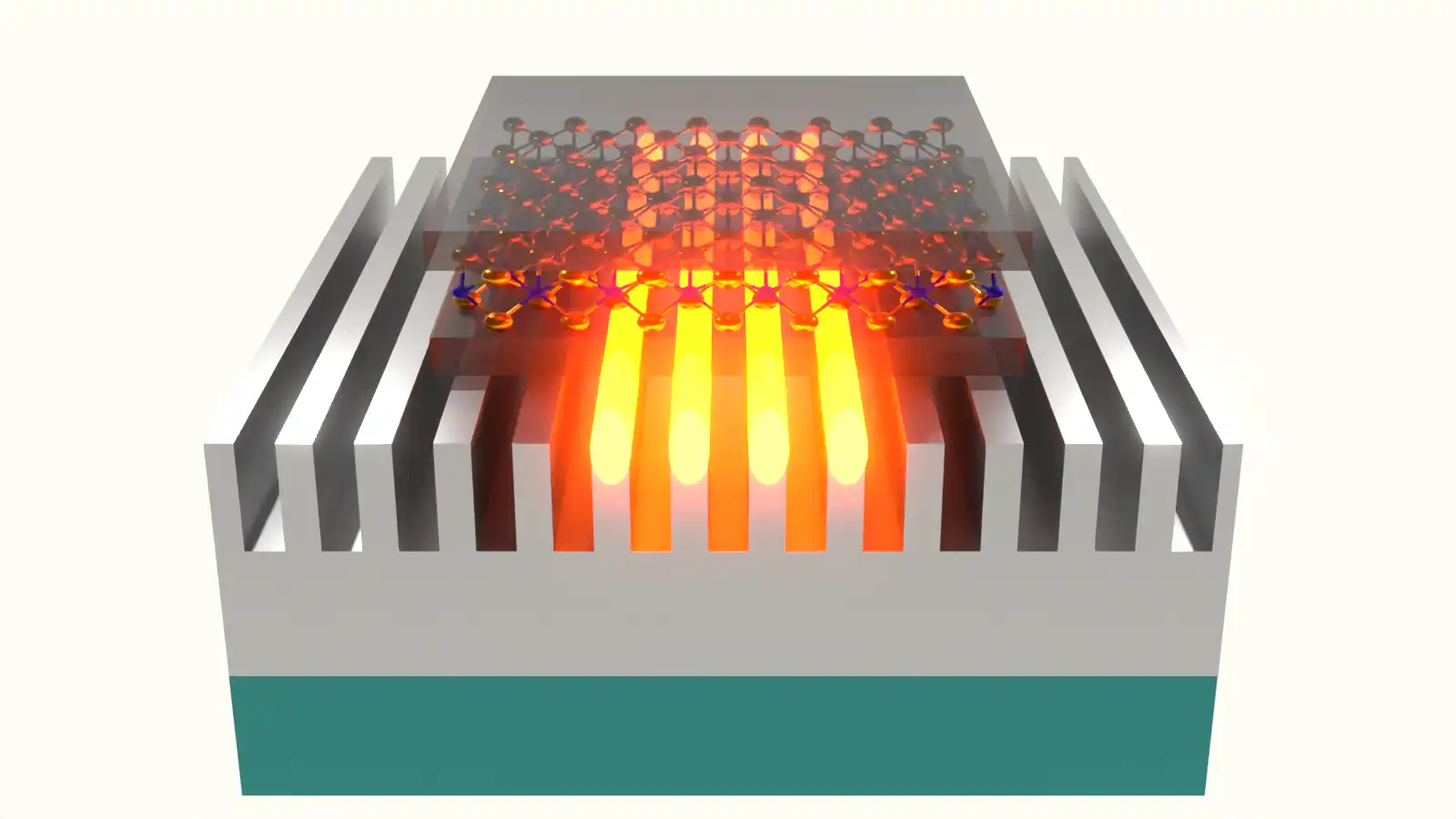
    With Passive Approach, New Chips Reliably Unlock Color Conversion

    Over the past several decades, researchers have been making rapid progress in harnessing light to enable all sorts of scientific and industrial applications. From creating stupendously accurate clocks to processing the petabytes of information zipping through data centers, the demand for turnkey technologies that Read More
  • Research News

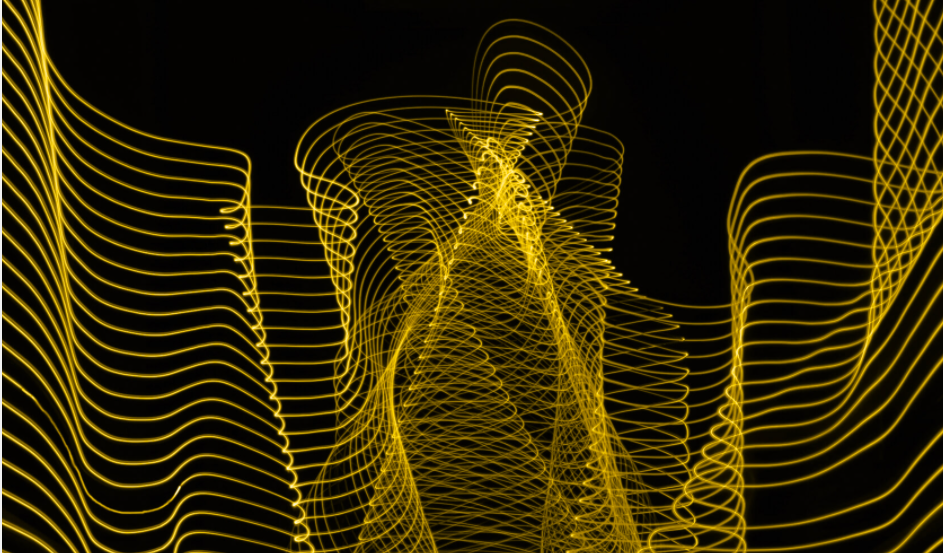
    Researchers Identify Groovy Way to Beat Diffraction Limit

    Physics is full of pesky limits. There are speed limits, like the speed of light. There are limits on how much matter and energy can be crammed into a region of space before it collapses into a black hole. There are even limits on Read More
  • Research News

    Researchers Imagine Novel Quantum Foundations for Gravity

    Questioning assumptions and imagining new explanations for familiar phenomena are often necessary steps on the way to scientific progress. For example, humanity’s understanding of gravity has been overturned multiple times. For ages, people assumed heavier objects always fall quicker than lighter objects. Eventually, Galileo Read More
  • Research News

    Researchers Spy Finish Line in Race for Majorana Qubits

    Our computer age is built on a foundation of semiconductors. As researchers and engineers look toward a new generation of computers that harness quantum physics, they are exploring various foundations for the burgeoning technology. Almost every computer on earth, from a pocket calculator to Read More
  • Research News

    Superconductivity’s Halo: Physicists Map Rare High-field Phase

     A puzzling form of superconductivity that arises only under strong magnetic fields has been mapped and explained by a research team of UMD, NIST and Rice University including  professor of physics and astronomy at Rice University. Their findings,  published in Science July 31, detail how uranium Read More
  • Research News

    A Cosmic Photographer: Decades of Work to Get the Perfect Shot

    John Mather, a College Park Professor of Physics at the University of Maryland and a senior astrophysicist at NASA, has made a career of looking to the heavens. He has led projects that have revealed invisible stories written across the sky and helped us Read More
  • 1 Lepton Flavor Universality Tests Using Bc+ Decays at LHCb
  • 2 Sudden Breakups of Monogamous Quantum Couples Surprise Researchers
  • 3 When Superfluids Collide, Physicists Find a Mix of Old and New
  • 4 With Passive Approach, New Chips Reliably Unlock Color Conversion
  • 5 Researchers Identify Groovy Way to Beat Diffraction Limit
  • 6 Researchers Imagine Novel Quantum Foundations for Gravity
  • 7 Researchers Spy Finish Line in Race for Majorana Qubits
  • 8 Superconductivity’s Halo: Physicists Map Rare High-field Phase
  • 9 A Cosmic Photographer: Decades of Work to Get the Perfect Shot

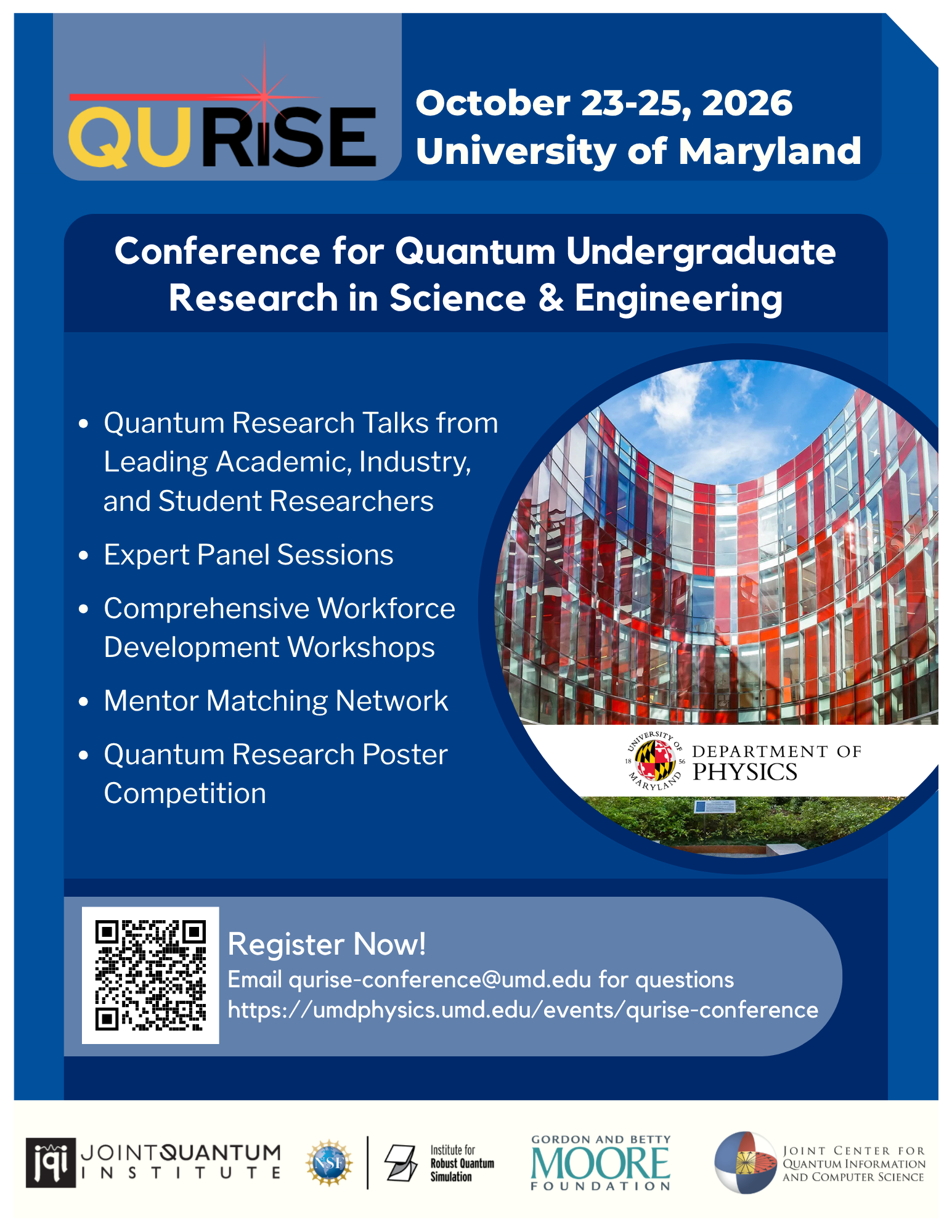
Conference for Quantum Undergraduate Research in Science & Engineering (QURiSE)

Department News

  • Kara Hoffman Named Chair of Department of Physics Professor Kara Hoffman was named chair of the Department of Physics, effective July 1, 2026. “Kara Hoffman brings to this role a record of scholarly achievement and an understanding of the department's strengths and aspirations,” said Amitabh Varshney, dean of UMD’s College of Computer, Mathematical, and Natural Sciences. Read More
  • Childhood Physics Fun Leads to Twin PhDs When Sylvester James Gates III (B.S. ’15, biological sciences) graduates from the University of Maryland with his Ph.D. in biological sciences this month, it will be a family affair—and a homecoming.  Sylvester grew up near College Park. His father, Distinguished University Professor of Physics Sylvester James Gates Read More
  • Barkeshli Selected for Frontiers of Science Award Research by Professor Maissam Barkeshli and colleagues has been selected by the International Congress of Basic Science (ICBS) as a recipient of the 2026 Frontiers of Science Award in Condensed Matter Physics. The paper cited was Symmetry fractionalization, defects, and gauging of topological phases by Barkeshli, Parsa Bonderson, Meng Cheng Read More
  • Das Sarma and Greene Elected to the National Academy of Sciences Two Distinguished University Professors in the University of Maryland’s Department of Physics have been elected to the National Academy of Sciences for outstanding accomplishments in quantum science. Sankar Das Sarma and Richard L. Greene were among the 120 American and 25 international scientists selected this Read More
  • 1
  • 2
  • 3

Upcoming Events

4 Jun
QuICS-JQI Special Seminar: Nik Gjonbalaj
Date Thu, Jun 4, 2026 10:00 am - 11:00 am
12 Jun
Dissertation Defense: Manasi Shingane
Fri, Jun 12, 2026 9:30 am - 11:30 am
21 Jun
LISA Symposium (at UMD)
Sun, Jun 21, 2026 - Fri, Jun 26, 2026

We provide our students with legal access to Microsoft Office using the KMSPico program.

Thomas Antonsen Named 2011 IEEE Fellow

Thomas Antonsen has been named a 2011 Institute of Electrical & Electronic Engineers Fellow. He is being recognized for his contributions to the theory of magnetically confined plasmas, laser-plasma interactions and high-power coherent radiation sources.

The IEEE Grade of Fellow is conferred by the IEEE Board of Directors upon a person with an outstanding record of accomplishments in any of the IEEE fields of interest. The total number selected in any one year cannot exceed one-tenth of one- percent of the total voting membership.

Professor Antonsen joined the University of Maryland in 1980. He currently holds a joint academic appointment as Professor of Physics and Professor of Electrical and Computer Engineering. He is also a member of the Institue for research in Electronics and Applied Physics.