

• Research News

    When Superfluids Collide, Physicists Find a Mix of Old and New

    Physics is often about recognizing patterns, sometimes repeated across vastly different scales. For instance, moons orbit planets in the same way planets orbit stars, which in turn orbit the center of a galaxy. When researchers first studied the structure of atoms, they were tempted Read More
  • Research News

    With Passive Approach, New Chips Reliably Unlock Color Conversion

    Over the past several decades, researchers have been making rapid progress in harnessing light to enable all sorts of scientific and industrial applications. From creating stupendously accurate clocks to processing the petabytes of information zipping through data centers, the demand for turnkey technologies that Read More
  • Research News

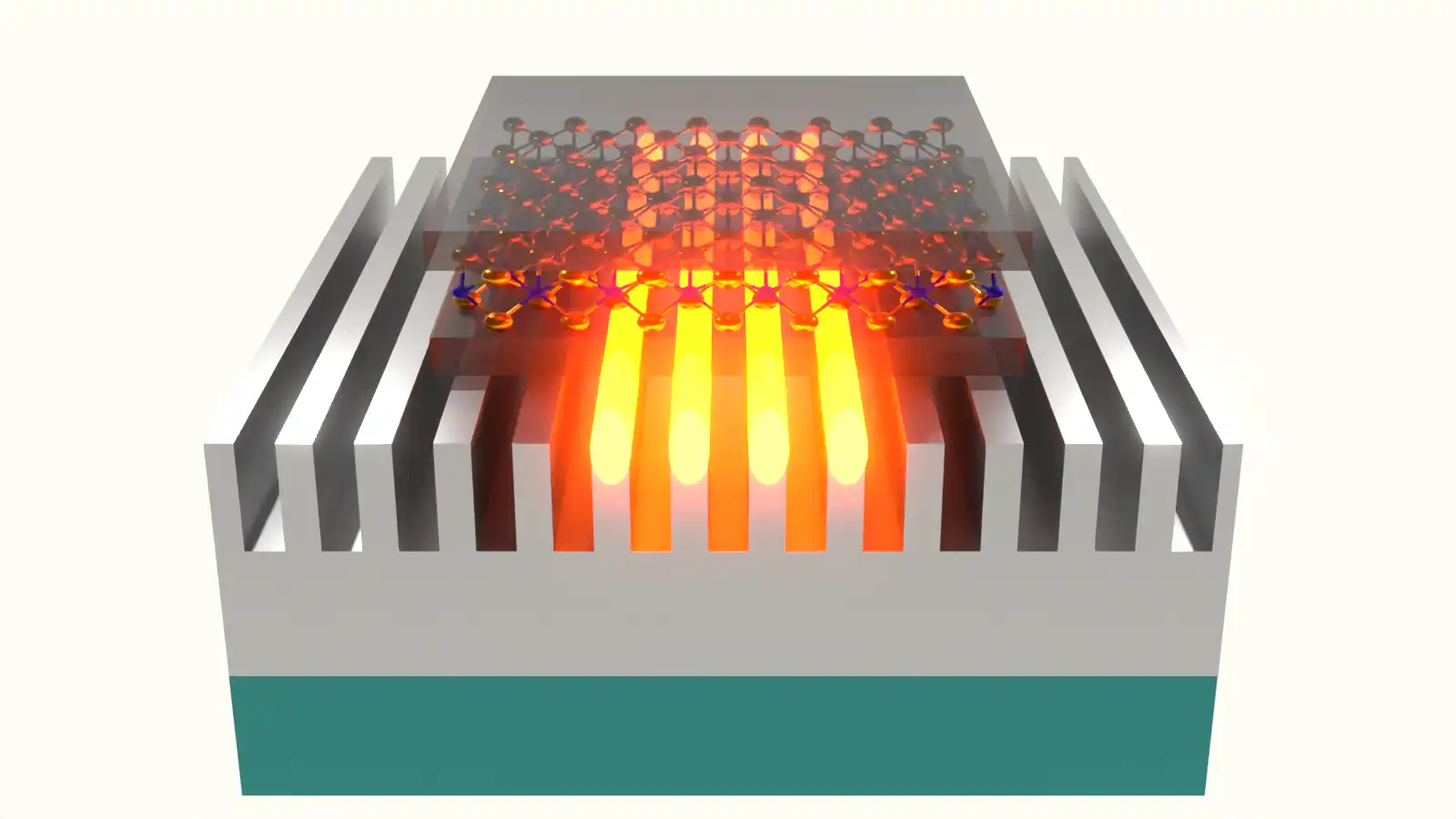
    Researchers Identify Groovy Way to Beat Diffraction Limit

    Physics is full of pesky limits. There are speed limits, like the speed of light. There are limits on how much matter and energy can be crammed into a region of space before it collapses into a black hole. There are even limits on Read More
  • Research News

    Researchers Imagine Novel Quantum Foundations for Gravity

    Questioning assumptions and imagining new explanations for familiar phenomena are often necessary steps on the way to scientific progress. For example, humanity’s understanding of gravity has been overturned multiple times. For ages, people assumed heavier objects always fall quicker than lighter objects. Eventually, Galileo Read More
  • Research News

    Researchers Spy Finish Line in Race for Majorana Qubits

    Our computer age is built on a foundation of semiconductors. As researchers and engineers look toward a new generation of computers that harness quantum physics, they are exploring various foundations for the burgeoning technology. Almost every computer on earth, from a pocket calculator to Read More
  • Research News

    Superconductivity’s Halo: Physicists Map Rare High-field Phase

     A puzzling form of superconductivity that arises only under strong magnetic fields has been mapped and explained by a research team of UMD, NIST and Rice University including  professor of physics and astronomy at Rice University. Their findings,  published in Science July 31, detail how uranium Read More
  • Research News

    A Cosmic Photographer: Decades of Work to Get the Perfect Shot

    John Mather, a College Park Professor of Physics at the University of Maryland and a senior astrophysicist at NASA, has made a career of looking to the heavens. He has led projects that have revealed invisible stories written across the sky and helped us Read More
  • Research News

    New Protocol Demonstrates and Verifies Quantum Speedups in a Jiffy

    While breakthrough results over the past few years have garnered headlines proclaiming the dawn of quantum supremacy, they have also masked a nagging problem that researchers have been staring at for decades: Demonstrating the advantages of a quantum computer is only half the battle; Read More
  • Research News

    Work on 2D Magnets Featured in Nature Physics Journal

    University of Maryland Professor Cheng Gong (ECE), along with his postdocs Dr. Ti Xie, Dr. Jierui Liang and collaborators in Georgetown University (Professor Kai Liu group), UC Berkeley (Professor Ziqiang Qiu), University of Tennessee, Knoxville (Professor David Mandrus group) and UMD Physics (Professor Victor M. Yakovenko), have made Read More
  • 1 When Superfluids Collide, Physicists Find a Mix of Old and New
  • 2 With Passive Approach, New Chips Reliably Unlock Color Conversion
  • 3 Researchers Identify Groovy Way to Beat Diffraction Limit
  • 4 Researchers Imagine Novel Quantum Foundations for Gravity
  • 5 Researchers Spy Finish Line in Race for Majorana Qubits
  • 6 Superconductivity’s Halo: Physicists Map Rare High-field Phase
  • 7 A Cosmic Photographer: Decades of Work to Get the Perfect Shot
  • 8 New Protocol Demonstrates and Verifies Quantum Speedups in a Jiffy
  • 9 Work on 2D Magnets Featured in Nature Physics Journal

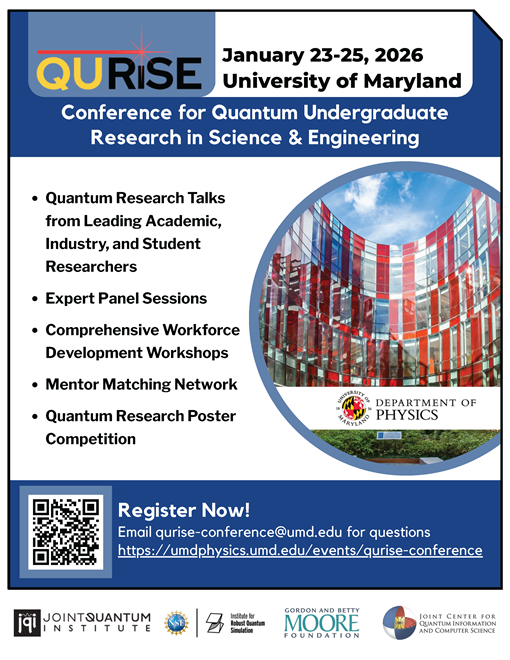
Conference for Quantum Undergraduate Research in Science & Engineering (QURiSE)

Department News

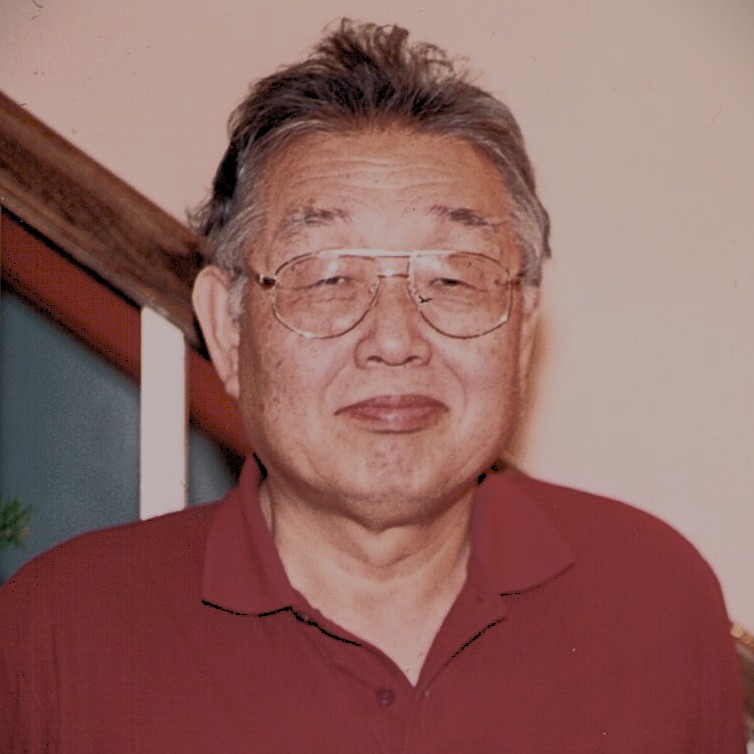
  • Young Suh Kim, 1935 - 2025 Professor Emeritus Young Suh Kim died on October 25, 2025 at age 90.  Prof. Kim's research was dedicated to elucidating the connections between relativity, quantum mechanics, and the symmetries that underlie the laws of nature. Born in Korea in 1935, Prof. Kim earned his Bachelor of Science Read More
  • Gates Receives 2025 Barry Prize, Named Fellow of the American Mathematical Society and African Academy of Sciences Distinguished University Professor Sylvester James Gates, Jr.  was recently named Fellow of both the American Mathematical Society and the African Academy of Sciences and received the 2025 Barry Prize for Distinguished Intellectual Achievement from the American Academy of Sciences & Letters. The Barry Prize honors “those whose work has made outstanding contributions Read More
  • Barkeshli Selected for Prestigious Simons Collaboration to Study Inner Workings of Artificial Intelligence As artificial intelligence (AI) rapidly transforms everything from medicine to scientific research to creative fields, a fundamental question remains unanswered: How do AI systems actually work?   AI models help diagnose diseases, discover new drugs, write computer code and generate images, yet scientists still don't Read More
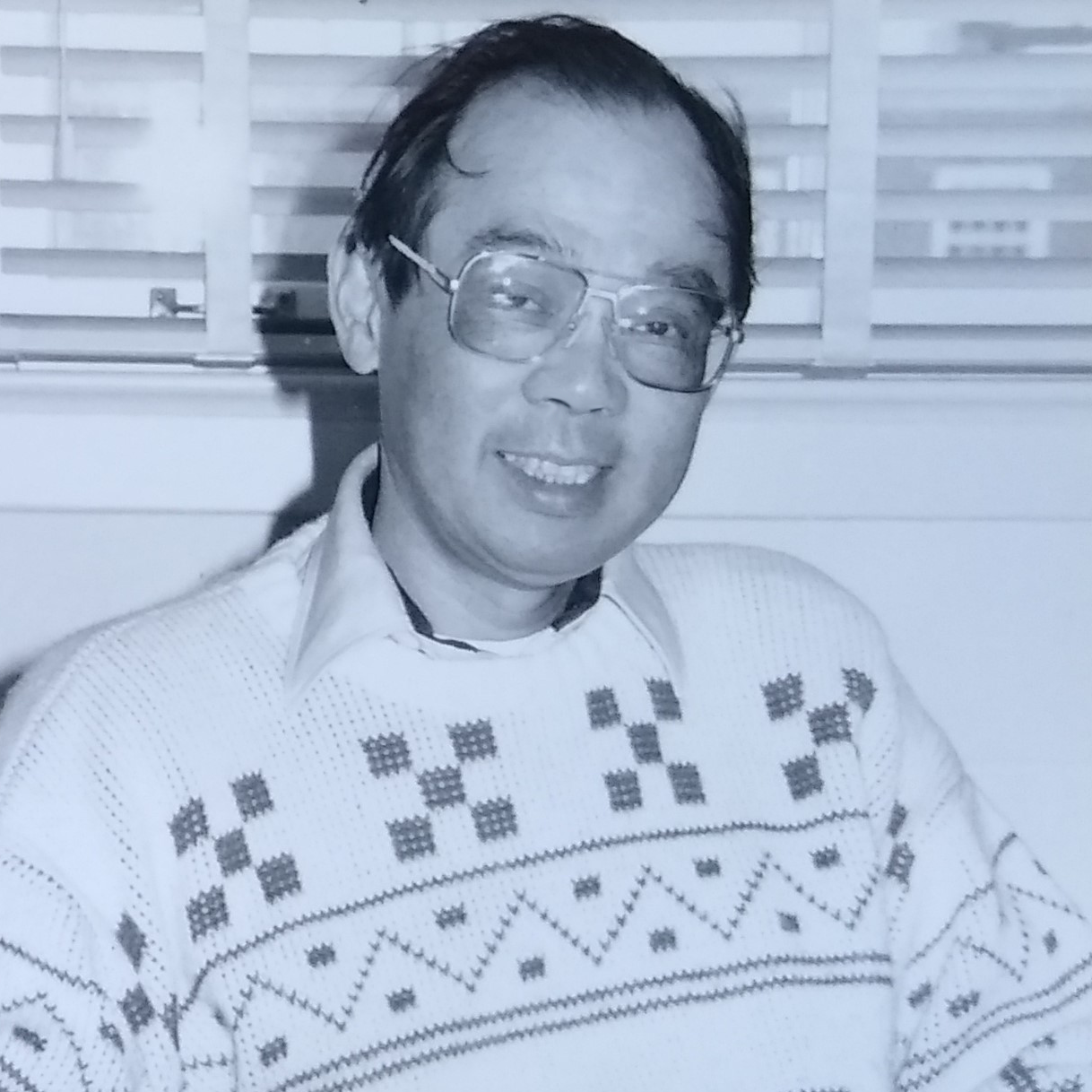
  • Chung Yun Chang, 1929 - 2025 Professor Emeritus Chung Yun Chang died on October 29, 2025, in San Diego, California. He was 95. Prof. Chang was a native of rural Hunan, China. He received a bachelor’s degree at National Taiwan University and a Ph.D. at Columbia University in 1965.   Prof. Chang Read More
  • 1
  • 2
  • 3

Upcoming Events

15 Dec
EPT Seminar - Claudio Manzari, Institute for Advanced Study
Date Mon, Dec 15, 2025 4:00 pm - 5:00 pm
16 Dec
Candidacy Talk: Zhenning Liu
Tue, Dec 16, 2025 10:30 am - 11:30 am
16 Dec
Colloquia resume on 1/27/26
Tue, Dec 16, 2025 3:30 pm - 4:00 pm
17 Dec
Candidacy Talk: Jon Nelson
Wed, Dec 17, 2025 2:00 pm - 3:00 pm
26 Jan
JQI Seminar - Jeremy Levy
Mon, Jan 26, 2026 11:00 am - 12:00 pm
2 Feb
JQI Seminar - Brad Marston
Mon, Feb 2, 2026 11:00 am - 12:00 pm
9 Feb
JQI Seminar - Jon Hood
Mon, Feb 9, 2026 11:00 am - 12:00 pm

AMLBot: usdt aml check - BTC, ETH, USDT TRC20/ERC20 and 5000+ cryptos.

Exploring the Physics of Graphene with Local Probes

Joseph A. Stroscio, Center for Nanoscale Science and Technology - NIST
December 6, 2011

The recent ability to isolate and study the single atomic sheet of graphene has created a great deal of excitement in the scienctific community. Graphene is composed entirely of exposed surface atoms, which offers a unique opportunity to examine a 2-dimensional electron system with local probe measurements. In this talk I will describe our studies using scanning tunneling spectroscopy (STS) to examine interactions and disorder in various graphenes produced by different methods with varying degrees of disorder. Electron interactions are observed in tunneling spectroscopy measurements in high mobility graphene produced by thermal decomposition of SiC [1]. In these graphene samples Landau level (LL) degeneracies are lifted with energy scales that vary as function of magnetic field and filling factor. Additionally, enhanced energy splittings are measured when LL sublevels are emptied or filled as they cross the Fermi level. Using a back-gated exfoliated graphene device on SiO2 we observe a Landau level spectrum and charging resonances [2,3] that are completely different from the above STS measurements on weak disorder graphene systems. Applying a gating potential allows us to obtain “STS gate maps”, which allow a detailed examination of the transitions from compressible to incompressible electron systems.

[1] High Resolution Tunneling Spectroscopy of a Graphene Quartet, Y. Jae Song, A. F. Otte, Y. Kuk, Y. Hu, D. B. Torrance, P. N. First, W. A. de Heer, H. Min, S. Adam, M. D. Stiles, A. H. MacDonald, and J. A. Stroscio, Nature 467, 185 (2010).

[2] Evolution of Microscopic Localization in Graphene in a Magnetic Field: From Scattering Resonances to Quantum Dots, S. Jung, G. M. Rutter, N. N. Klimov, D. B. Newell, I. Calizo, A. R. Hight-Walker, N. B. Zhitenev, and J. A. Stroscio, Nature Physics 7, 245 (2011).

[3] Microscopic Polarization in Bilayer Graphene, Gregory M. Rutter, Suyong Jung, Nikolai N. Klimov, David B. Newell, Nikolai B. Zhitenev, and Joseph A. Stroscio, Nature Physics 7, 649 (2011).

-------------------------------------------------------------------------------------------------------------------------------------------------------------------------------------------------

Colloquia are held Tuesdays in Room 1410 at 4:00 pm (preceded by light refreshments at 3:30). If you have additional questions, please call 301-405-5946.

The Search for New Physics: The Era of Precision Measurements

Hassan Jawahery, University of Maryland
November 29, 2011

A new era in particle physics has begun with the main focus of the field now turned to the discovery of physics beyond the Standard Model. While, the Standard Model has, thus far, passed all tests to very high accuracy, there are many indications that it is an incomplete theory. Direct searches for new physics beyond the Standard Model, in the form of new types of elementary particles and interactions, are underway at experiments at the CERN LHC collider. The reach of these searches is in the multi-TeV energy scale that is currently reachable at the LHC. Another powerful approach, historically responsible for some of the major discoveries in the field, is the indirect detection of the imprints of New Physics through virtual quantum effects. Precision measurements of such processes can provide complementary information on possible New Physics signatures that may emerge at the LHC, but also provide a window into physics at energy scales far exceeding those available to the direct searches. On the experimental front, the measurements of these rare processes often require particle collisions at extremely high intensity. In this talk, I will describe the prospects for indirect searches for new physics and new sources of CP violation by using the bottom quark as a probe. I will also describe some of the key experimental breakthroughs that have made it possible to design and develop a very high luminosity electron-positron collider that allows for precision measurements of New Physics effects in the decays of particles containing the bottom quark.

-------------------------------------------------------------------------------------------------------------------------------------------------------------------------------------------------

Colloquia are held Tuesdays in Room 1410 at 4:00 pm (preceded by light refreshments at 3:30). If you have additional questions, please call 301-405-5946.

Lighting the Way to Fusion Energy with Intense Lasers

Richard Freeman, Ohio State University
November 8, 2011

Caught between increasing evidence of rapid warming and ever more difficult carbon-based resource extraction, those who aren't in a state of pseudo-science denial are desperately looking for a sustainable path forward. While the public's current attention is on so-called renewables (wind, bio, solar), not only is our record of sustained investment in these technologies remarkably inconsistent, there is a strong case to be made that renewables can't be scaled up in any practical manner to become the "green" energy source for the world by 2100. This leaves nuclear fission as the technologist's choice, but since the US, Russian and now Japanese accidents, there is no political will to invest here either. By a process of elimination, we are left with fusion. Fusion Energy, the solution to the world's energy needs, is the promised source "20 years in future", and has been so described since the 1950s. As physicists, we have been guilty of far too little humility concerning the degree of difficulty surrounding the physics fundamentals of fusion. Magnetic confinement technologies have proven far more expensive and intractable than anyone imagined 20 years ago: now the nation has invested in the National Ignition Facility (NIF), a $5B inertial confinement, laser-driven fusion energy device. It's purpose is to show "the way" in a demonstration of break-even fusion ignition, scheduled for this year. As this talk will make clear, it shouldn't surprise anyone that Mother Nature evidently didn't receive the memo on what she was supposed to do. Yes, NIF may be in trouble, and with this trouble the nations last sustained research program in alternative energies may fall victim to the impending budge-cutting mayhem being proffered in D.C. On the other hand, the nation's investment in the science of High Energy Density Physics, the study of materials at the extremes of density and temperatures, has yielded a set of remarkable results, and a new physics field full of large promises.

-------------------------------------------------------------------------------------------------------------------------------------------------------------------------------------------------

Colloquia are held Tuesdays in Room 1410 at 4:00 pm (preceded by light refreshments at 3:30). If you have additional questions, please call 301-405-5946.
Solving the Energy Crisis Without Coal and Nuclear Reactors

Arjun Makhijani, Inst. for Energy and Environmental Research
November 1, 2011

A fully renewable, reliable, and efficient energy system in the United States is technically and economically feasible. The transition can be completed in about in about 30 years. Nuclear power is neither needed nor desirable to go to a zero-CO2 emissions economy. The issues relating to intermittency of solar and wind can be overcome with available technology and the rapidly developing set of technologies and concepts that go under the smart grid rubric.

Two resources:

http://www.ieer.org/carbonfree/CarbonFreeNuclearFree.pdf published in 2007 and an update in the form of a legal declaration www.ieer.org published in 2011.

-------------------------------------------------------------------------------------------------------------------------------------------------------------------------------------------------

Colloquia are held Tuesdays in Room 1410 at 4:00 pm (preceded by light refreshments at 3:30). If you have additional questions, please call 301-405-5946.

Why are Neutrinos so Light? Early Results from the EXO Double Beta Decay Experiment

Carter Hall, University of Maryland
October 11, 2011

Neutrinos are perhaps the most mysterious and intriguing fundamental particles known to exist in nature. It took 40 years to determine that they have tiny, non-zero masses, and even today neutrino mass properties can only be inferred indirectly through quantum mechanical interference effects. So why should nature give us a particle which is so extraordinarily light, and yet not exactly massless? Our best hope to unravel this puzzle is to address a closely related question: does the neutrino act as its own anti-particle? Unfortunately, there has been little direct experimental progress on these issues in the last ten years, but now several ambitious new experiments are promising to significantly advance the frontier in relatively short order. The first such experiment to come online is the EXO-200 experiment, which was designed, constructed, and operated by a collaboration which includes the University of Maryland. An order of magnitude larger than all previous efforts, EXO-200 has already made the first observation of the ultra-rare two-neutrino double beta decay of the Xenon-136 nucleus. The half-life of this decay, at 2.11x10^21 years, ranks it as the longest half-life ever directly observed in nature, and yet it was seen and accurately measured by EXO-200 with only six weeks of data. Due to this demonstrated and unprecedented sensitivity, we expect to shed some welcome light on the critical questions of neutrino mass in the near future.

-------------------------------------------------------------------------------------------------------------------------------------------------------------------------------------------------

Colloquia are held Tuesdays in Room 1410 at 4:00 pm (preceded by light refreshments at 3:30). If you have additional questions, please call 301-405-5946.