• Research News

    When Superfluids Collide, Physicists Find a Mix of Old and New

    Physics is often about recognizing patterns, sometimes repeated across vastly different scales. For instance, moons orbit planets in the same way planets orbit stars, which in turn orbit the center of a galaxy. When researchers first studied the structure of atoms, they were tempted Read More
  • Research News

    With Passive Approach, New Chips Reliably Unlock Color Conversion

    Over the past several decades, researchers have been making rapid progress in harnessing light to enable all sorts of scientific and industrial applications. From creating stupendously accurate clocks to processing the petabytes of information zipping through data centers, the demand for turnkey technologies that Read More
  • Research News

    Researchers Identify Groovy Way to Beat Diffraction Limit

    Physics is full of pesky limits. There are speed limits, like the speed of light. There are limits on how much matter and energy can be crammed into a region of space before it collapses into a black hole. There are even limits on Read More
  • Research News

    Researchers Imagine Novel Quantum Foundations for Gravity

    Questioning assumptions and imagining new explanations for familiar phenomena are often necessary steps on the way to scientific progress. For example, humanity’s understanding of gravity has been overturned multiple times. For ages, people assumed heavier objects always fall quicker than lighter objects. Eventually, Galileo Read More
  • Research News

    Researchers Spy Finish Line in Race for Majorana Qubits

    Our computer age is built on a foundation of semiconductors. As researchers and engineers look toward a new generation of computers that harness quantum physics, they are exploring various foundations for the burgeoning technology. Almost every computer on earth, from a pocket calculator to Read More
  • Research News

    Superconductivity’s Halo: Physicists Map Rare High-field Phase

     A puzzling form of superconductivity that arises only under strong magnetic fields has been mapped and explained by a research team of UMD, NIST and Rice University including  professor of physics and astronomy at Rice University. Their findings,  published in Science July 31, detail how uranium Read More
  • Research News

    A Cosmic Photographer: Decades of Work to Get the Perfect Shot

    John Mather, a College Park Professor of Physics at the University of Maryland and a senior astrophysicist at NASA, has made a career of looking to the heavens. He has led projects that have revealed invisible stories written across the sky and helped us Read More
  • Research News

    New Protocol Demonstrates and Verifies Quantum Speedups in a Jiffy

    While breakthrough results over the past few years have garnered headlines proclaiming the dawn of quantum supremacy, they have also masked a nagging problem that researchers have been staring at for decades: Demonstrating the advantages of a quantum computer is only half the battle; Read More
  • Research News

    Work on 2D Magnets Featured in Nature Physics Journal

    University of Maryland Professor Cheng Gong (ECE), along with his postdocs Dr. Ti Xie, Dr. Jierui Liang and collaborators in Georgetown University (Professor Kai Liu group), UC Berkeley (Professor Ziqiang Qiu), University of Tennessee, Knoxville (Professor David Mandrus group) and UMD Physics (Professor Victor M. Yakovenko), have made Read More
  • 1 When Superfluids Collide, Physicists Find a Mix of Old and New
  • 2 With Passive Approach, New Chips Reliably Unlock Color Conversion
  • 3 Researchers Identify Groovy Way to Beat Diffraction Limit
  • 4 Researchers Imagine Novel Quantum Foundations for Gravity
  • 5 Researchers Spy Finish Line in Race for Majorana Qubits
  • 6 Superconductivity’s Halo: Physicists Map Rare High-field Phase
  • 7 A Cosmic Photographer: Decades of Work to Get the Perfect Shot
  • 8 New Protocol Demonstrates and Verifies Quantum Speedups in a Jiffy
  • 9 Work on 2D Magnets Featured in Nature Physics Journal

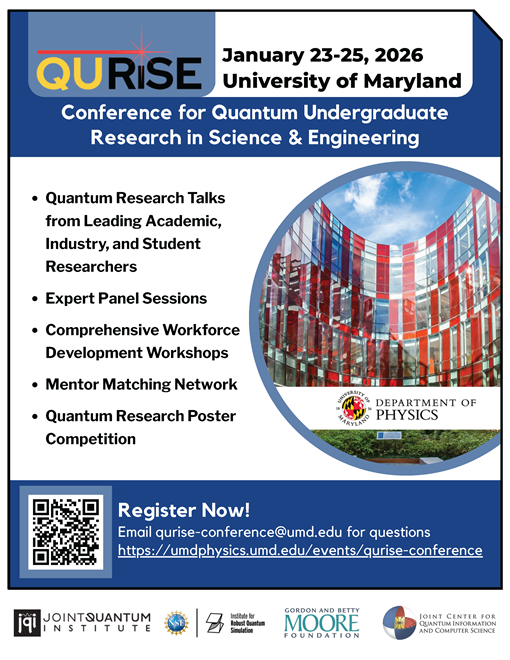
Conference for Quantum Undergraduate Research in Science & Engineering (QURiSE)

Department News

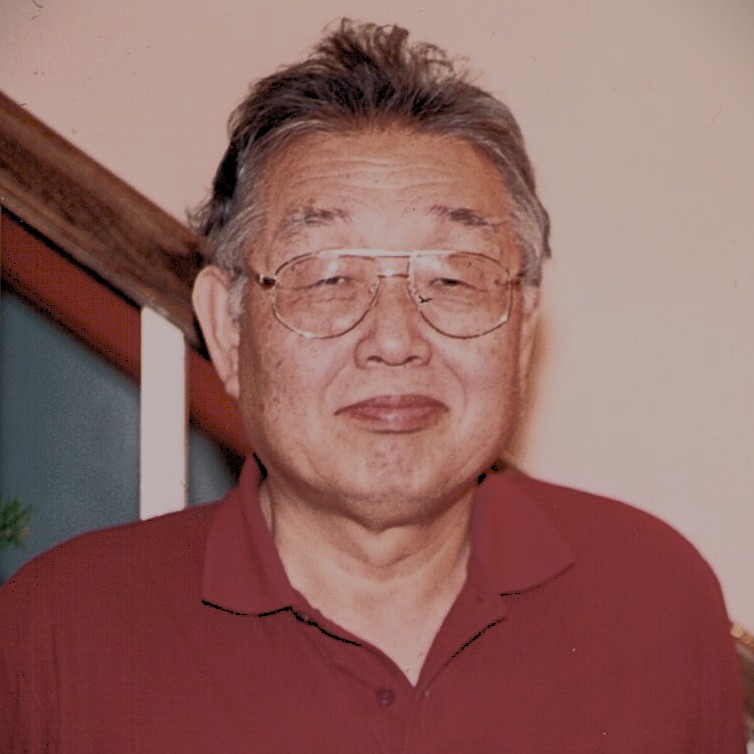
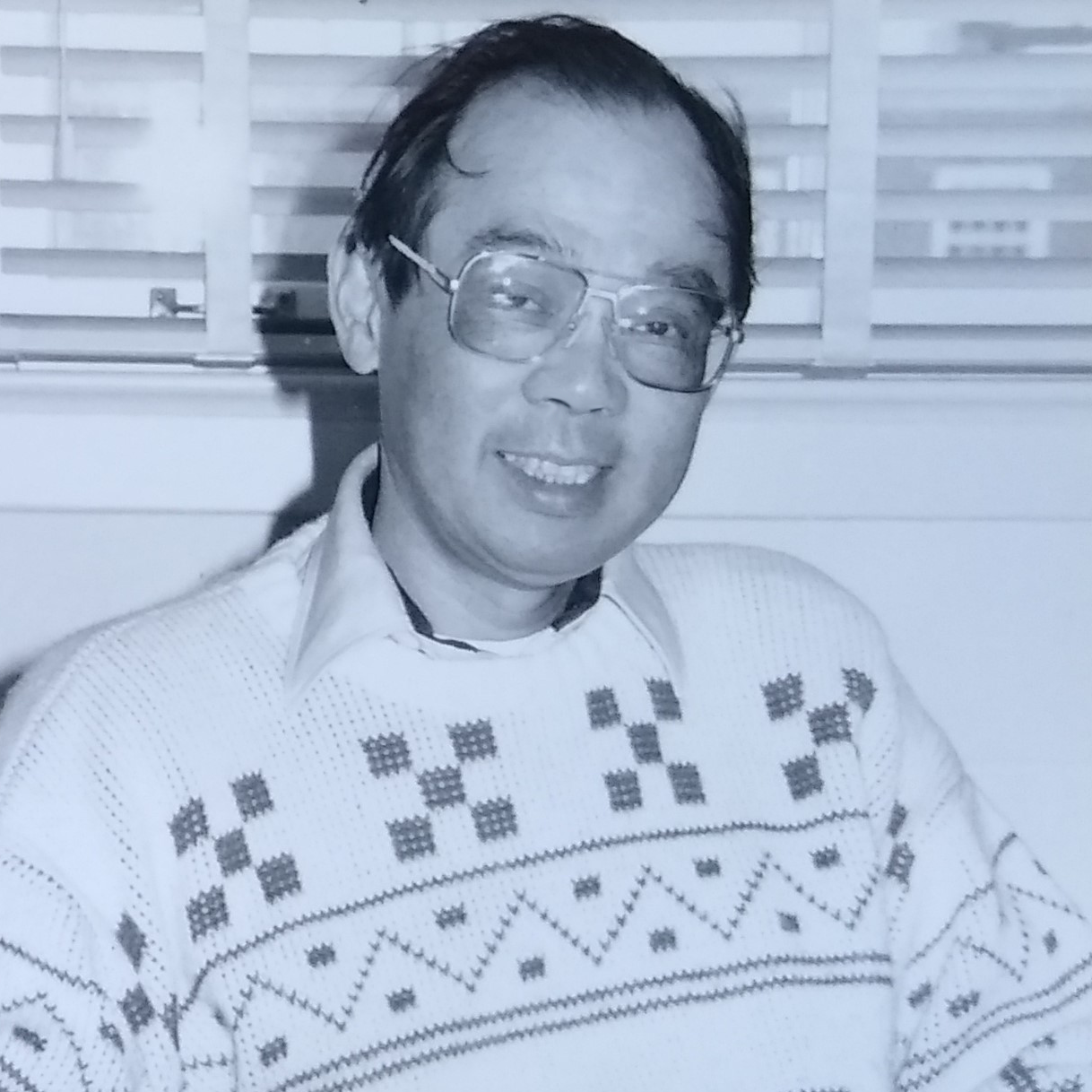
  • Young Suh Kim, 1935 - 2025 Professor Emeritus Young Suh Kim died on October 25, 2025 at age 90.  Prof. Kim's research was dedicated to elucidating the connections between relativity, quantum mechanics, and the symmetries that underlie the laws of nature. Born in Korea in 1935, Prof. Kim earned his Bachelor of Science Read More
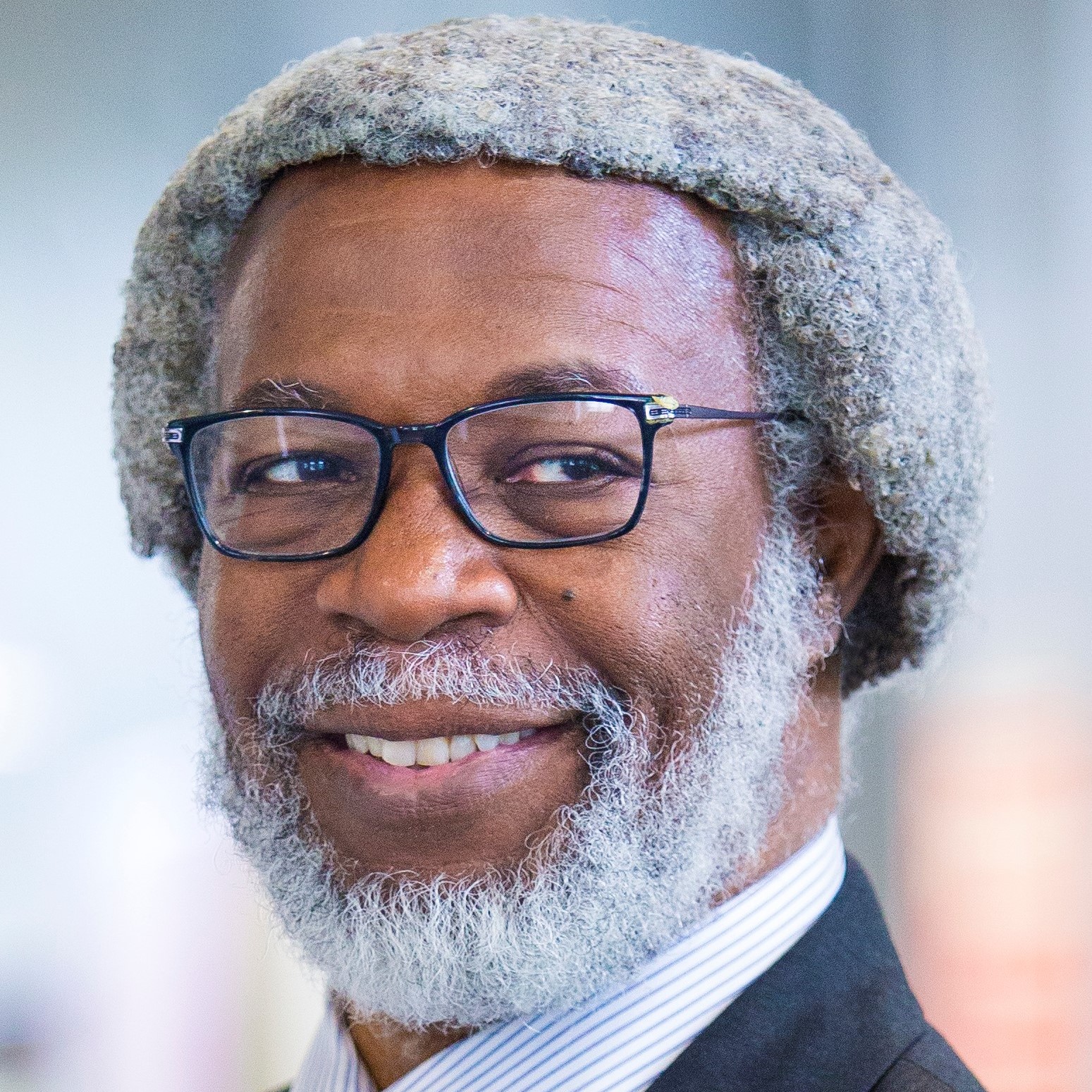
  • Gates Receives 2025 Barry Prize, Named Fellow of the American Mathematical Society and African Academy of Sciences Distinguished University Professor Sylvester James Gates, Jr.  was recently named Fellow of both the American Mathematical Society and the African Academy of Sciences and received the 2025 Barry Prize for Distinguished Intellectual Achievement from the American Academy of Sciences & Letters. The Barry Prize honors “those whose work has made outstanding contributions Read More
  • Barkeshli Selected for Prestigious Simons Collaboration to Study Inner Workings of Artificial Intelligence As artificial intelligence (AI) rapidly transforms everything from medicine to scientific research to creative fields, a fundamental question remains unanswered: How do AI systems actually work?   AI models help diagnose diseases, discover new drugs, write computer code and generate images, yet scientists still don't Read More
  • Chung Yun Chang, 1929 - 2025 Professor Emeritus Chung Yun Chang died on October 29, 2025, in San Diego, California. He was 95. Prof. Chang was a native of rural Hunan, China. He received a bachelor’s degree at National Taiwan University and a Ph.D. at Columbia University in 1965.   Prof. Chang Read More
  • 1
  • 2
  • 3

Upcoming Events

15 Dec
EPT Seminar - Claudio Manzari, Institute for Advanced Study
Date Mon, Dec 15, 2025 4:00 pm - 5:00 pm
16 Dec
Candidacy Talk: Zhenning Liu
Tue, Dec 16, 2025 10:30 am - 11:30 am
16 Dec
Colloquia resume on 1/27/26
Tue, Dec 16, 2025 3:30 pm - 4:00 pm
17 Dec
Candidacy Talk: Jon Nelson
Wed, Dec 17, 2025 2:00 pm - 3:00 pm
26 Jan
JQI Seminar - Jeremy Levy
Mon, Jan 26, 2026 11:00 am - 12:00 pm
2 Feb
JQI Seminar - Brad Marston
Mon, Feb 2, 2026 11:00 am - 12:00 pm
9 Feb
JQI Seminar - Jon Hood
Mon, Feb 9, 2026 11:00 am - 12:00 pm

AMLBot: usdt aml check - BTC, ETH, USDT TRC20/ERC20 and 5000+ cryptos.

Quantum Simulation with Atoms, Ions and Molecules

Peter Zoller, Institute for Theoretical Physics, University of Innsbruck
& Institute for Quantum Optics and Quantum Information of the Austrian Academy of Sciences

May 08, 2012

Quantum optical systems of cold atoms, ions and molecules provide one of the best ways to implement quantum simulation of many body systems. In this talk we will discuss some recent theoretical and experimental developments towards "open system" quantum simulation, where a many body system is coupled to an engineered environment. This provides a new scenarios to prepare entangled states in quantum information, and leads to a new non-equilibrium condensed matter physics of driven-dissipative systems. Specific examples to be discussed include an open system Rydberg quantum simulator, and a related experiment with trapped ions demonstrating preparation of GHZ states and dynamical quantum phase transitions. In addition, we briefly touch topics like Majorana fermions induced by dissipation, and dissipative d-wave pairing.

-------------------------------------------------------------------------------------------------------------------------------------------------------------------------------------------------

Colloquia are held Tuesdays in Room 1410 at 4:00 pm (preceded by light refreshments at 3:30). If you have additional questions, please call 301-405-5946.

The Strangest Man: the life of Paul Dirac

Graham Farmelo
April 24, 2012

Paul Dirac, co-discover of quantum mechanics, was one of the greatest theoretical physicists of the twentieth century. Now often called "the theorist’s theorist," he is most famous for prediction of anti-matter on the basis of his relativistic equation for the electron. He is also well known for his extraordinary personality, especially his taciturnity, his rectilinear thought processes and his lack of empathy. In this talk, Graham Farmelo shall explore his work, his character and his posthumous productivity as perhaps the most influential of the pioneers of quantum physics.

-------------------------------------------------------------------------------------------------------------------------------------------------------------------------------------------------

Colloquia are held Tuesdays in Room 1410 at 4:00 pm (preceded by light refreshments at 3:30). If you have additional questions, please call 301-405-5946.
Higgs Boson: On the Verge of Discovery

Andrey Korytov, University of Florida
March 6, 2012

The Higgs boson was conceived in 1960s with a very special purpose: in the standard model of elementary particles, it is via interactions with the Higgs boson field that particles can acquire masses without breaking the foundational principle of the gauge invariance. The Large Hadron Collider was designed to discover the Higgs boson or ascertain its non-existence. The former outcome will be seen as a triumph of the standard model, while the later result would be qualified as a revolution in the particle physics. I will briefly overview the standard model basics and the Higgs mechanism by which particles acquire masses, review the design and operation of the Large Hadron Collider and its experiments, and give insights into the recent very suggestive, and highly publicized, results that have been released by the LHC experiments in December.

-------------------------------------------------------------------------------------------------------------------------------------------------------------------------------------------------

Colloquia are held Tuesdays in Room 1410 at 4:00 pm (preceded by light refreshments at 3:30). If you have additional questions, please call 301-405-5946.

Plasmonic Terahertz Waveguides

Daniel Mittleman, Rice University
April 3, 2012

Concentrating optical energy into an ultra-small spot beyond the diffraction limit has long been an interesting topic in photonics. For terahertz radiation, this challenge is of particular importance, to meet the growing interest in imaging and spectroscopy of materials with a size below the sub-millimeter scale of the free-space wavelength. One of the most exciting new approaches is to use subwavelength-sized plasmonic waveguides, based on the excitation of localized surface plasmon polaritons (SPPs) on metallic surfaces. While most of the studies on plasmonic waveguides have been focused in the optical regime, subwavelength plasmonic waveguides in the THz spectral regime have also recently attracted a great deal of attention. Here, we discuss several terahertz waveguide structures in the context of plasmonic waveguiding, and show how this understanding can enable deep subwavelength confinement of broadband terahertz signals.

-------------------------------------------------------------------------------------------------------------------------------------------------------------------------------------------------

Colloquia are held Tuesdays in Room 1410 at 4:00 pm (preceded by light refreshments at 3:30). If you have additional questions, please call 301-405-5946.

The First Neutral Atom Circuit Analogs to Basic Electric Circuit Elements

Wendell T. Hill III, Joint Quantum Institute
March 13, 2012

Atomtronics, a relatively new field of physics, seeks to re-engineer electronics where atoms are the basic carriers of information. Today, electronics only exploits the charge of the electron; it is becoming more and more clear, however, that simply utilizing the spin of the electron would enable novel ways to store information. Devices based on so-called spintronics have the potential to revolutionize electronics. The atom, having a more complex internal structure than the electron, makes the possibilities with atomtronics far richer than those with spintronics. Crossed laser beams, producing optical lattices, and lasers with exotic spatial distributions, such as higher order Laguerre-Gauss modes, provide a means for establishing optical dipole potentials that have lead to several cold atom-based analogs to electronics and condensed states of matter. Persistent currents in a ring, a close atom analog to a superconducting circuit, and even a Josephson junction are just two examples of circuit analogs that have been demonstrated. While these harmonic potentials have received the most attention, arbitrary, non-harmonic potentials would allow a host of new analogs to be constructed, including more basic electrical elements. Exploiting an adaptation of a generalized phase-contrast approach, we have generated high-quality two-dimensional (2D) optical patterns that are ideal for creating low-noise potentials for neutral atoms – free-space atom chips. The chip is composed of an etched “light substrate” – a 2D sheet of light that is either red or blue detuned from the atomic resonance. The substrate is etched by the spatially-shaped beam propagating in a direction orthogonal to the plane of the sheet, which can be either red detuned or blue detuned as well. In contrast to the more familiar material-based atom chips, free-space atom chips can possess potentials that are non-harmonic, have sharp walls and barriers that can even be modified on a timescale commensurate with the flow of an atomic BEC. We have taken the initial steps toward realizing these chips by creating RLC circuits, the resistance and inductance of which are equivalent to the Sharvin (ballistic) resistance in metals and the usually small kinetic inductance, respectively. Similarly, the capacitance is related to the imbalance between the number of atoms and the chemical potential between two points in the circuit. To our knowledge, this is the first demonstration of an atomtronics circuit with analogs to basic elements of an electronic circuit and the first direct observation in real time of the flow of an ideal gas through a channel.

-------------------------------------------------------------------------------------------------------------------------------------------------------------------------------------------------

Colloquia are held Tuesdays in Room 1410 at 4:00 pm (preceded by light refreshments at 3:30). If you have additional questions, please call 301-405-5946.