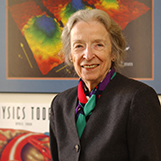
Distinguished University Professor Ellen D. Williams recently returned to UMD Physics and the Institute for Physical Science and Technology (IPST) after spending several years working for energy company BP and later, the U.S. Department of Energy. Prof. Williams will give a colloquium on her experiences and outlook on Tuesday, April 25 at 4pm in the lobby of the PSC.
Prof. Williams first arrived at UMD in 1981, working as a postdoctoral researcher for Prof. Bob Park after completing her doctorate in chemistry at Caltech. She joined the physics faculty in 1983, studying materials and surface physics; her specific areas of research included experimental statistical mechanics, statistical properties of nanostructures and flexible electronics. In 1991, she founded what would become the University of Maryland Materials Research Science and Engineering Center (MRSEC). She was elected to the American Academy of Arts and Sciences in 2003 and the National Academy of Sciences in 2005.
In 2010, Prof. Williams was recruited to be Chief Scientist at BP, succeeding physicist Steve Koonin. In response to climate change, BP had been exploring alternative energy sources for a decade. She accepted the job in London, and plunged into the extraordinary array of issues involved in the production of energy with minimal environmental disruption. Examples include land use decisions in the production of biofuels, management of the quantities of water involved in fossil fuel production, availability of rare earth elements for electric motors and lithium for batteries for electric vehicles. Prof. Williams oversaw a consortium of university researchers studying these and other topics in BP's Energy Sustainability Challenge. The research led to publication of Materials Critical to the Energy Industry, Water in the Energy Industry and Biomass in the Energy Industry.
Another major responsibility was heading BP’s technical advisory committee, which studies innovations upstream (getting oil and gas out of the Earth) and downstream (refining to create fuels, petrochemicals and other products). The TAC met four times a year to review all the company’s technical R&D activities. Prof. Williams notes that innovations in science over the last few decades allow for greater efficiencies and new approaches to technical problems in energy production. Supercomputers have played a significant role, whether used with seismic imaging and geophysics to determine the likely locations of oil reserves, or to model efficient means of breaking cellulosic materials into usable biofuels.
As one of the world’s largest producers and consumers of energy, the United States is keenly interested in such questions. A 2007 report published by the National Academies, Rising Above the Gathering Storm: Energizing and Employing America for a Brighter Economic Future, recommended the establishment of the Advanced Research Projects Agency-Energy (ARPA-E) in the Department of Energy’s Office of Science to foster innovation toward energy efficiency and sustainability using grants on specific energy or environmental topics. ARPA-E was first funded as part of the American Recovery and Reinvestment Act of 2009. In 2013, newly-installed Energy Secretary Ernest Moniz contacted Prof. Williams, who recalled that she “could hardly contain my joy” at the prospect of leading ARPA-E.
The federal vetting process and assorted delays took several months; the congressional approval process took a year. During that time, Prof. Williams resigned from BP and worked as a senior advisor to Secretary Moniz until her appointment was confirmed; she took the helm at ARPA-E in December 2014.
Prof. Williams very much enjoyed the broad scope of sciences cultivated by ARPA-E. For example: soil depletion of agricultural land releases carbon into the atmosphere and spurs greater use of fertilizer, a major source of nitrous oxide emissions. ROOTS, or Rhizosphere Observations Optimizing Terrestrial Sequestration, supported research to keep carbon in the ground through creative scanning and phenotyping techniques for root systems. MONITOR, or Methane Observation Networks with Innovative Technology to Obtain Reductions, aimed to limit leaks of methane during the processing and transport of natural gas. Nimble combinations of lasers, computing, photonics and fluid dynamics yielded ultra-precise sensors of interest to the Environmental Protection Agency, the Department of the Interior and the energy industry.
Well before she joined the Department of Energy, Prof. Williams held a deep interest in government and public policy. She has served on the International Security Advisory Board of the U.S. Department of State and on JASON, an independent scientific advisory group that provides consulting services to the U.S. government on matters of defense science and technology. She chaired the National Academy of Science’s committee on Technical Issues Concerning the Comprehensive Test Ban Treaty from 2009-11, and was a member of the NAS Policy and Global Affairs Committee. She is currently developing a class on the interplay of clean energy technology, policy and regulations to be offered in the Fall of 2017.