• Home
  • About Us
    • Physics Administration
    • Directions
    • Awards
    • Student Awards
    • Make a Donation
    • News
      • Research News
      • Department News
      • Newsletters
    • PTK Policy
  • People
    • All
    • Faculty
      • Current
      • Emeritus
      • Adjunct
      • Affiliate
      • Research Professors
    • Research Scientists
    • Postdocs
    • Staff
    • Lecturers
    • Visitors
    • Graduate Students
  • Research
    • Research Areas
      • AI and Physical Sciences
      • Astro Metrology
      • Atomic, Molecular & Optical
      • Biophysics
      • Chemical Physics
      • Condensed Matter Experiment
      • Condensed Matter Theory
      • Cosmic Ray Physics
      • Elementary Particles
      • Gravitation Experiment
      • Gravitational Theory
      • High Energy Physics
      • Nonlinear Dynamics, Chaos and Complex Systems
      • Nuclear Physics
      • Particle Astrophysics
      • Physics Education Research
      • Plasma Physics
      • Plasma Theory
      • Quantum Science and Technology
      • Quarks, Hadrons and Nuclei
      • Space Physics
    • Centers & Institutes
  • Academics
    • OSES Home (Student Services)
    • OSES News
    • Undergraduate Program
      • Prospective Students
      • Apply Now
      • Degree Requirements and Policies
      • Scholarships
      • Undergraduate Research
      • Advising
      • Undergraduate Forms
      • Undergraduate Events
      • Departmental Honors
      • Society of Physics Students
      • FAQ
      • Undergraduate Student Committee
    • Graduate Program
      • Prospective Students
      • Open House
      • Degree Requirements
      • Graduate Resources
      • Deadlines and Forms
      • PhD Defenses
        • PhD Defenses 2026
        • PhD Defenses 2025
        • PhD Defenses 2024
        • PhD Defenses 2023
        • PhD Defenses 2022
        • PhD Defenses 2021
        • PhD Defenses 2020
        • PhD Defenses 2019
        • PhD Defenses 2018
        • PhD Defenses 2017
        • PhD Defenses 2016
      • Events
      • Scholarships & Awards
      • Qualifier
      • Graduate Student Organizations
      • FAQ
    • Student Opportunities
      • GRAD-MAP
      • Graduate Student Organizations
      • Outreach Volunteering
      • Society of Physics Students
      • NSF S-STEM Program
      • Undergraduate Research
      • Women in Physics
      • Undergraduate Quantum Association
    • Courses
    • Academic Support
    • NSF S-STEM Program
    • Teaching Assistants
  • Events
    • Calendar
    • Physics Colloquia
    • W.J. Carr Lecture
    • Research Interaction Team (RIT) Math/Physics
    • Mechanick Quantum Biology Lecture
    • Irving and Renee Milchberg Endowed Lectureship
    • Charles W. Misner Endowed Lectureship in Gravitational Physics
    • John S. Toll Endowed Lecture
    • Prange Prize Lecture
    • Maryland Day
    • Outreach
      • Outreach Home
      • Physics is Phun
      • Discovery Days
    • Summer Programs
      • Physics Makers Camp
      • Physics of Quidditch
      • Science Discovery Camp
      • Advanced Physics Summer Program
      • Toolkit for Success
    • CUWiP
    • Vortex Makerspace
    • QURiSE Conference
  • Services
    • Building Access Requests
    • Computing Services
    • Conference Room Reservations
    • Department Operations Directory
    • Electronic and Mechanical Development
    • Hiring Procedures
    • Lecture Demo
    • Mental Health Resources
    • Parking
    • Physics Ombudspersons
    • Printing Services
      • Poster Print Request
    • Proposal Submissions
    • Purchase Order
    • Suggestion Box
    • Textbook Information
  • Give
  1. Home
  2. About Us
  3. News

Written on 27 March 2014. Posted in Research News.

Researchers See Kelvin Wave on Quantum “Tornado” for First Time

Click image for information.

Draining the water from a bathtub causes a spinning tornado to appear. The downward flow of water into the drain causes the water to rotate, and as the rotation speeds up, a vortex forms that obeys the laws of classical mechanics. However, if the water is extremely cold liquid helium, the fluid will swirl around an invisible line to form a vortex that obeys the laws of quantum mechanics. Sometimes, two of these quantum tornadoes flex into curved lines, cross over one another to form a letter X shape, swap ends, and then violently retract from one another—a process called reconnection.

Computer simulations have suggested that after the vortexes snap away from each other, they develop ripples called “Kelvin waves” to quickly get rid of the energy caused by the connection and relax the system. However, the existence of these waves had never been experimentally proven.

Now, for the first time, researchers provide visual evidence confirming that the reconnection of quantum vortexes launches Kelvin waves. The study, which was conducted at the University of Maryland, will be published the week of March 24, 2014 in the online early edition of the journal Proceedings of the National Academy of Sciences. The research was supported by the National Science Foundation.

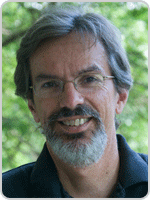
“We weren’t surprised to see the Kelvin waves on the quantum vortex, but we were excited to see them because they had never been seen before,” said Daniel Lathrop, a UMD physics professor. “Seeing the Kelvin waves provided the first experimental evidence that previous theories predicting they would be launched from vortex reconnection were correct.”

Understanding turbulence in quantum fluids, such as ultracold liquid helium, may offer clues to neutron stars, trapped atom systems and superconductors. Superconductors, which are materials that conduct electricity without resistance below certain temperatures, develop quantized vortices. Understanding the behavior of the vortices may help researchers develop superconductors that remain superconducting at higher current densities.

Physicists Richard Feynman and Lars Onsager predicted the existence of quantum vortices more than a half-century ago. However, no one had seen quantum vortices until 2006. In Lathrop’s laboratory at UMD, researchers prepared a cylinder of supercold helium—at 2 degrees Celsius above absolute zero—injected with frozen tracer particles made from atmospheric air and helium gases. When they shined a laser into the cylinder, the researchers saw the particles trapped on the vortices like dew drops on a spider web.

“Kelvin waves on quantized vortices had been predicted, but the experiments were challenging because we had to conduct them at lower temperatures than our previous experiments,” explained Lathrop.

Since 2006, the researchers have used the same technique to further examine quantum vortexes. During an experiment in February 2012, they witnessed a unique reconnection event. One vortex reconnected with another and a wave propagated down the vortex. To quantitatively study the wave’s motion, the researchers tracked the position of the particles on the vortex. The resulting waveforms agreed generally with theories of Kelvin waves propagating from quantum vortexes.

“These first observations of Kelvin waves will surely lead to exciting new experiments that push the limits of our knowledge of these exotic quantum motions,” added Lathrop.

In the future, Lathrop plans to use florescent nanoparticles to investigate what happens near the transition to the superfluid state.

Lathrop conducted the current study with David Meichle, a UMD physics graduate student; Enrico Fonda, who was a research scholar at UMD and graduate student at the University of Trieste when the study was performed and is now a postdoctoral researcher at New York University; Nicholas Ouellette, who was a visiting assistant professor at UMD when the study was performed and is now an associate professor in mechanical engineering & materials science at Yale University; and Sahand Hormoz, a postdoctoral researcher at the University of California, Santa Barbara’s Kavli Institute for Theoretical Physics.

This research was supported by the National Science Foundation (NSF) under Award No. DMR-0906109. The content of this article does not necessarily reflect the views of the NSF.

The research paper, “Direct observation of Kelvin waves excited by quantized vortex reconnections,” Enrico Fonda, David P. Meichle, Nicholas T. Ouellette, Sahand Hormoz, and Daniel P. Lathrop, published the week of March 24, 2014 in the online early edition of the journal Proceedings of the National Academy of Sciences.


Written on 26 March 2014. Posted in Department News.

Geoffrey Ji Wins Goldwater Scholarship

Geoffrey Ji

Geoffrey Ji has been awarded a scholarship by the Barry M. Goldwater Scholarship and Excellence in Education Foundation, which encourages students to pursue advanced study and careers in the sciences, engineering and mathematics. He is among the 283 students selected from 1,166 students nominated nationally this year. Ji—who is majoring in physics, mathematics, economics and computer science—has been conducting quantum science research for two years in the laboratory of Chris Monroe, Bice Zorn Professor of Physics.

“Geoffrey has almost single-handedly outfitted advanced digital and analog electronic control circuits, in addition to writing impressive computer code that will soon be adopted by most of our other projects,” said Monroe.

Ji also conducted theoretical nuclear physics research with Paulo Bedaque, associate professor of physics, which resulted in co-authorship of a peer-reviewed publication in the journal Physical Review D. He is a member of the UMD Honors College and plans to pursue a doctoral degree.


Written on 12 March 2014. Posted in Department News.

Physics Receives High Marks in 2015 Graduate School Rankings

Maryland Physics was ranked 14th by U.S. News and World Report's 2015 Best Graduate Schools -- with four specialties in the top 10. Our rankings included:

The plasma specialty ranked 3rd
The atomic/molecular/optical specialty ranked 6th
The quantum specialty ranked 8th
The condensed matter specialty ranked 10th
The cosmology/gravity/relativity specialty ranked 13th

 
The College of Computer, Mathematical and Natural Sciences' full Best Graduate School rankings are available here.

Written on 10 March 2014. Posted in Research News.

Researchers Demonstrate Long-Lived High-Power Optical Waveguides in Air

In a recent experiment, published in Physical Review X, Howard Milchberg and his colleagues in the intense laser-matter interactions group demonstrate that femtosecond filaments can set up an extended and robust thermal waveguide structure in air with a lifetime of several milliseconds, making possible the very-long-range guiding and distant projection of high-energy laser pulses and high-average power beams. This is the subject of articles that appear in the latest issues of APS Viewpoint, Physics Today and Science News.


APS/Alan Stonebraker
Click image for more information

Written on 10 March 2014. Posted in Department News.

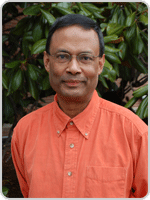
Paglione Appointed CIFAR Associate

Johnpierre Paglione was appointed an Associate for the Canadian Institute for Advanced Research (CIFAR). CIFAR brings together a network of nearly 400 researchers to focus on important questions with the potential to improve human health and the environment, transform technology, build strong societies, understand human culture and even chart the universe.

Professor Paglione will serve as an Associate of the Quantum Materials research program.

For the full list of 2014 research appointments, visit: http://ter.ps/522

More Articles …

  1. Losert's Lab Designs RoboClam with Amazing Digging Powers
  2. Lockheed Martin, UMD Partner to Develop Next Generation Quantum Computer
  3. UMD Physicist and Colleagues Solve a Longstanding Biological Puzzle
  4. Professor Gates is Harvard Foundation's Scientist of the Year

Page 162 of 203

  • 157
  • 158
  • 159
  • 160
  • 161
  • 162
  • 163
  • 164
  • 165
  • 166
  • Physics Administration
  • Directions
  • Awards
  • Student Awards
  • Make a Donation
  • News
    • Research News
    • Department News
    • Newsletters
  • PTK Policy

College and Department Links

Department of Physics

Physical Sciences Complex
4296 Stadium Dr
College Park, MD 20742
Phone: 301.405.3401

Information

  • Campus Directory
  • Undergraduate Research
  • Scholarships
  • Prospective Undergraduates
  • Directions & Transit
  • Web Accessibility
© 2026 University of Maryland - Department of Physics
Top
  • Home
  • About Us
    • Physics Administration
    • Directions
    • Awards
    • Student Awards
    • Make a Donation
    • News
      • Research News
      • Department News
      • Newsletters
    • PTK Policy
  • People
    • All
    • Faculty
      • Current
      • Emeritus
      • Adjunct
      • Affiliate
      • Research Professors
    • Research Scientists
    • Postdocs
    • Staff
    • Lecturers
    • Visitors
    • Graduate Students
  • Research
    • Research Areas
      • AI and Physical Sciences
      • Astro Metrology
      • Atomic, Molecular & Optical
      • Biophysics
      • Chemical Physics
      • Condensed Matter Experiment
      • Condensed Matter Theory
      • Cosmic Ray Physics
      • Elementary Particles
      • Gravitation Experiment
      • Gravitational Theory
      • High Energy Physics
      • Nonlinear Dynamics, Chaos and Complex Systems
      • Nuclear Physics
      • Particle Astrophysics
      • Physics Education Research
      • Plasma Physics
      • Plasma Theory
      • Quantum Science and Technology
      • Quarks, Hadrons and Nuclei
      • Space Physics
    • Centers & Institutes
  • Academics
    • OSES Home (Student Services)
    • OSES News
    • Undergraduate Program
      • Prospective Students
      • Apply Now
      • Degree Requirements and Policies
      • Scholarships
      • Undergraduate Research
      • Advising
      • Undergraduate Forms
      • Undergraduate Events
      • Departmental Honors
      • Society of Physics Students
      • FAQ
      • Undergraduate Student Committee
    • Graduate Program
      • Prospective Students
      • Open House
      • Degree Requirements
      • Graduate Resources
      • Deadlines and Forms
      • PhD Defenses
        • PhD Defenses 2026
        • PhD Defenses 2025
        • PhD Defenses 2024
        • PhD Defenses 2023
        • PhD Defenses 2022
        • PhD Defenses 2021
        • PhD Defenses 2020
        • PhD Defenses 2019
        • PhD Defenses 2018
        • PhD Defenses 2017
        • PhD Defenses 2016
      • Events
      • Scholarships & Awards
      • Qualifier
      • Graduate Student Organizations
      • FAQ
    • Student Opportunities
      • GRAD-MAP
      • Graduate Student Organizations
      • Outreach Volunteering
      • Society of Physics Students
      • NSF S-STEM Program
      • Undergraduate Research
      • Women in Physics
      • Undergraduate Quantum Association
    • Courses
    • Academic Support
    • NSF S-STEM Program
    • Teaching Assistants
  • Events
    • Calendar
    • Physics Colloquia
    • W.J. Carr Lecture
    • Research Interaction Team (RIT) Math/Physics
    • Mechanick Quantum Biology Lecture
    • Irving and Renee Milchberg Endowed Lectureship
    • Charles W. Misner Endowed Lectureship in Gravitational Physics
    • John S. Toll Endowed Lecture
    • Prange Prize Lecture
    • Maryland Day
    • Outreach
      • Outreach Home
      • Physics is Phun
      • Discovery Days
    • Summer Programs
      • Physics Makers Camp
      • Physics of Quidditch
      • Science Discovery Camp
      • Advanced Physics Summer Program
      • Toolkit for Success
    • CUWiP
    • Vortex Makerspace
    • QURiSE Conference
  • Services
    • Building Access Requests
    • Computing Services
    • Conference Room Reservations
    • Department Operations Directory
    • Electronic and Mechanical Development
    • Hiring Procedures
    • Lecture Demo
    • Mental Health Resources
    • Parking
    • Physics Ombudspersons
    • Printing Services
      • Poster Print Request
    • Proposal Submissions
    • Purchase Order
    • Suggestion Box
    • Textbook Information
  • Give