
What does quantum research have to do with video game graphics? Well, nothing—at least not directly, according to William Donnelly (Ph.D. '12, physics). Donnelly conducted quantum entanglement and gravity research for his dissertation at the University of Maryland and is now a senior rendering researcher at Electronic Arts (EA)—the video game company behind hit franchises including The Sims, Battlefield, Star Wars: Battlefront, Need for Speed and the EA Sports titles. 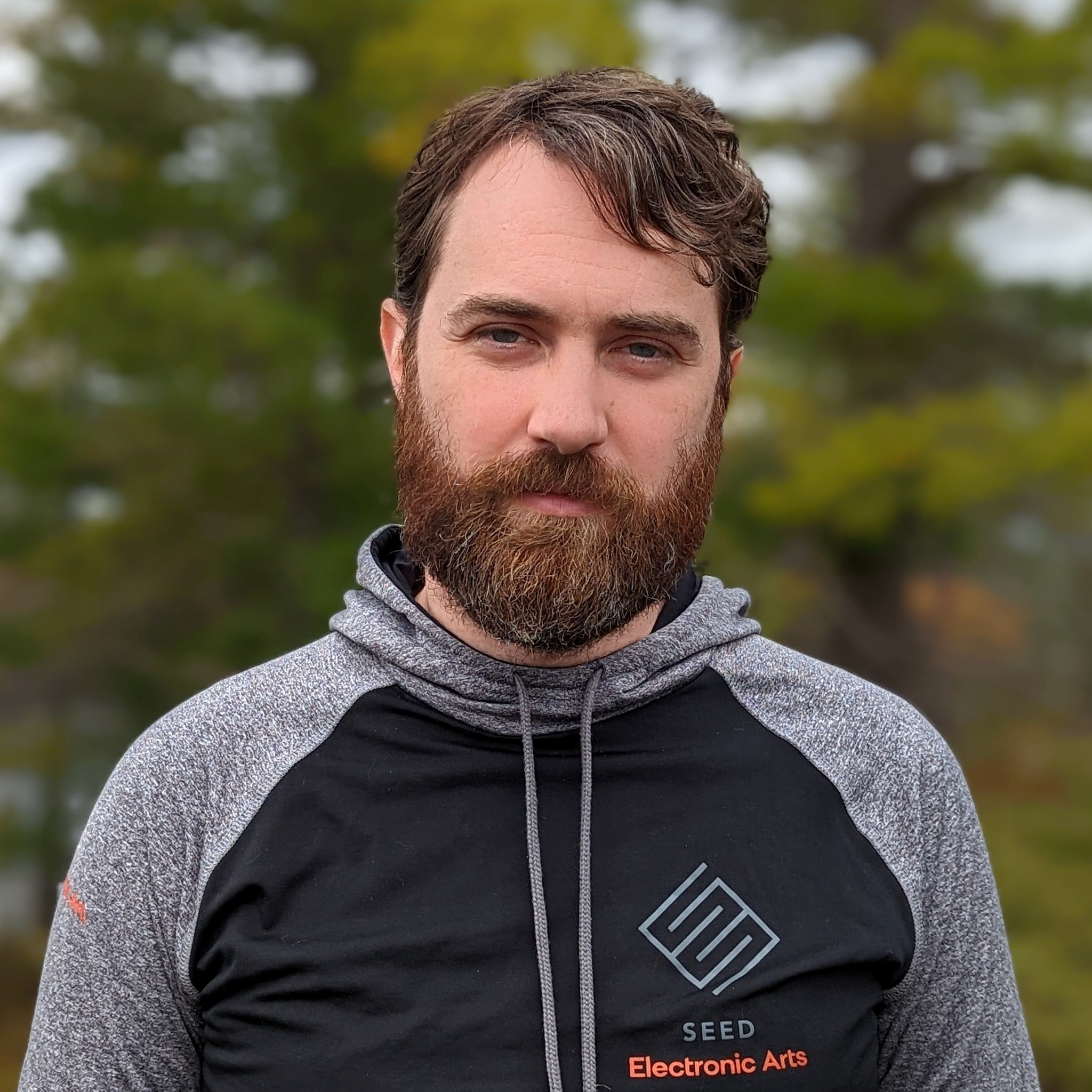 William Donnelly
He works in EA’s Search for Extraordinary Experiences Division (SEED), which houses roughly 60 researchers working on bringing digital characters to life, using machine learning for game AI and content creation, and developing novel real-time graphics & physics techniques. Donnelly is part of SEED’s Future Graphics team, which works on next-generation computer graphics and breakthrough physics simulation.
“Our goal is to push forward the state of the art in electronic entertainment,” he said.
His team’s recent projects include developing advanced techniques to denoise graphics and to animate cloth and fluids—and some of their tools have already been incorporated into EA’s titles and its game engine, Frostbite.
Although Donnelly noted that there are no direct applications from his theoretical physics research to his computer graphics work now, he doesn’t regret studying physics—far from it.
In his work at EA, Donnelly often uses the skills he developed in writing and presenting research. He also uses techniques from theoretical physics, such as heat kernel methods used to solve heat equations, in his work on generative artificial intelligence and computer graphics.
“You’re never sure how useful these things will be in the ‘real’ world,” he said. “But ultimately, they’re invaluable.”
On a fundamental level, Donnelly said that physics is at the core of creating video games. To create a realistic or believable virtual reality, game designers must have a deep understanding of the rules that govern the physical realm.
“To make cool gamelike simulations, you really have to understand how the world works,” he explained. “All of my experience at UMD translated extremely well to the work that I do now.”
From computer graphics to physics and back again
SEED isn’t Donnelly’s first stint working in computer science. He earned a bachelor’s degree in computer science and a master’s degree in applied mathematics from the University of Waterloo in Canada.
As an undergraduate student in the early 2000s, he interned at computer graphics companies—including NVIDIA—where he published his first scientific papers on graphics processing units. These were brand-new technologies at the time, so Donnelly invented and demonstrated new techniques to make the best use of them.
One of his early publications, titled “Variance shadow maps,” was a “big hit,” he said. The technique he proposed, which provides a solution for a problem called shadow map aliasing, rapidly spread through the gaming industry and appeared in published games.
But around this time, Donnelly began pondering deeply about the inner workings of the world. He took coursework in quantum mechanics, quantum information and general relativity, and he was captivated by problems at the forefront of quantum gravity.
He debated between pursuing a Ph.D. in computer graphics and a Ph.D. in physics and opted for the latter, enrolling at UMD, where his dissertation focused on quantum entanglement, black hole entropy and quantum gravity. After graduating, he spent nine years as a postdoctoral researcher at the University of Waterloo; the University of California, Santa Barbara; and the Perimeter Institute for Theoretical Physics in Waterloo.
Still, he left the door open to return to computer graphics. And although he found quantum physics “fascinating, deep, mysterious and worthwhile,” he never particularly enjoyed academia. So, he pivoted to industry and joined SEED in 2021.
‘Computer rendering is actually a physics problem’
Although there are no direct ties between Donnelly’s quantum research and his computer graphics work, his broader physics education helps in his current role.
“If you want to make a character jump, you have to know how a body moves under gravity. To simulate smoke, it’s important to understand not only the underlying physics of fluids, but also how light interacts with the material,” he explained. “There’s a lot of math and physics involved.”
In addition to mechanics, computer rendering, which involves translating a 3D geometry description to pixels on a screen, applies concepts in optics.
“Computer rendering is actually a physics problem,” he said. “You actually have to solve equations of light transport. You have to study how the light from the sun and other sources bounces around and makes it into your eye.”
One of Donnelly’s biggest achievements so far is improving how programs solve light transport equations to reduce noise in renderings. Effectively, the new technology hides noise generated during the graphics rendering process by pushing it into sensory spaces that humans can’t perceive. He and his collaborators published the technique in May 2024 in the Proceedings of the ACM on Computer Graphics and Interactive Techniques, and it has already been incorporated into EA’s Frostbite game engine.
That’s what Donnelly enjoys most about his career in industry compared with academic research in theoretical physics—how rapidly new findings get applied.
“I love that things go straight into the real world. You know it works because it instantly looks more real or better,” he said. “You immediately get feedback—60 frames per second worth of it.”
Written by Jason P. Dinh