


Toolkit for Success
- Details
- Created: Thursday, September 09 2021 11:07
- Last Updated: Friday, June 20 2025 14:39
- Written by Anne Suplee
- Hits: 18155
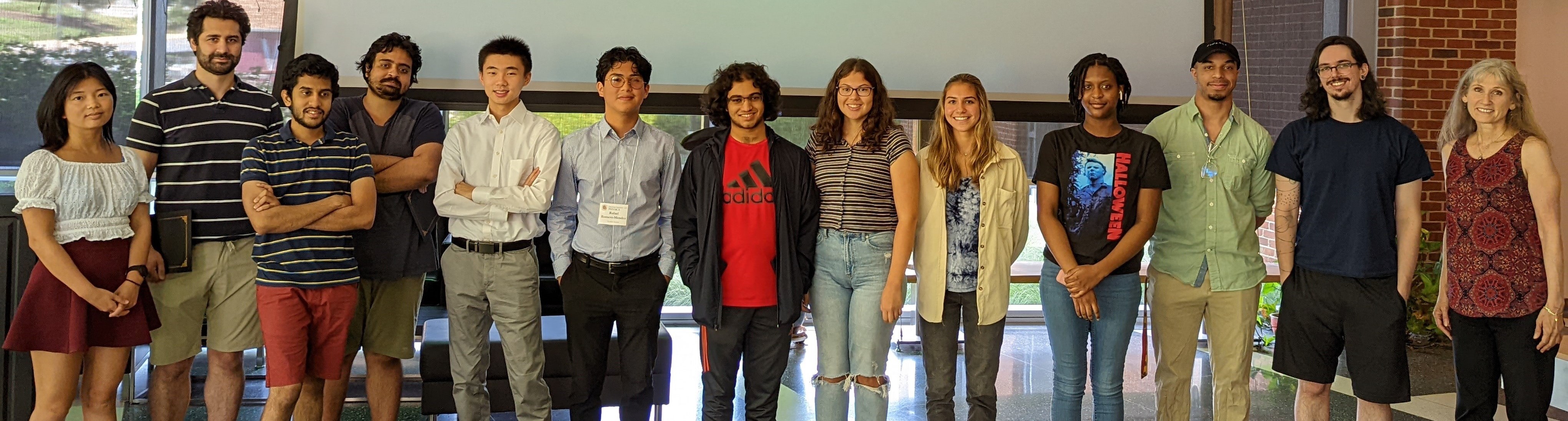
Toolkit for Success runs June 30th - July 25th, 2025
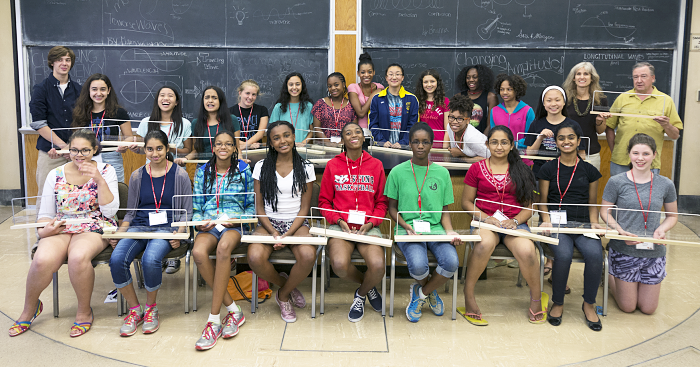
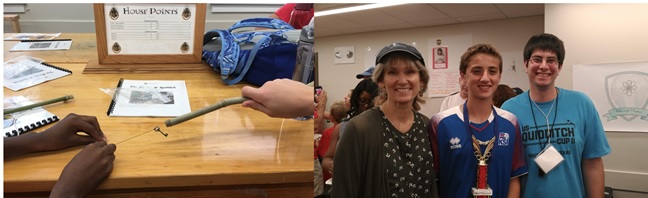
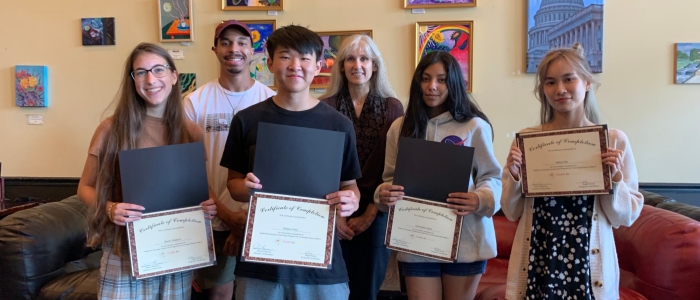
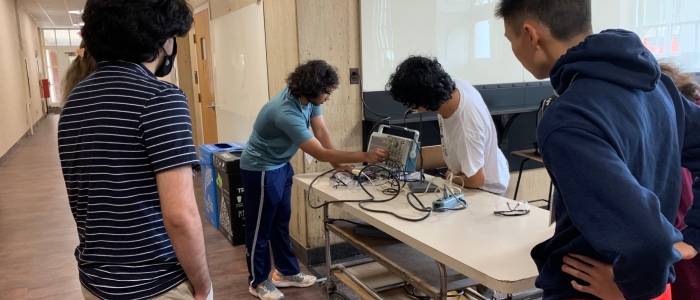
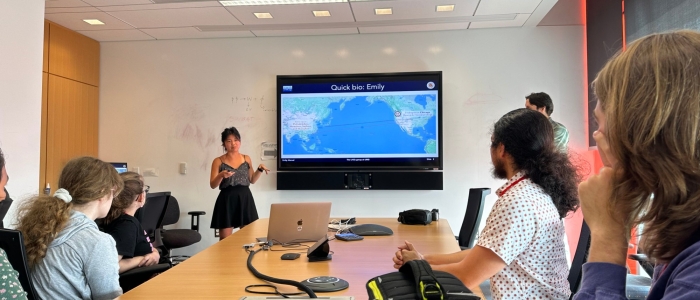
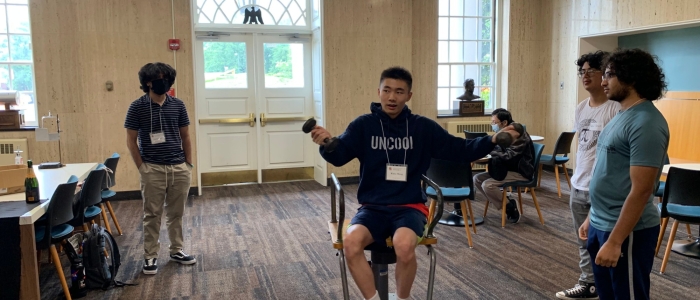
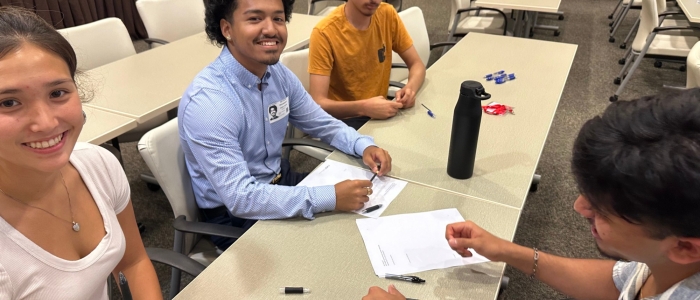
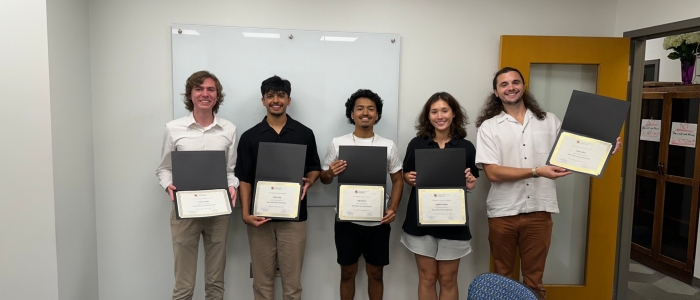
The Toolkit for Success Internship program was created by the UMD Department of Physics' Office of Student & Education Services in 2020. The Toolkit mission is to empower interns through exposure to physics research, physics & math lessons, technical & professional skill development, community building & belonging, and career exploration.
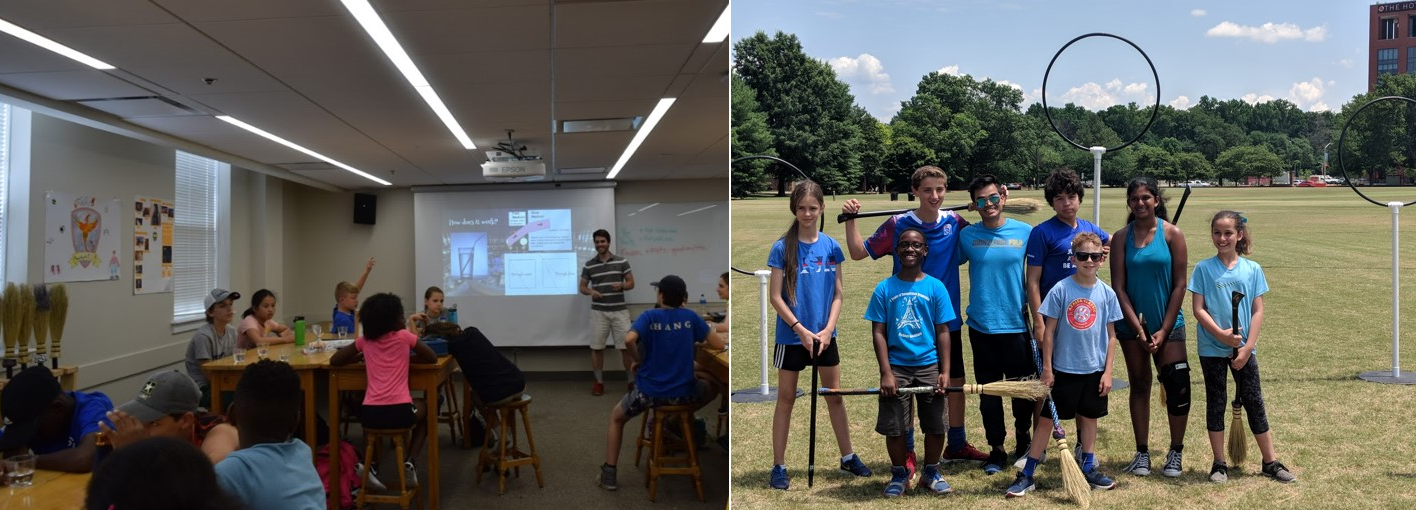
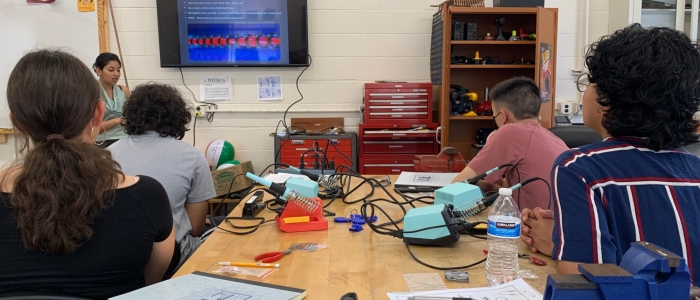
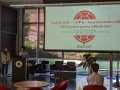
Activities for Toolkit interns include:
- Explore diverse research areas
- Engage in physics and math lessons
- Attain technical & professional skills
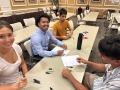
- Develop a peer network
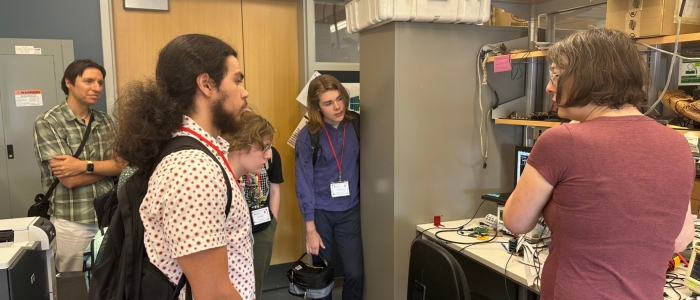
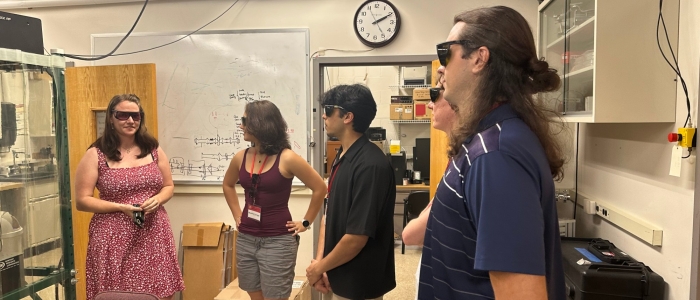
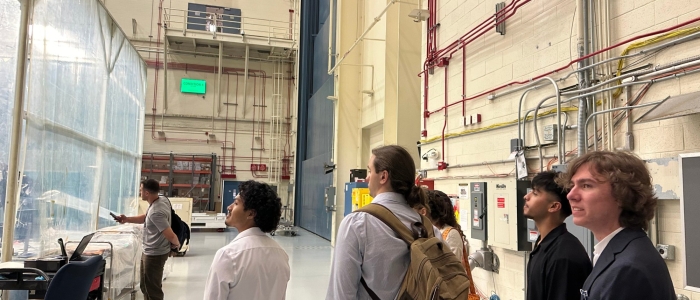
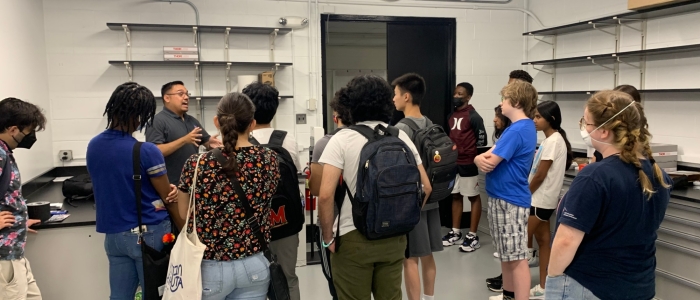
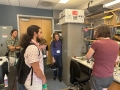
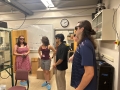
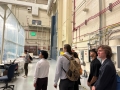
- Visit department and national research labs
- Meet professionals from industry, government, and academia
For questions about the program or admissions, email us at: This email address is being protected from spambots. You need JavaScript enabled to view it.
|
|
|
|
|
|
|
|
|
|
|
|
|
|
|
|
|
|
|
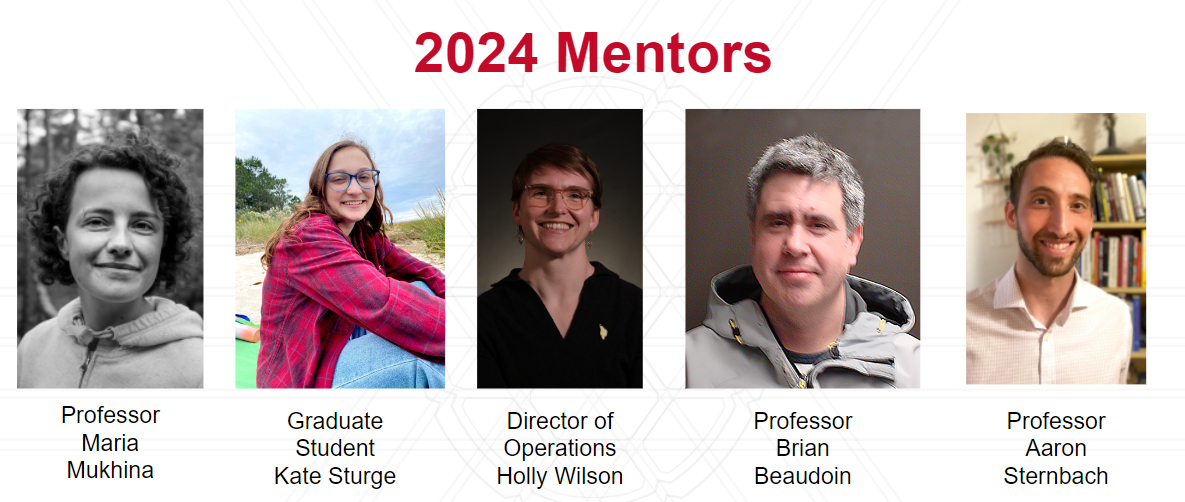
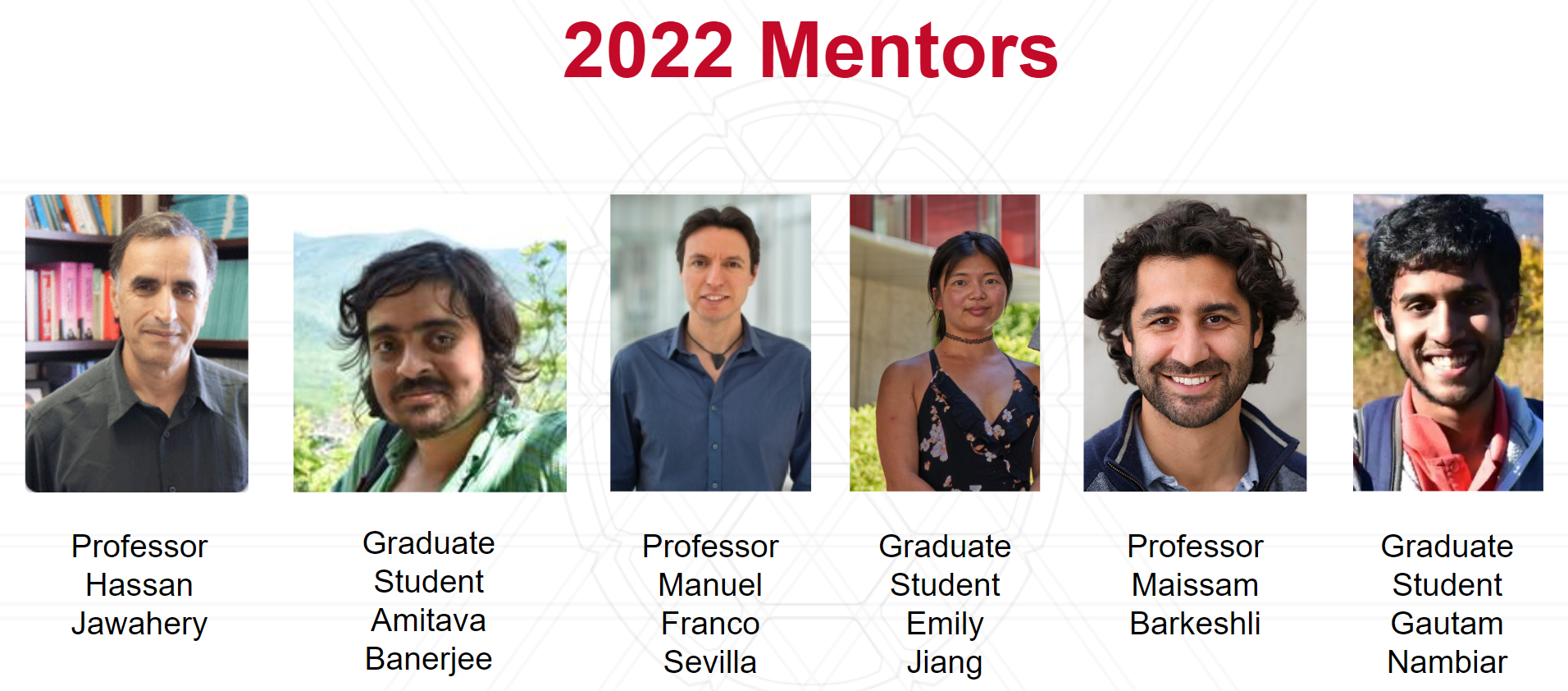
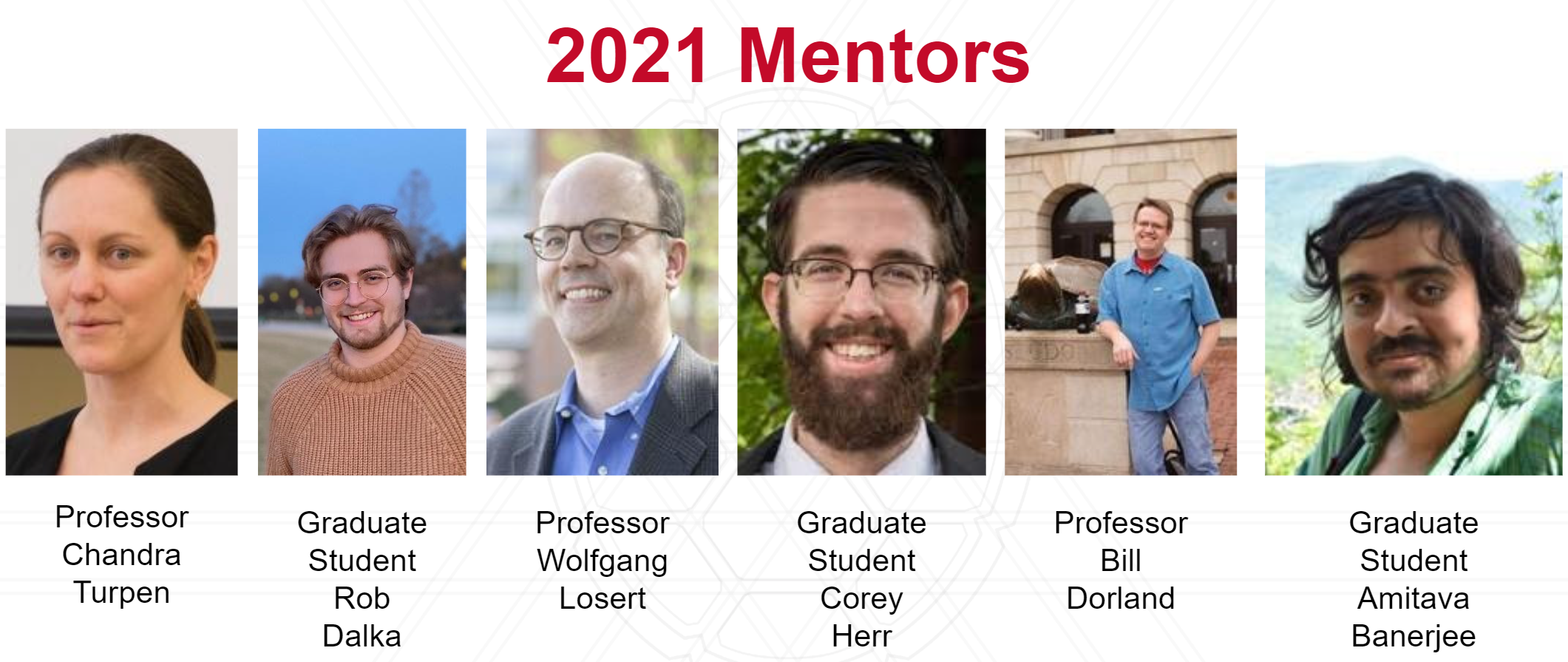
Previous Mentors include:
Previous Projects include:
2022 Research Projects
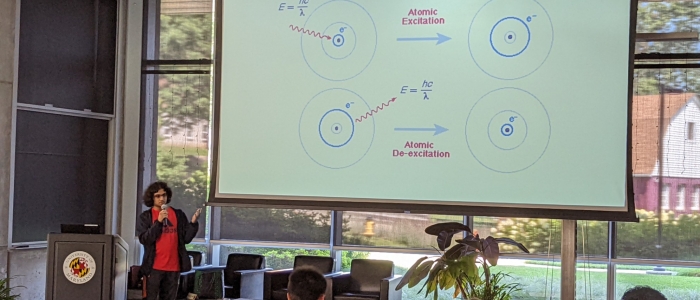
Quantum Mechanics of the Decay of Excitation
Mayank Gupta working with Graduate Student Gautam Nambiar
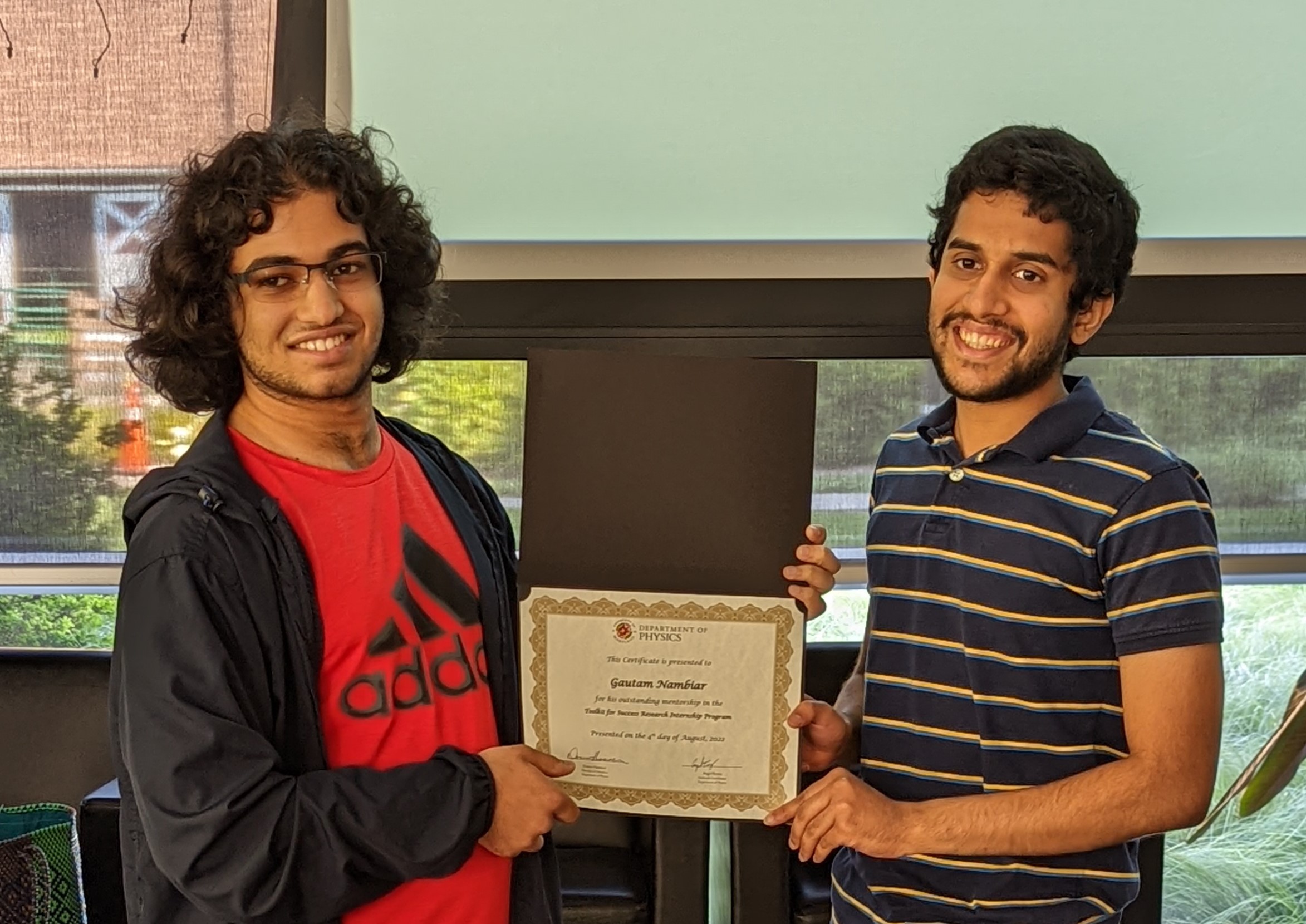
If you excite an atom to its first excited state, it will eventually decay to its ground state. For example, this is how sodium lamps work. Why does this happen? If the atom were isolated, it would just stay in its excited state and never decay. But in reality, the atom is coupled to what is called the "vacuum fluctuations of the rest of the universe" which is what ultimately causes it to decay. In this project, we will develop an understanding of this phenomenon by playing around with a much simpler toy model. To do this, we will start with the quantum mechanics of an atom coupled to one mode of the "environment". Then we will slowly increase the number of modes in the environment to mimic the real world better and better.
Topological States of Matter in Non-Interacting Electron Models
Shoshana Braier working with Professor Barkeshli
In this project, students will study topological properties of band structures in models of non-interacting electrons propagating in a crystal. The goal will be to first understand some basics of tight-binding Hamiltonians and how to calculate their band structures. Then the student will learn how to numerically compute certain topological invariants of bands, such as the Chern number. Eventually the goal will be to study in numerical simulations novel kinds of topological invariants that rely on the crystalline symmetry of the lattice and their consequences for properties of crystalline defects.
Network Science with Machine Learning
Waley Wang working with Graduate Student Amitava Banerjee
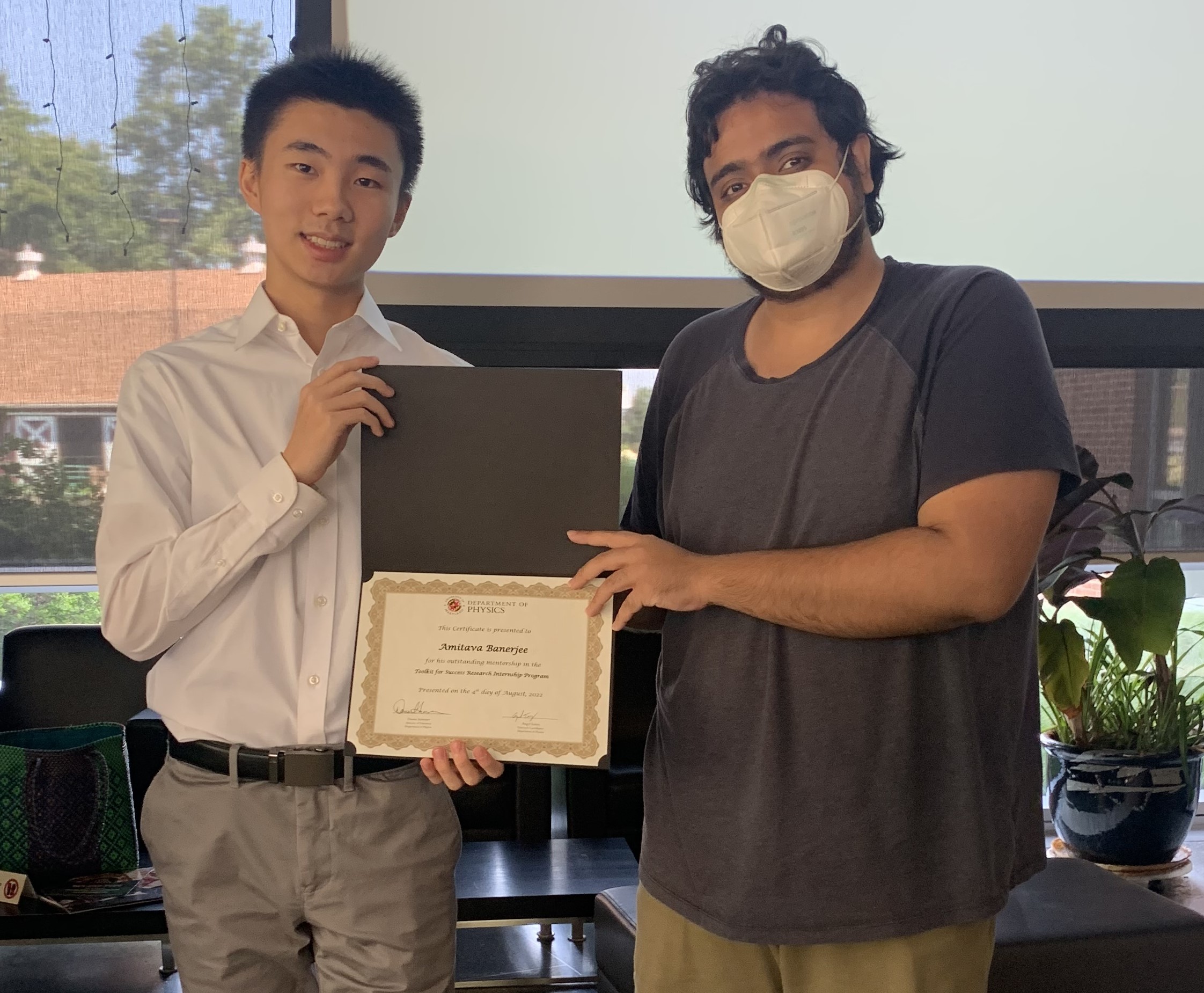
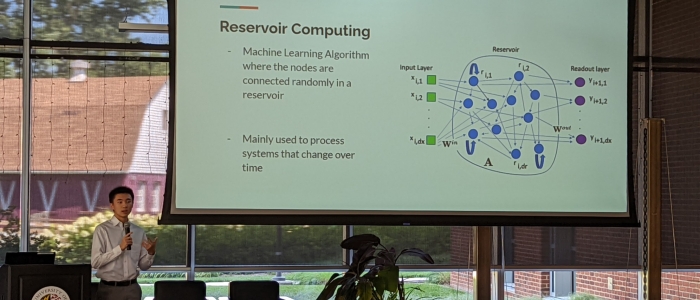
What can we learn about different networked systems around us by looking into their behavior over time? This question is a broad one that has diverse applications: mapping neuronal networks by looking into how neurons fire together, predicting weather better by understanding how temperatures and rainfall patterns at nearby cities affect each other, learning how do birds communicate while moving in a flock, and so on. A very general setting that encompasses all these scenarios is having time-series recordings from nodes of a network and reverse-engineering the network from those recordings. In this project, we will solve this problem with machine-learning-based tools that will be built with nonlinear dynamical systems.
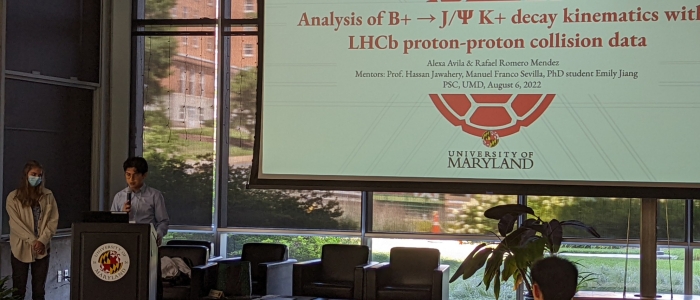
Analysis of B+ → J/Ψ K+ decay kinematics with LHCb proton-proton collision data
Rafael Romero Mendez working with Professor Jawahery, Professor Franco Sevilla, and Graduate Student Emily Jiang
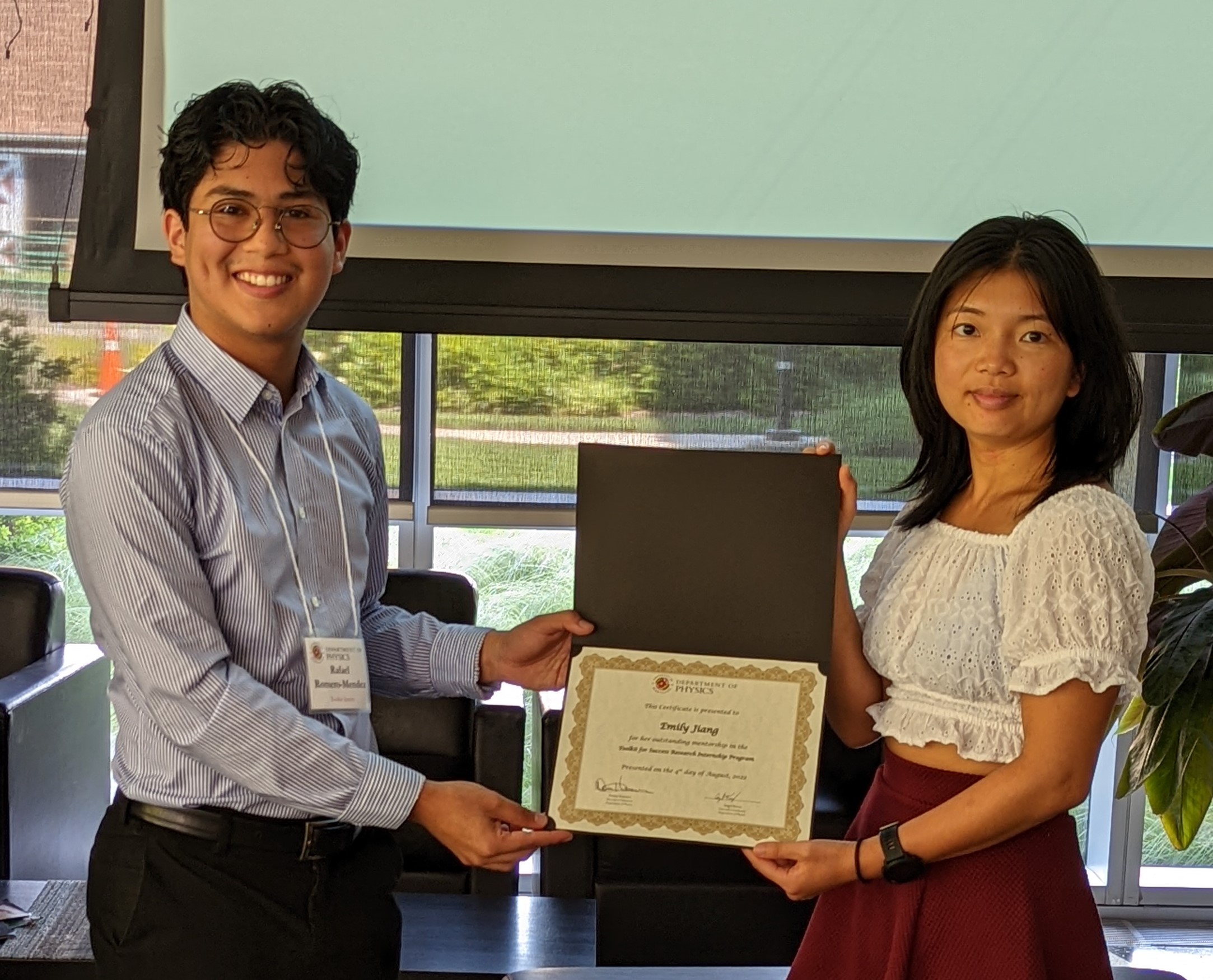
The LHCb experiment at the CERN laboratory in Switzerland has collected very large quantities of proton-proton collision data at center-of-mass energies between 7 and 13 TeV. LHCb focuses on flavor physics, the study of the transitions of the fundamental fermions (quarks and leptons) between their three generations. For these studies a key decay of B mesons is B+ → J/Ψ K+. This project will first reconstruct J/Ψ → μ+ μ- and B+ → J/Ψ K+ decays via fits to their corresponding invariant masses. Subsequently, the decay kinematics and the raw CP violation of the B+ meson decay will be studied in several background-subtracted kinematic variables.
2021 Research Projects
Analysis of Organizational Documents by Physics Departments and Their Correlation to the Preparation of Their Students
Shane Amare and Sarah Waldych working with Professor Turpen and Graduate Student Rob Dalka
Physics Education Research (PER) is a broad field of study that employs both quantitative and qualitative methods to build a better understanding of how the teaching and learning of physics happens. As a part of participating in this project, students engage in discussions about PER and learn about the various research questions it asks. This project focuses on providing students with experience in quantitative methods, primarily statistical analyses and possibly network analysis, either using the programming language R or Python. Students are first be guided through the basics of the programming language and practice on open source data. Then, they work with data that has been collected through a survey of Physics Department Chairs to develop findings about that data. This type of analysis and the programming skills will be widely applicable.
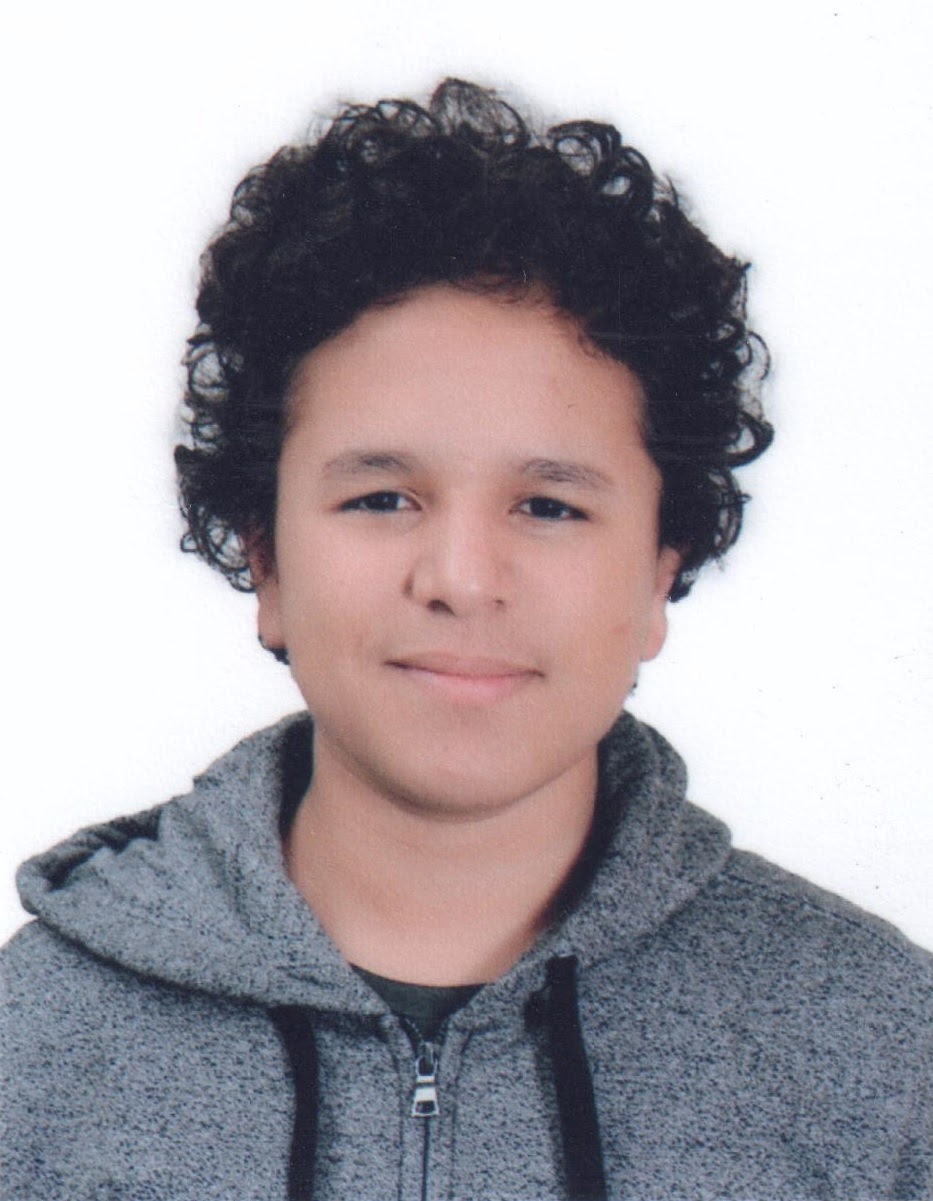
"It's hard for me to say what was more valuable: the research experience I gained, the practical skills I learned, or the amazing insight I received from listening to the top-notch guest speakers." - Shane Amare
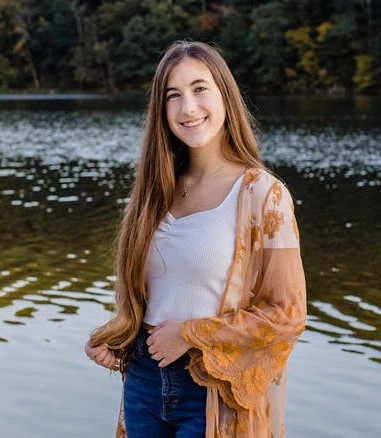
"Working with Dr. Chandra Turpen and Mr. Rob Dalka over the summer was an amazing experience as I was able to get my first exposure to working in Python handling large data sets. The Toolkit for Success community was so welcoming as both of my mentors were incredibly kind and patient." - Sarah Waldych
Simultating Stellarator Turbulence
Tannishtha Saha and Wenxi Wu working with Professor Dorland
In the project, a small team of students from around the country work together (virtually) to build a simulation program. The goal is to be able to evaluate proposed thermonuclear "stellarator" configurations (ie, fusion reactors, as recently called for by the National Academy of Sciences)) in the context of the turbulence that will be present in the superheated fuel. The turbulence causes the fuel to cool very rapidly and this project is focused on identifying reactor designs that minimize the effects of the turbulence.

"It was an honor working under the mentorship of Professor Bill Dorland. Through the course of this research project on simulating stellarator turbulence, I gained skills and experiences that I’m sure will prove fruitful in my college tenure." - Tannishtha Saha

"Toolkit for success is a great program that provides opportunities for hands-on research experience and mentorship with experts in the field. It widened my horizon on plasma physics research and fascinating programming skills." - Wenxi Wu
Analysis of a One-Dimensional Excitable Cell Network Model
Patrick Chen working with Professor Losert and Graduate Student Corey Herr
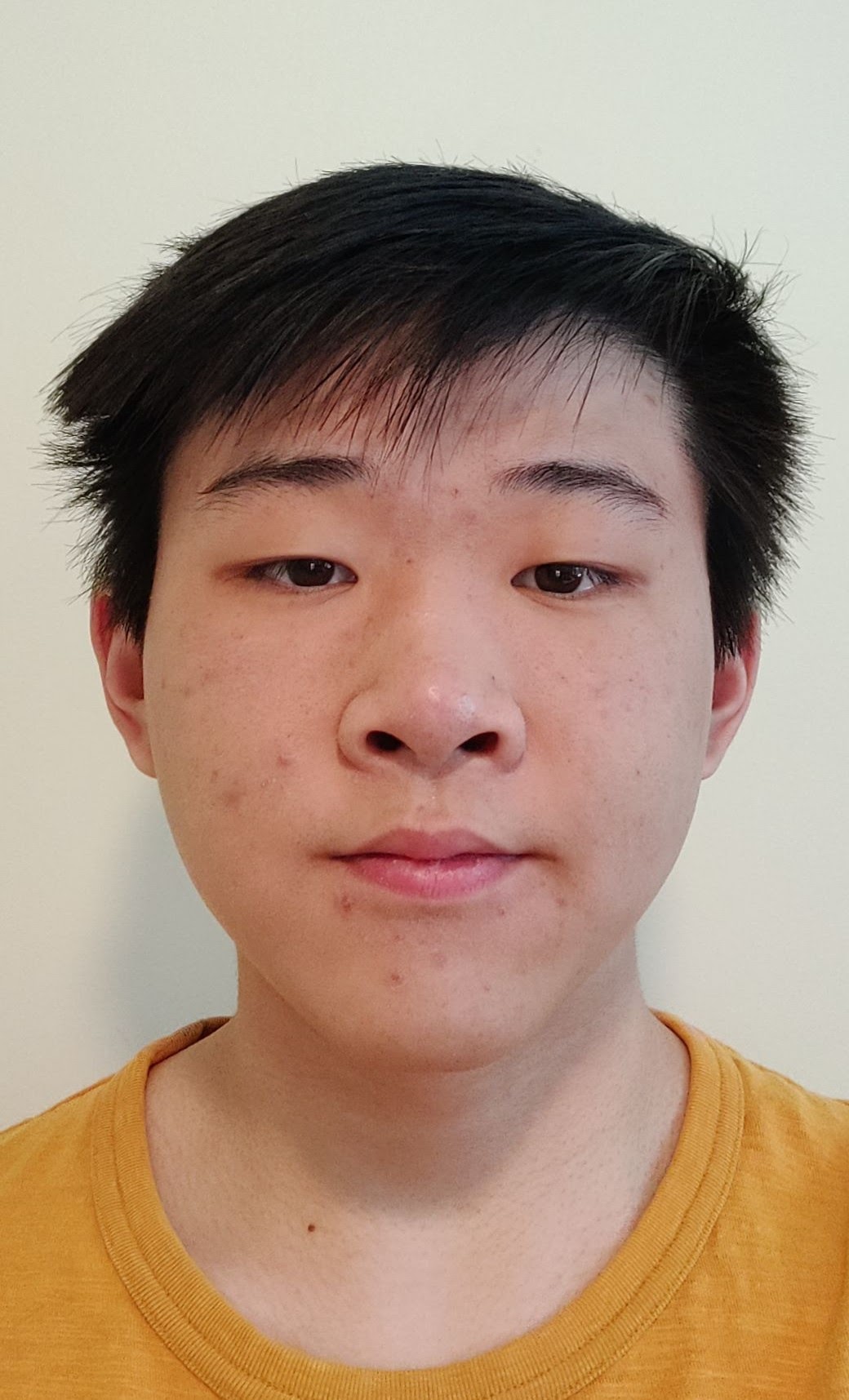
"Working on actual research with Corey Herr and Professor Wolfgang Losert has provided a valuable insight into what a future career may look like that classes can not match." - Patrick Chen
Analyzing Neural Networks and Predicting Futures of Dynamical Systems
Neil Shah working with Graduate Student Amitava Banerjee
For this project, students use artificial neural networks to map out unknown network structures and interaction patterns between different dynamical variables from their sampled time series data. This involves a very general technique covering a very broad set of interdisciplinary problems. Examples include: data for populations of different species in an ecosystem and finding out how they are dependent on one another, collections of fish swarms and starling murmurations and showing how interactions between individuals lead to these collective behaviors, and data of ocean currents and global temperature profiles, and mapping how global warming affects ocean circulation. Students use machine-learning-based computational techniques developed by our group to analyze experimental, simulated, and/or real-world, multi-variable, time-series datasets to discover network structures and interaction patterns in them.
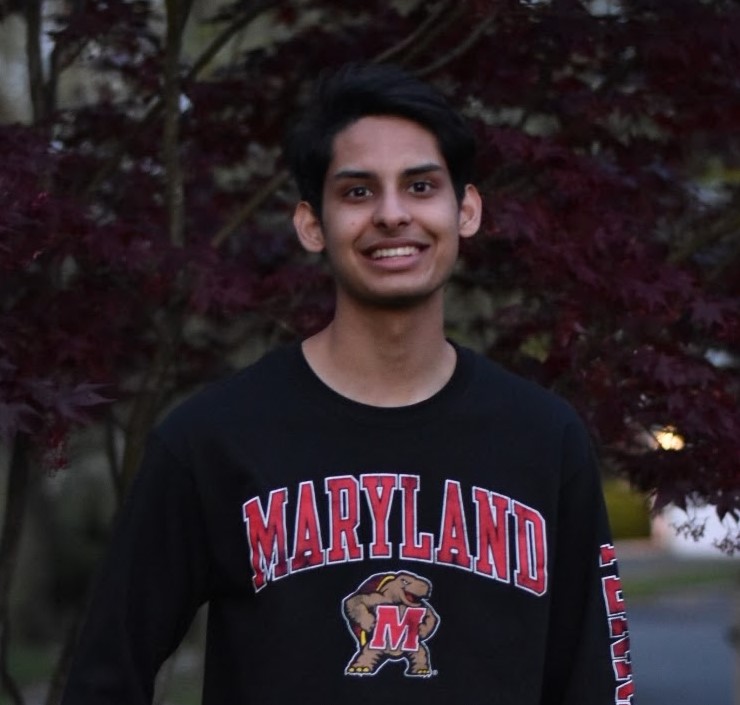
"I came into this research opportunity having little experience with research and using numerical methods to solve problems. However, through my research with my mentor, Amitava Banerjee, I was able to contribute to his research from my knowledge at the time and learn so much more about topics I was previously unfamiliar with. The whole experience was a great way for me to dive into a new area of physics and research." - Neil Shah