• Home
  • About Us
    • Physics Administration
    • Directions
    • Awards
    • Student Awards
    • Make a Donation
    • News
      • Research News
      • Department News
      • Newsletters
    • PTK Policy
  • People
    • All
    • Faculty
      • Current
      • Emeritus
      • Adjunct
      • Affiliate
      • Research Professors
    • Research Scientists
    • Postdocs
    • Staff
    • Lecturers
    • Visitors
    • Graduate Students
  • Research
    • Research Areas
      • AI and Physical Sciences
      • Astro Metrology
      • Atomic, Molecular & Optical
      • Biophysics
      • Chemical Physics
      • Condensed Matter Experiment
      • Condensed Matter Theory
      • Cosmic Ray Physics
      • Elementary Particles
      • Gravitation Experiment
      • Gravitational Theory
      • High Energy Physics
      • Nonlinear Dynamics, Chaos and Complex Systems
      • Nuclear Physics
      • Particle Astrophysics
      • Physics Education Research
      • Plasma Physics
      • Plasma Theory
      • Quantum Science and Technology
      • Quarks, Hadrons and Nuclei
      • Space Physics
    • Centers & Institutes
  • Academics
    • OSES Home (Student Services)
    • OSES News
    • Undergraduate Program
      • Prospective Students
      • Apply Now
      • Degree Requirements and Policies
      • Scholarships
      • Undergraduate Research
      • Advising
      • Undergraduate Forms
      • Undergraduate Events
      • Departmental Honors
      • Society of Physics Students
      • FAQ
      • Undergraduate Student Committee
    • Graduate Program
      • Prospective Students
      • Open House
      • Degree Requirements
      • Graduate Resources
      • Deadlines and Forms
      • PhD Defenses
        • PhD Defenses 2026
        • PhD Defenses 2025
        • PhD Defenses 2024
        • PhD Defenses 2023
        • PhD Defenses 2022
        • PhD Defenses 2021
        • PhD Defenses 2020
        • PhD Defenses 2019
        • PhD Defenses 2018
        • PhD Defenses 2017
        • PhD Defenses 2016
      • Events
      • Scholarships & Awards
      • Qualifier
      • Graduate Student Organizations
      • FAQ
    • Student Opportunities
      • GRAD-MAP
      • Graduate Student Organizations
      • Outreach Volunteering
      • Society of Physics Students
      • NSF S-STEM Program
      • Undergraduate Research
      • Women in Physics
      • Undergraduate Quantum Association
    • Courses
    • Academic Support
    • NSF S-STEM Program
    • Teaching Assistants
    • Where's my TA?
  • Events
    • Calendar
    • Physics Colloquia
    • W.J. Carr Lecture
    • Research Interaction Team (RIT) Math/Physics
    • Mechanick Quantum Biology Lecture
    • Irving and Renee Milchberg Endowed Lectureship
    • Charles W. Misner Endowed Lectureship in Gravitational Physics
    • John S. Toll Endowed Lecture
    • Prange Prize Lecture
    • Maryland Day
    • Outreach
      • Outreach Home
      • Physics is Phun
      • Discovery Days
    • Summer Programs
      • Physics Makers Camp
      • Physics of Quidditch
      • Science Discovery Camp
      • Advanced Physics Summer Program
      • Toolkit for Success
    • CUWiP
    • Vortex Makerspace
    • QURiSE Conference
  • Services
    • Building Access Requests
    • Computing Services
    • Conference Room Reservations
    • Department Operations Directory
    • Electronic and Mechanical Development
    • Hiring Procedures
    • Lecture Demo
    • Mental Health Resources
    • Parking
    • Physics Ombudspersons
    • Printing Services
      • Poster Print Request
    • Proposal Submissions
    • Purchase Order
    • Suggestion Box
    • Textbook Information
  • Give

Written on September 11, 2019. Posted in Department News.

Faculty Position in Theoretical Plasma Physics

The University of Maryland Department of Physics invites applications for a tenure-track faculty position at the level of Assistant Professor in theoretical plasma physics. A more senior level position may be considered for exceptional candidates. 

The Department has a broad research effort in plasma physics, including nonlinear dynamics, magnetic confinement fusion theory, plasma astrophysics, heliospheric plasma physics, and intense laser-plasma/laser particle-beam interactions. Our on-campus ties to astronomy, electrical engineering, applied mathematics, computer science, and quantum and applied physics complement our ties to NASA’s Goddard Space Flight Center and the U.S. Naval Research Laboratory, both located nearby. The successful candidate will be a leader from any area(s) of theoretical plasma physics. The preferred starting date for the position is August of 2020.

Minimum requirements: A Ph.D. in physics or a physics-related discipline.  Good teaching, particularly in settings with diverse groups, is a high priority of the Department, and a potential for teaching excellence is necessary. Candidates should have a demonstrated ability to conduct independent research, have good communication skills, and have the potential for leadership within the research community. The University of Maryland and Department of Physics are committed to increasing the diversity of the campus community. Candidates who have experience working with a diverse range of faculty, staff, and students, and who can contribute to the climate of inclusivity are encouraged to identify their experience in these areas.

Only applications submitted through the UMD online site will be considered: https://ejobs.umd.edu/postings/73354

Required are (1) a cover letter, (2) a CV, (3) a statement of research interests and plans, (4) a statement of teaching philosophy and (5) the names and email addresses of four reference writers. For best consideration, applications should be received by December 1, 2019.

The University of Maryland, College Park, an equal opportunity/affirmative action employer, complies with all applicable federal and state laws and regulations regarding nondiscrimination and affirmative action; all qualified applicants will receive consideration for employment. The University is committed to a policy of equal opportunity for all persons and does not discriminate on the basis of race, color, religion, sex, national origin, physical or mental disability, protected veteran status, age, gender identity or expression, sexual orientation, creed, marital status, political affiliation, personal appearance, or on the basis of rights secured by the First Amendment, in all aspects of employment, educational programs and activities, and admissions.

Written on August 23, 2019. Posted in Research News.

Ions Clear Another Hurdle Toward Scaled-up Quantum Computing

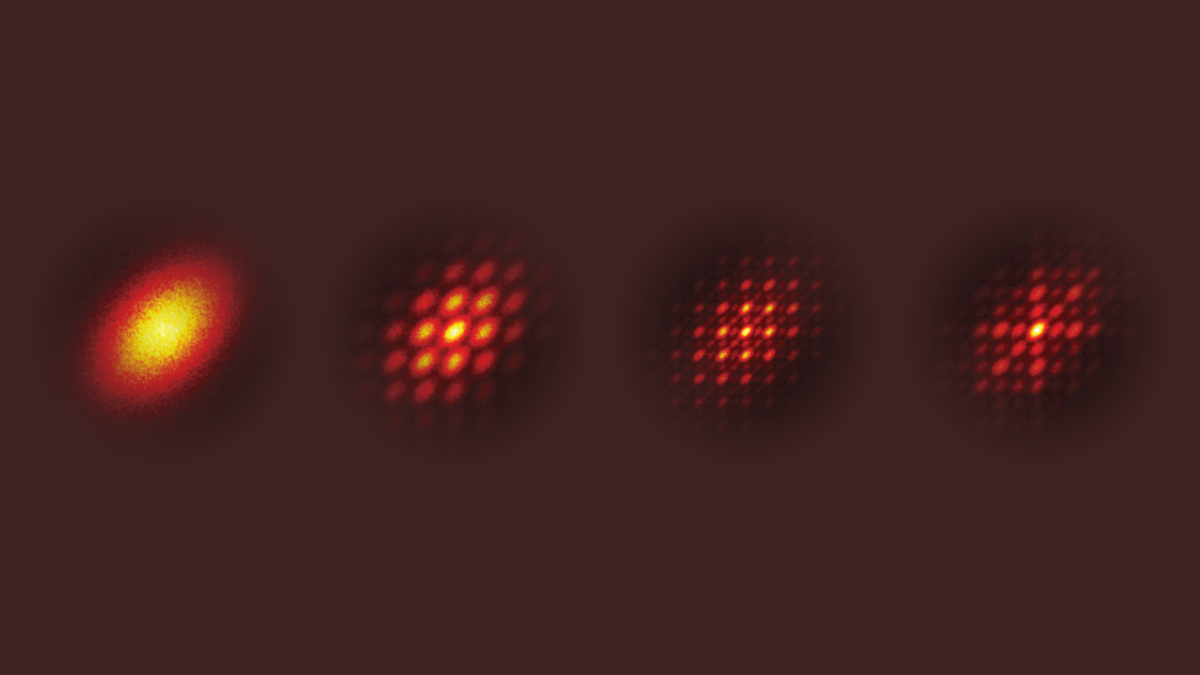
parallel gates

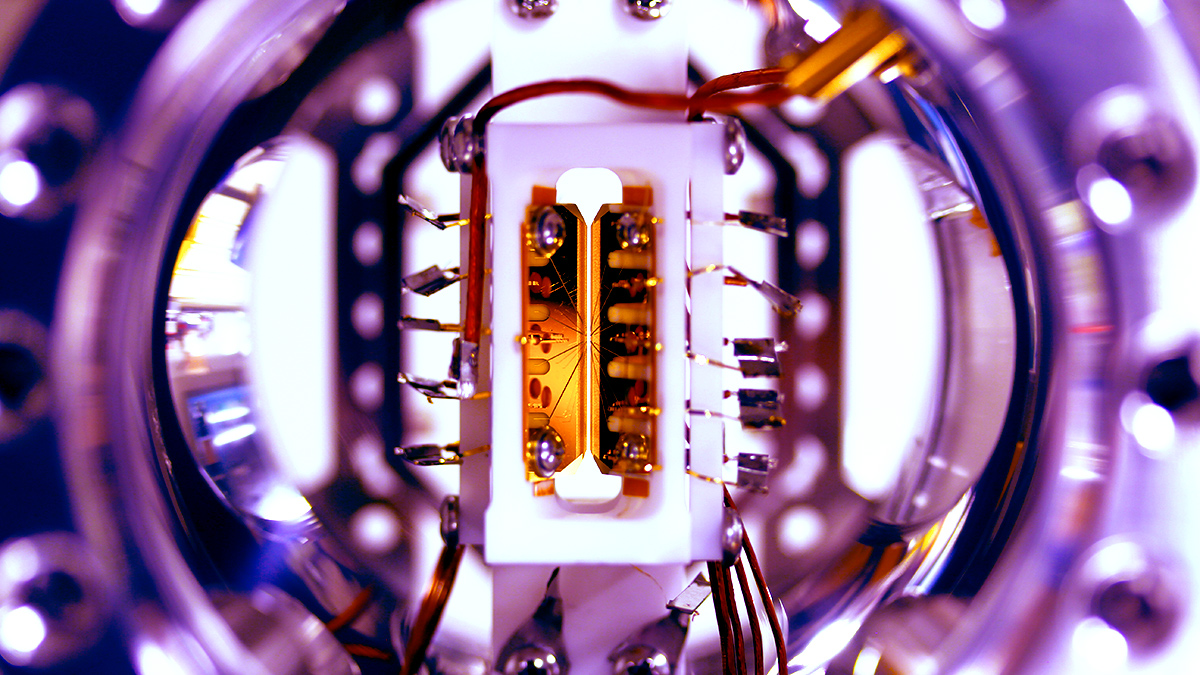
Scientists at the Joint Quantum Institute (JQI) have been steadily improving the performance of ion trap systems, a leading platform for future quantum computers. Now, a team of researchers led by JQI Fellows Norbert Linke and Christopher Monroe has performed a key experiment on five ion-based quantum bits, or qubits. They used laser pulses to simultaneously create quantum connections between different pairs of qubits—the first time these kinds of parallel operations have been executed in an ion trap. The new study, which is a critical step toward large-scale quantum computation, was published on July 24 in the journal Nature.  

“When it comes to the scaling requirements for a quantum computer, trapped ions check all of the boxes,” says Monroe, who is also the Bice-Sechi Zorn professor in the UMD Department of Physics and co-founder of the quantum computing startup IonQ. “Getting these parallel operations to work further illustrates that advancing ion trap quantum processors is not limited by the physics of qubits and is instead tied to engineering their controllers.” 

Ion traps are devices for capturing charged atoms and molecules, and they are commonly deployed for chemical analysis. In recent decades, physicists and engineers have combined ion traps with sophisticated laser systems to exert control over single atomic ions. Today, this type of hardware is one of the most promising for building a universal quantum computer.

The JQI ion trap used in this study is made from gold-coated electrodes, which carry the electric fields that confine ytterbium ions. The ions are caught in the middle of the trap where they form a line, each one separated from its neighbor by a few microns. This setup enables researchers to have fine control over individual ions and configure them as qubits.

Each ion has internal energy levels or quantum states that are naturally isolated from outside influences. This feature makes them ideal for storing and controlling quantum information, which is notoriously delicate. In this experiment, the research team uses two of these states, called “0” and “1”, as the qubit.

The researchers aim laser pulses at a string of qubits to execute programs on this small-scale quantum computer. The programs, also called circuits, are broken down into a set of single- and two-qubit gates. A single-qubit gate can, for instance, flip the state of an ion from 1 to 0. This is a straightforward task for a laser pulse. A two-qubit gate requires more sophisticated pulses because it involves tailoring the interactions between qubits. Certain two-qubit operations can create entanglement—a quantum connection necessary for quantum computation—between two qubits. 

Until now, circuits in ion trap quantum computers have been limited to a sequence of individual gates, one after another. With this new demonstration, researchers can now do two-qubit gates in parallel, creating entanglement between different pairs of ions simultaneously. The research team achieved this by optimizing the laser pulse sequences used to perform operations, making sure to cancel out unwanted laser-qubit interactions. In this way, they were able to successfully implement simultaneous entangling gates on two separate ion pairs.

According to the authors, parallel entangling gates will enable programs to correct errors during a quantum computation—a near-certain requirement in quantum computers with many more qubits. In addition, a quantum computer that factors large numbers or simulates quantum physics will likely need parallel entangling operations to achieve a speed advantage over conventional computers. 

Story by E. Edwards

In addition to Monroe and Linke, Caroline Figgatt, former JQI graduate student and scientist at Honeywell, was lead author on this research paper and provided background material for this news story. The research paper was published simultaneous to similar work done by former JQI postdoctoral researcher and Tsinghua University professor Kihwan Kim. 

REFERENCE PUBLICATION
"Parallel entangling operations on a universal ion-trap quantum computer," Caroline Figgatt, A Ostrander, Norbert M. Linke, Kevin A. Landsman, D Zhu, Dmitri Maslov, Christopher Monroe, Nature, , (2019)
RELATED JQI ARTICLES
  • Programmable ions set the stage for general-purpose quantum computers
  • Quantum simulators wield control over more than 50 qubits

Written on August 22, 2019. Posted in Department News.

University of Maryland Launches Quantum Technology Center

On August 22, 2019, the University of Maryland announced the launch of the Quantum Technology Center (QTC), which aims to translate quantum physics research into innovative technologies.

The center will capitalize on the university’s strong research programs and partnerships in quantum science and systems engineering, and pursue collaborations with industry and government labs to help take promising quantum advances from the lab to the marketplace. QTC will also train students in the development and application of quantum technologies to produce a workforce educated in quantum-related engineering.

The new center is a collaboration between UMD’s Department of Physics in the College of Computer, Mathematical, and Natural Sciences (CMNS) and UMD’s Department of Electrical and Computer Engineering in the A. James Clark School of Engineering.

"The Quantum Technology Center will add to the University of Maryland’s world-renowned leadership in the quantum fields, including physics, engineering, computer science, and materials research," said Laurie Locascio, vice president for research at UMD. "This new center will build on these strengths to develop future quantum technology and new applications, and to train students and researchers in quantum technology."

The announcement comes at a pivotal time when quantum science research is expanding beyond physics into materials science, engineering, computer science, chemistry and biology. Scientists across these disciplines are looking for ways to exploit quantum physics to build powerful computers, develop secure communication networks, and improve sensing and imaging capabilities. In the future, quantum technology could also impact fields such as artificial intelligence, energy and medicine.

Ronald Walsworth. Credit: Kris Snibbe/Harvard. Click image to download hi-res version.Ronald Walsworth. Credit: Kris Snibbe/Harvard. Click image to download hi-res version.

The director of QTC will be Ronald Walsworth, who recently joined UMD after serving on the faculty at Harvard University and as a senior physicist at the Smithsonian Astrophysical Observatory.

“We are thrilled that Dr. Ronald Walsworth has chosen the University of Maryland and our commitment to accelerating quantum research and discovery,” said Darryll J. Pines, dean of the A. James Clark School of Engineering and Farvardin Professor. “As a signature senior hire for Maryland and as the inaugural director of the Quantum Technology Center, Dr. Walsworth brings a critical expertise in quantum sensing, measurement, and instrumentation to College Park.”

Walsworth is an expert in utilizing quantum physics to develop advanced measurement tools for medicine, planetary science and fundamental physics. He holds several patents on a quantum sensing technology that uses an optically active defect in diamond to probe tiny changes in electromagnetic fields and temperature.

Walsworth’s lab spun off two startups that apply quantum sensing technology to biomedical diagnostics, and he has served as a scientific advisor for several technology companies including Quantum Diamond Technologies Inc., Butterfly Network, Quantum-Si and Hyperfine Research.

He is also a fellow of the American Physical Society and received its 2005 Francis M. Pipkin Award for his work in developing and applying precision measurement tools. Walsworth received his bachelor’s degree in physics from Duke University in 1984 and his Ph.D. in physics from Harvard University in 1991.

“I am excited to join the strong quantum community at the University of Maryland and work together to make QTC a world leader in quantum technology development, translation, and education,” said Walsworth, who joined UMD for Fall 2019 as the Minta Martin Professor in the Department of Electrical and Computer Engineering with a joint appointment in the Department of Physics.

QTC will initially draw members from the Departments of Electrical and Computer Engineering, Physics, and Computer Science. New faculty members have also been hired, including Electrical and Computer Engineering Assistant Professor Cheng Gong and Physics Assistant Professors Alicia Kollár and Norbert Linke.

“We are proud to work with our colleagues in engineering to jointly establish the Quantum Technology Center,” said Amitabh Varshney, dean of CMNS. “QTC will enable the rapid development of quantum technologies through high-impact research that spans sensors, secure communication, and advanced computation.”

QTC will have laboratory space in the Jeong H. Kim Engineering Building, the Physical Sciences Complex, and the Clark School’s new E.A. Fernandez IDEA (Innovate, Design and Engineer for America) Factory, which is dedicated to creative innovation and entrepreneurship by students and faculty and is expected to open in 2021. The center will be administered through UMD’s Institute for Research in Electronics and Applied Physics.

The new center will add to the university’s world-renowned leadership in the quantum fields, which includes being ranked No. 6 in quantum and atomic physics by U.S. News & World Report. UMD is also home to two quantum research partnerships with the National Institute of Standards and Technology—the Joint Quantum Institute and the Joint Center for Quantum Information and Computer Science—as well as a research collaboration with the Army Research Laboratory.

In addition, UMD quantum faculty members are also entrepreneurs. The quantum computing startup IonQ, which aims to bring general-purpose quantum computers to market, was co-founded by UMD Distinguished University Professor Christopher Monroe.

Media Relations Contact: Abby Robinson, 301-405-5845, 

University of Maryland
College of Computer, Mathematical, and Natural Sciences
2300 Symons Hall
College Park, MD 20742
www.cmns.umd.edu
@UMDscience  

Written on August 20, 2019. Posted in Research News.

Newfound Superconductor Material Could Be the ‘Silicon of Quantum Computers’

 We have already found lots of superconductors, but this whimsical illustration shows why one superconductor's newfound properties may make it especially useful. Most known superconductors are spin singlets, found on the island to the left. Uranium ditelluride, however, is a rare spin triplet, found on the island to the right, and also exists at the top of a mountain representing its unusually high resistance to magnetic fields. These properties may make it a good material for making qubits, which could maintain coherence in a quantum computer despite interference from the surrounding environment. Credit: N. Hanacek/NIST We have already found lots of superconductors, but this whimsical illustration shows why one superconductor's newfound properties may make it especially useful. Most known superconductors are spin singlets, found on the island to the left. Uranium ditelluride, however, is a rare spin triplet, found on the island to the right, and also exists at the top of a mountain representing its unusually high resistance to magnetic fields. These properties may make it a good material for making qubits, which could maintain coherence in a quantum computer despite interference from the surrounding environment. Credit: N. Hanacek/NIST

 A collaboration of the NIST Center for Neutron Research, the UMD's Center for Nanophysics and Advanced Materials and the Ames Laboratory has yielded a new superconductor with properties highly advantageous for the development of quantum computers. Uranium ditelluride, or UTe2, described in Science magazine, resists magnetism and could maintain coherence in qubits.  Read more at NIST.gov. 


More Articles …

  1. Corkscrew Photons May Leave Behind a Spontaneous Twist
  2. Davoudi, Manucharyan Receive DOE Early Career Research Funding
  3. Alicia Kollár Joins UMD Physics
  4. Mirrors on the Moon

Page 111 of 255

  • 106
  • 107
  • 108
  • 109
  • 110
  • 111
  • 112
  • 113
  • 114
  • 115
  • Physics Administration
  • Directions
  • Awards
  • Student Awards
  • Make a Donation
  • News
    • Research News
    • Department News
    • Newsletters
  • PTK Policy

College and Department Links

Department of Physics

Physical Sciences Complex
4296 Stadium Dr
College Park, MD 20742
Phone: 301.405.3401

Information

  • Campus Directory
  • Undergraduate Research
  • Scholarships
  • Prospective Undergraduates
  • Directions & Transit
  • Web Accessibility
© 2026 Department of Physics - University of Maryland
Back to Top
  • Home
  • About Us
    • Physics Administration
    • Directions
    • Awards
    • Student Awards
    • Make a Donation
    • News
      • Research News
      • Department News
      • Newsletters
    • PTK Policy
  • People
    • All
    • Faculty
      • Current
      • Emeritus
      • Adjunct
      • Affiliate
      • Research Professors
    • Research Scientists
    • Postdocs
    • Staff
    • Lecturers
    • Visitors
    • Graduate Students
  • Research
    • Research Areas
      • AI and Physical Sciences
      • Astro Metrology
      • Atomic, Molecular & Optical
      • Biophysics
      • Chemical Physics
      • Condensed Matter Experiment
      • Condensed Matter Theory
      • Cosmic Ray Physics
      • Elementary Particles
      • Gravitation Experiment
      • Gravitational Theory
      • High Energy Physics
      • Nonlinear Dynamics, Chaos and Complex Systems
      • Nuclear Physics
      • Particle Astrophysics
      • Physics Education Research
      • Plasma Physics
      • Plasma Theory
      • Quantum Science and Technology
      • Quarks, Hadrons and Nuclei
      • Space Physics
    • Centers & Institutes
  • Academics
    • OSES Home (Student Services)
    • OSES News
    • Undergraduate Program
      • Prospective Students
      • Apply Now
      • Degree Requirements and Policies
      • Scholarships
      • Undergraduate Research
      • Advising
      • Undergraduate Forms
      • Undergraduate Events
      • Departmental Honors
      • Society of Physics Students
      • FAQ
      • Undergraduate Student Committee
    • Graduate Program
      • Prospective Students
      • Open House
      • Degree Requirements
      • Graduate Resources
      • Deadlines and Forms
      • PhD Defenses
        • PhD Defenses 2026
        • PhD Defenses 2025
        • PhD Defenses 2024
        • PhD Defenses 2023
        • PhD Defenses 2022
        • PhD Defenses 2021
        • PhD Defenses 2020
        • PhD Defenses 2019
        • PhD Defenses 2018
        • PhD Defenses 2017
        • PhD Defenses 2016
      • Events
      • Scholarships & Awards
      • Qualifier
      • Graduate Student Organizations
      • FAQ
    • Student Opportunities
      • GRAD-MAP
      • Graduate Student Organizations
      • Outreach Volunteering
      • Society of Physics Students
      • NSF S-STEM Program
      • Undergraduate Research
      • Women in Physics
      • Undergraduate Quantum Association
    • Courses
    • Academic Support
    • NSF S-STEM Program
    • Teaching Assistants
    • Where's my TA?
  • Events
    • Calendar
    • Physics Colloquia
    • W.J. Carr Lecture
    • Research Interaction Team (RIT) Math/Physics
    • Mechanick Quantum Biology Lecture
    • Irving and Renee Milchberg Endowed Lectureship
    • Charles W. Misner Endowed Lectureship in Gravitational Physics
    • John S. Toll Endowed Lecture
    • Prange Prize Lecture
    • Maryland Day
    • Outreach
      • Outreach Home
      • Physics is Phun
      • Discovery Days
    • Summer Programs
      • Physics Makers Camp
      • Physics of Quidditch
      • Science Discovery Camp
      • Advanced Physics Summer Program
      • Toolkit for Success
    • CUWiP
    • Vortex Makerspace
    • QURiSE Conference
  • Services
    • Building Access Requests
    • Computing Services
    • Conference Room Reservations
    • Department Operations Directory
    • Electronic and Mechanical Development
    • Hiring Procedures
    • Lecture Demo
    • Mental Health Resources
    • Parking
    • Physics Ombudspersons
    • Printing Services
      • Poster Print Request
    • Proposal Submissions
    • Purchase Order
    • Suggestion Box
    • Textbook Information
  • Give