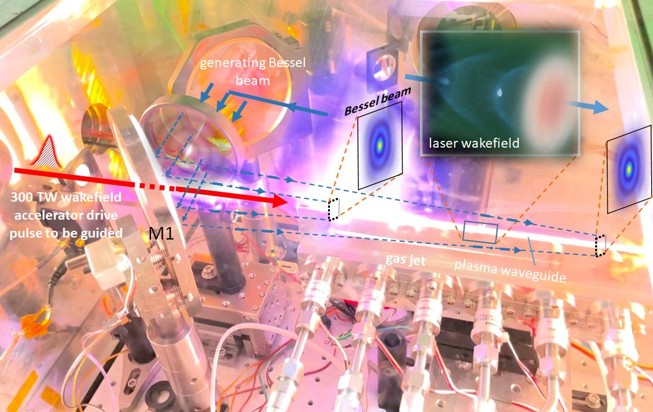
The world would look radically different without rulers and measuring tapes that fit into a pocket. Carpenters, fashion designers and engineers rely on these trusty tools to check the size of everything from a wooden board to a fabric swatch. But physicists who work with light lack that same convenience for one of the basic measurements of their craft. They routinely need to measure and compare the frequencies—colors—of the light waves they are using. To date, they have lacked a similarly pocket-sized tool for routine measurements, and they make do with cumbersome equipment that crowds their lab space and is far from portable. An artistic visualization of a novel process that forms an optical frequency comb, which researchers can use to perform a variety of precision measurements. During the formation process, two lasers circulate in a small resonator and spread out, forming the blue and red curves, while also interacting to produce the purple curve. All three curves merge into a comb that provides a pristine ruler for measuring light, represented by the purple lines at the top of the image. (Credit: Carl De Torres at the Optics Lab)
The standard tool for measuring the frequency of light is called an optical frequency comb. This device produces a rainbow of different frequencies of light, all spaced at regular intervals like the tick marks on a measuring tape. Frequency combs let researchers measure the difference between distinct frequencies and are crucial for many experiments and measurements that use light. Large lab setups have proven the usefulness of frequency combs by enabling the creation of the most precise clocks in the world—atomic clocks—as well as many other applications. Researchers have been seeking smaller optical frequency combs both to make their lives easier and to provide the basis for new light-based technologies. For instance, portable atomic clocks could help map underground variations in mineral deposits and enable navigation systems that don’t rely on GPS satellite signals.
JQI researchers have worked with an international collaboration to develop and demonstrate a new type of frequency comb. The new design eliminates the need for bulky equipment while also making it simple to adapt a single device to a variety of practical measurement tasks. The researchers described the advances behind their frequency comb and its performance on common tasks in an article published Sept. 30, 2026, in the journal Nature. To demonstrate the adaptability of their compact device, they used it with a variety of light sources to test its capability at tasks that are the bread and butter of optical frequency combs.
The result builds on a decade of research that JQI research scientist Grégory Moille and JQI Fellow and Co-Director Kartik Srinivasan have put into miniature optical frequency combs that fit on a portable chip. Their new approach grew out of a partnership with a team led by Miro Erkintalo, who is a researcher at the University of Auckland (UoA) in New Zealand and the Dodd-Walls Centre for Photonic and Quantum Technologies, to explore a new way to make optical frequency combs. Using the new approach, the team, including additional colleagues at the University of Maryland at Baltimore County (UMBC), the University of California at Santa Barbara (UCSB), AV Incorporated and the Air Force Research Laboratory (AFRL), has made an optical frequency comb that performs as well as the older behemoth tabletop versions but takes up a fraction of the lab space.
“Though we have been working on chip-integrated optical frequency combs for many years, their control and stabilization—essential for many applications—has often been complicated and difficult,” says Moille, the first author on the paper who is also an associate of the National Institute of Standards and Technology (NIST). “With this new approach, we finally see a viable path for their use in deployable atomic timekeeping, which is one of their most demanding and important applications.”
Two Lasers Are Better Than One
The new optical frequency comb relies on a phenomenon called parametrically driven cavity solitons (PDCSs), first predicted in 2023 by a team led by Erkintalo. PDCSs involve circulating light from two lasers around a tiny ring, called a microresonator. If the ring is the right shape and researchers inject light into it in just the right way, then the circling light interacts with itself via the material comprising the ring and generates a string of pulses that researchers can use as a frequency comb. PDCS-based combs themselves build on nearly two decades of research into frequency combs using a single laser injected into a microresonator on a chip, but prior attempts haven’t succeeded at freeing chip-based techniques from bulky equipment and getting it reliably deployed outside labs.
The collaboration began after Moille and Srinivasan, who is also a NIST Fellow, learned about Erkintalo and his colleagues’ prediction, and the two groups teamed up to make it a reality. They reported on their experiments producing PDCSs in 2024 and showed that they had unlocked a way to measure a range of frequencies that were previously inaccessible.
That first PDCS demonstration proved the concept and explored the underlying physics but left much of the research into how it performed at practical tasks for future experiments. In particular, the frequency comb produced multiple overlapping sets of frequency lines. The overlap made the comb almost impossible to use, like a ruler misprinted with multiple sets of tick marks.
In the new paper, the researchers combined the PDCS approach with a synchronization technique that Srinivasan, Moille and their colleagues previously demonstrated can stabilize optical frequency combs. The combination of techniques locked all the frequency lines into alignment—a process called self alignment—and provided a pristine ruler with just a single set of tick marks for measuring frequencies.
Moille and Srinivasan nicknamed this particular way of driving light in a resonator a SParCS (self-aligned parametrically-driven cavity soliton). The new SParCS-based combs have unique advantages derived from the way they distribute the power carried by light at different frequencies throughout the comb. Past approaches used a single laser to create a comb that spread out on either side of the laser’s frequency. Those additional frequencies—the comb teeth—have less power the further they are from the central frequency, and they become less sharply defined towards the edges.
In contrast, researchers can select two lasers at distinct frequencies to create a comb for a particular task, and the two lasers used in the PDCS technique serve as bookends for the comb with the additional teeth forming in the space between. This produces more precise teeth throughout the comb and concentrates the power toward the edges, which are often the critical comb teeth for many practical measurements.
In particular, measuring the exact value of a frequency isn’t possible if you don’t know how far the comb is from zero frequency—a value called the zero-frequency offset. Physicists must find the offset for each comb, since small idiosyncrasies in the fabrication of every resonator makes each comb a little different.
The edge teeth are generally essential for determining the zero-frequency offset for a given comb. There is a standard method for finding it, which earned its creators the 2005 Nobel Prize in physics, but combs must meet a crucial requirement for it to work: One of the teeth must be at approximately twice the frequency of a lower-frequency tooth. Physicists use the same language as musicians and call such a span of frequencies an octave. In practice, teeth at the edge of an octave are going to be at or near the comb’s edge, and if they are too weak or unstable, researchers need additional bulky equipment to find the offset.
The team’s ability to select their two laser frequencies, and thus the edge teeth, let them ensure that the comb spans an octave and that the critical edge teeth are easy to work with—making the process of setting up experiments considerably easier and quicker.
Even though the new approach uses twice as many lasers to create a comb, it still makes the overall setup smaller than prior attempts. Other approaches generally have to add a second laser anyway, along with a host of other equipment, to amplify the edge teeth to be strong enough to use in experiments. The new approach eliminates the need for complex, lab-scale equipment and provides a clear path toward devices that are easy to deploy outside a lab.
Running the Comb Through Its Paces
After producing a pristine comb, the team turned toward demonstrating the convenience and versatility of their approach by performing a variety of common measurement tasks. Frequency combs enable diverse measurement techniques by allowing researchers to link two frequencies, to detect subtle fluctuations of frequencies, and to produce light at a very stable frequency.
In particular, the team wanted to show that SParCS-based combs can act as a perfect frequency gearbox that serves as a link between two frequencies to keep them locked together, similar to how gears coordinate rotations even when they are at different speeds. Essentially, the comb can not only help researchers measure the difference between two frequencies but can also serve as a bridge that locks the spacing in place. Researchers can lock a laser to a particular tooth, establishing a fixed relationship between their laser and the other teeth in the comb. This lets teeth at other frequencies reflect the stability, or conversely the fluctuations, in that laser. If you lock the comb to a very stable laser, it provides stability to teeth at other frequencies, or if your attached laser fluctuates, you can detect that at another frequency that is easier to measure.
The group partnered the comb with various frequencies of light from different sources to demonstrate that a simple swap of lasers could allow the single device to perform tasks that are useful for performing different types of measurements. The tasks drew on the unique hardware and expertise provided by the members of the collaboration.
First, they used the comb to link microwaves, which oscillate at billions of cycles per second, to optical light waves, which oscillate at hundreds of trillions of cycles per second. This sort of portable comb could improve frequency measurements in many devices that measure light frequencies or use light to measure distances, including the lidar used in self-driving cars. The microwaves partnered with the comb let them better pin down the frequency of the teeth, which can allow the comb to make precise frequency measurements or produce stable optical frequency sources.
They then turned their attention to performing the opposite process—linking optical light to microwaves—using the same device. When the comb works in this direction, it has the extra advantage that it naturally decreases the amount of random fluctuations—noise—in the microwaves.
They demonstrated links in this direction through two tasks that frequency combs are used for in different measurements—monitoring light in atomic clocks and the production of microwaves with little noise.
In an atomic clock, the waves in laser light serve as rapid ticks marking time. The laser is made incredibly stable by keeping it tied to the behavior of atoms, but the waves that interact with the atoms oscillate so fast that no electronics can track their fluctuations. A comb is used to transfer the stability of the optical light to a microwave signal that carries the same long-term stability. Those microwaves can then be used by the clock’s electronic systems to track time.
Moille used a device called a “stable atomic clock reference” that was supplied by his colleagues at AFRL, to show how the comb performed at this essential role in an atomic clock. The experiment demonstrated that using the optical light with their comb produced stable microwaves, which are needed to run an atomic clock. They showed that they could use these microwaves to measure the original light frequency, which was oscillating several hundred trillion times per second, to within about a hundred thousand oscillations per second of the value the atoms should produce.
Producing microwaves without much noise is also useful for other measurements outside of atomic clocks. For instance, lowering the noise of microwaves can improve measurements of distance by radar systems. So Moille also swapped in a laser, called a “low-noise laser reference,” that was produced using a specialized chip supplied by their colleagues at UCSB. The experiment demonstrated that using light from a low-noise laser with their comb produced ultra-pure microwave frequencies.
To judge the results, the group also attached all three sources—the two optical sources supplied by colleagues and the microwave source—to their standard tabletop comb system for comparison. They found, to the levels they could check in the experiment, that their small chip produced the same frequencies and generally lived up to its large predecessor in terms of its stability and noise.
“With SParCS, we have a substantially different comb generation process than has been shown previously, and it was important to verify that regardless of how the comb is generated, it can perform its essential functions well,” Srinivasan says. “We're always basically saying, how well are we doing relative to the existing technology? We were very happy to find that our SParCS comb is indeed working well.”
The SParCS approach did more than live up to its massive forebears; it also made it easy for the team to adapt the frequency comb to different applications. Moille used the same device in all the demonstrations. This contrasts with previous on-chip demonstrations, which required a specially tailored microcomb for a given application.
Moille says that performing one of these tasks with a small frequency comb would previously require a team of several people working for weeks or months to get practical results. By comparison, the new experiments were much easier, with him easily swapping in the different light sources supplied by his collaborators.
“As experimentalists, this new optical frequency comb has simplified much of our work,” Moille says. “The system made it so easy that you actually have only one operator at a time doing each application.”
The adaptability of the comb also allows the team to compensate for variations, decreasing the demand for accuracy when fabricating combs. This flexibility could make the combs more practical for mass production and integration into products. The convenience also lets the team spend more time performing experiments instead of needing to sift out functional devices from several fabrication attempts and then spend additional time fine-tuning the working ones to get experimental results.
The group demonstrated this robustness by performing measurements using devices made with several different layouts and showed that they could still produce useful results with simple adjustments to their experiments. Moving forward, the team wants to further refine the devices and explore their properties to see how far they can push their performance, such as by making combs that cover larger frequency ranges. Eventually, they hope they may even be able to make the approach work with a single laser feeding into both sides of the comb. Meanwhile, they are using the combs as tools in other experiments.
“Our lab, as of 18 months ago, was 90% dedicated to the typical approach of pumping in the center and then extending out to the edges,” Srinivasan says. “We've now switched all these experiments to focus on the new SParCS approach. Within the last year, we’ve been able to stabilize more than ten times the number of microcombs than we had across all the preceding years combined, and that’s why we feel so strongly that this approach has a lot of potential going forward.”
Original story by Bailey Bedford: New Chip-Based Frequency Combs Demonstrate Potential for Portable Atomic Clocks | Joint Quantum Institute
In addition to Moille, Erkintalo, and Srinivasan, co-authors of the paper include UMBC graduate student Pradyoth Shandilya; UMBC professor Curtis Menyuk; NIST research scientist Jordan Stone; JQI graduate student Shao-Chien Ou; UoA professor Zongda , UCSB graduate students Mark Harrintong and Kaikai Liu; UCSB professor Daniel Blumenthal; River Beard from AFRL and AV Incorporated; and AFRL research physicists Robert Rockmore and Sean Krzyzewski.