- Details
-
Category: Research News
-
Published: Wednesday, September 03 2025 01:40
Questioning assumptions and imagining new explanations for familiar phenomena are often necessary steps on the way to scientific progress.
For example, humanity’s understanding of gravity has been overturned multiple times. For ages, people assumed heavier objects always fall quicker than lighter objects. Eventually, Galileo overturned that knowledge, and Newton went on to lay down the laws of motion and gravity. Einstein in turn questioned Newton’s version of gravity and produced the theory of general relativity, also known as Einstein's theory of gravity. Einstein imagined a new explanation of gravity connected to the curvature of space and time and revealed that Newton’s description of gravity was just a good approximation for human circumstances.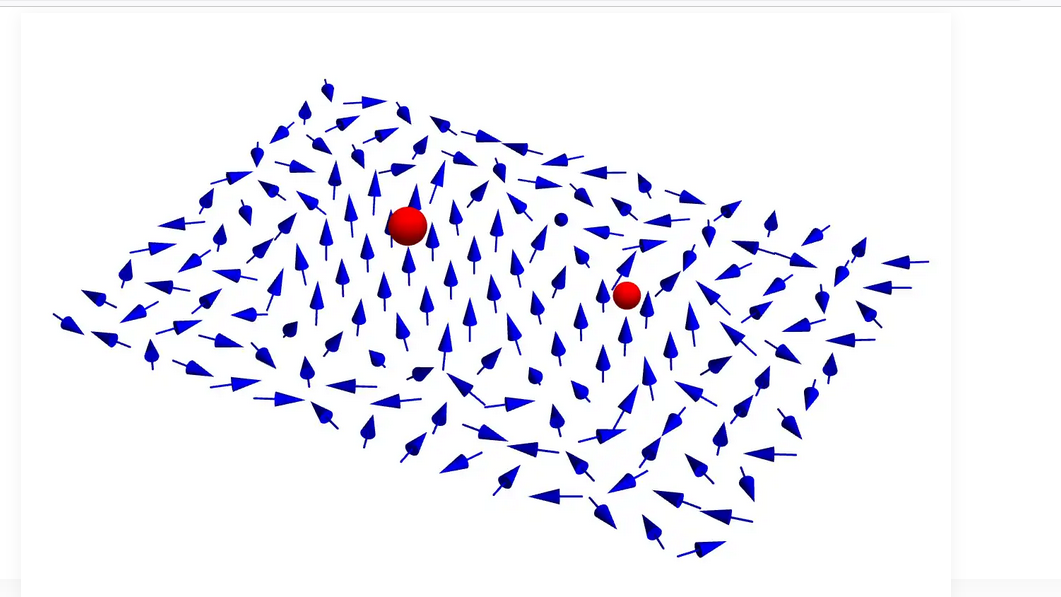 Researchers have proposed new models of how gravity could result from many quantum particles interacting with massive objects. In the image, the orientation of quantum particles with spin (the blue arrows) are influenced by the presence of the masses (represented by red balls). Each mass causes the spins near it to orient in the same direction with a strength that depends on how massive it is (represented by the difference in size between the red balls). The coordination of the spins favor objects being close together, which pulls the masses toward each other. (Credit: J. Taylor)
Einstein’s theory of gravity has been confirmed with many experiments, but scientists studying gravity at the tiniest scales have uncovered lingering mysteries around the ubiquitous force. For miniscule things like atoms or electrons, the rules of quantum physics take over and interactions are defined by discrete values and particles. However, physicists haven’t developed an elegant way to definitively combine their understanding of gravity with the reality of quantum physics experiments. This lack of a quantum explanation makes gravity stand out as an enigma among the four fundamental forces—the forces of gravity, the electromagnetic force, the strong nuclear force and the weak nuclear force. Every other force, like friction, pressure or tension, is really just one or more of those four forces in disguise.
To unravel gravity’s lingering idiosyncrasies, researchers are designing new experiments and working to identify the foundations of gravity at the quantum scale. For decades, scientists have been proposing alternative models, but none has emerged as the definitive explanation.
“We know how electromagnetism works,” says Daniel Carney, a scientist at Lawrence Berkeley National Laboratory (LBNL) who formerly worked as a postdoctoral researcher at JQI and the Joint Center for Quantum Information and Computer Science (QuICS). “We know how the strong and weak nuclear forces work. And we know how they work in quantum mechanics very precisely. And the question has always been, is gravity going to do the same thing? Is it going to obey the same kind of quantum mechanical laws?”
The three other fundamental forces are each associated with interactions where quantum particles pop into existence to transmit the force from one spot to another. For instance, electromagnetic forces can be understood as particles of light, called photons, moving around and mediating the electromagnetic force. Photons are ubiquitous and well-studied; they allow us to see, heat food with microwave ovens and listen to radio stations.
Physicists have proposed that similar particles might carry the effect of gravity, dubbing the hypothetical particles gravitons. Many researchers favor the idea of gravitons existing and gravity following the same types of quantum laws as the other three fundamental forces. However, experiments have failed to turn up a single graviton, so some researchers are seeking alternatives, including questioning if gravity is a fundamental force at all.
What might the world look like if gravity is different, and gravitons are nowhere to be found? In an article published in the journal Physical Review X on August 11, Carney, JQI Fellow Jacob Taylor and colleagues at LBNL and the University of California, Berkeley are laying the early groundwork for graviton-free descriptions of gravity. They presented two distinct models that each sketch out a vision of the universe without gravitons, proposing instead that gravity emerges from interactions between massive objects and a sea of quantum particles. If the models prove to be on the right track, they are still just a first step. Many details, like the exact nature of the quantum particles, would still need to be fleshed out.
In the new proposals, gravity isn’t a fundamental force like electromagnetism but is instead an emergent force like air pressure. The force created by air pressure doesn’t have the equivalent of a photon; instead, pressure results from countless gas molecules that exist independent of the force and behave individually. The unorganized molecules move in different directions, hit with different strengths, and sometimes work against each other, but on a human scale their combined effect is a steady push in one direction.
Similarly, instead of including discrete gravitons that embody a fundamental force of gravity, the new models consider many interacting quantum particles whose combined behavior produces the pull of gravity. If gravity is an emergent force, researchers need to understand the quirks of the collective process so they can be on the lookout for any resulting telltale signs in experiments.
The two models the group introduced in the paper are intentionally oversimplified—they are what physicists call toy models. The models remain hazy or flexible on many details, including the type of particles involved in the interactions. However, the simplicity of the models gives researchers a convenient starting point for exploring ideas and eventually building up to more complex and realistic explanations.
“We’re using these toy models … because we understand that there are many differences between this sort of microscopic model we proposed here and a model that is consistent with general relativity,” says Taylor, who is also a QuICS Fellow and was also a physicist at the National Institute of Standards and Technology when the research was conducted. “So rather than assume how to get there, we need to find the first steps in the path.”
The initial steps include laying out potential explanations and identifying the signature each would produce in experiments. Both Taylor and Carney have spent about a decade thinking about how to make grounded predictions from quantum theories of gravity. In particular, they have been interested in the possibility of gravity resulting from many particles interacting and coming to equilibrium at a shared temperature.
They were inspired by research by University of Maryland Physics professor Ted Jacobson that hinted at black holes and Einstein’s theory of gravity being linked to thermodynamics. Thermodynamics is the physics of temperatures and the way that energy, generally in the form of heat, moves around and influences large groups of particles. Thermodynamics is crucial to understanding everything from ice cream melting to stars forming. Similarly, the researchers think a theory of gravity might be best understood as the result of many interacting particles producing a collective effect tied to their temperature.
However, while there are theoretical clues that a thermodynamic foundation of gravity might exist, experiments haven’t provided researchers with any indication of what sort of quantum particles and interactions might be behind an emergent form of gravity. Without experimental evidence supporting any choice, researchers have been free to propose any type of quantum particle and any form of interaction to be the hypothetical cause of gravity.
Taylor and Carney started with the goal of recreating the basic gravitational behaviors described by Newton instead of immediately attempting to encompass all of Einstein’s theory. A key feature described by Newton is the very particular way that gravity gets weaker as separation increases: Gravity always falls off at a rate proportional to the square of the distance between two objects, called the inverse-square force law. The law means that as you move away from the Earth, or some other mass, its gravitational pull decreases at a quicker and quicker rate. But identifying quantum interactions with matter that could create even that general behavior wasn’t trivial, and that first step to imagining a new form of gravity eluded researchers.
In the fall of last year, Carney and Manthos Karydas, a postdoctoral researcher working with Carney at LBNL who is also an author of the paper, worked out a simple model of quantum interactions that could capture the needed law. After Carney discussed the idea with Taylor, they were able to formulate a second distinct model with an alternative type of interaction.
“Dan came into my office and outlined the basic mechanism on the chalkboard,” Karydas says. “I found it very elegant, though his initial model gave a constant force between the masses. With some refinement, we managed to recover the inverse-square force law we had been aiming for.”
Both models assume there are many particles at a given temperature that can interact with all the masses included in the model. Unlike gravitons, these new particles can be understood as having a more permanent independent existence independent from gravity.
For convenience, they created the models where the sea of quantum particles were all spins, which behave like tiny magnets that tend to align with magnetic fields. A vast variety of quantum objects can be described as spins, and they are ubiquitous in quantum research.
In one of the models, which the team called the local model, the quantum spins are spread evenly on a grid, and their interactions depend on their position relative to both the masses and each other. Whenever a massive object is placed somewhere on the grid it interacts with the nearby spins making them more likely to point in the same direction. And when it moves through the crowd, a cloud of quantum influence accompanies it.
The clouds of coordination around a mass can combine when two masses approach one another. The combination of their influence into the same space decreases the energy stored in the surrounding quantum particles, drawing the masses toward each other.
In contrast, the original model that Carney and Karydas developed doesn’t paint a clear picture of how the spins are distributed and behave in space. They were inspired by the way waves behave when trapped between objects: When light is trapped between two mirrors or sound waves are trapped between two walls, only waves of specific lengths are stable for any particular spacing between the objects. You can define a clear set of all the waves that neatly fit into the given space.
While the particles in the model are spins and not waves, properties of their interactions resemble waves that must neatly fit between the two masses. Each spin interacts with every possible pair of masses in this wave-like way. The group dubbed this model the “non-local model” since the interactions don’t depend on where the quantum particles or masses are located individually but just on the distance between the masses. Since the positions of the spins don’t influence anything, the model doesn’t describe their arrangement in space at all. The group showed that the appropriate set of wave-like interactions can make the quantum particles store less energy when objects are close together, which will pull the objects towards each other.
“The nonlocal model seemed kind of bizarre when we first were writing it down,” Taylor says. “And yet, why should we guess which one is correct? We don't think either of them is correct in the fundamental sense; by including them both, we're being clear to the physics community that these are ways to get started without presupposing where to go.”
The particles being spins isn’t an essential feature of the models. The team demonstrated that other types of particles are worth considering by redoing their work on the non-local model for an alternative type of particle. They showed that the wave-like interactions could also produce gravity if the proposed particles were quantum harmonic oscillators, which can bounce or swing between states similar to springs and pendulums.
The group’s calculations illustrate that both types of quantum interactions could produce a force with the signature behavior of Newton’s gravity, and the team described how the details of the interactions can be tailored so that the strength of the force matches what we see in reality. However, neither model begins to capture the intricacies of Einstein’s theory of gravity.
“This is not a new theory of gravity,” Taylor says. “I want to be super clear about this. This is a way to reason about how thermodynamic models, including possibly those of gravity, could impact what you can observe in the lab.”
Despite the intentional oversimplification of both models, they still provide insights into what results researchers might see in future experiments. For instance, the interactions of the particles in both models can impact how much noise—random fluctuations—gravity imparts on objects as it pulls on them. In experiments, some noise is expected to come from errors introduced by the measurement equipment itself, but in these models, there is also an inescapable amount of noise produced by gravity.
The many interactions of quantum particles shouldn’t produce a steady pull of gravity but instead impart tiny shifts of momentum that produce the gravitational force on average. It is similar to the miniscule, generally imperceptible kicks of individual gas molecules collectively producing air pressure: Gravity in the models at large scales seems like a constant force, but on the small scale, it is actually the uneven pitter patter of interactions tugging irregularly. So as researchers make more and more careful measurements of gravity, they can keep an eye out for a fluttering that they can’t attribute to their measurement technique and check if it fits with an emergent explanation of gravity.
While the two models share some common features, they still produce slightly different predictions. For instance, the non-local model only predicts noise if at least two masses are present, but the local model predicts that even a solitary mass will constantly be buffeted by random fluctuations.
Moving forward, these models need to be compared to results from cutting-edge experiments measuring gravity and improved to capture additional phenomena, such as traveling distortions of space called gravitational waves, that are described by Einstein’s theory of gravity.
“The clear next thing to do, which we are trying to do now, is make a model that has gravitational waves because we know those exist in nature,” Carney says. “So clearly, if this is going to really work as a model of nature, we have to start reproducing more and more things like that.”
Story by Bailey Bedford
In addition to Carney, Karydas and Taylor, co-authors of the paper include Thilo Scharnhorst, a graduate student at the University of California, Berkely (UCB), and Roshni Singh, a graduate student at UCB and LBNL.
 Will Fox. Credit: Sarah Jane White