• Home
  • About Us
    • Physics Administration
    • Directions
    • Awards
    • Student Awards
    • Make a Donation
    • News
      • Research News
      • Department News
      • Newsletters
    • PTK Policy
  • People
    • All
    • Faculty
      • Current
      • Emeritus
      • Adjunct
      • Affiliate
      • Research Professors
    • Research Scientists
    • Postdocs
    • Staff
    • Lecturers
    • Visitors
    • Graduate Students
  • Research
    • Research Areas
      • AI and Physical Sciences
      • Astro Metrology
      • Atomic, Molecular & Optical
      • Biophysics
      • Chemical Physics
      • Condensed Matter Experiment
      • Condensed Matter Theory
      • Cosmic Ray Physics
      • Elementary Particles
      • Gravitation Experiment
      • Gravitational Theory
      • High Energy Physics
      • Nonlinear Dynamics, Chaos and Complex Systems
      • Nuclear Physics
      • Particle Astrophysics
      • Physics Education Research
      • Plasma Physics
      • Plasma Theory
      • Quantum Science and Technology
      • Quarks, Hadrons and Nuclei
      • Space Physics
    • Centers & Institutes
  • Academics
    • OSES Home (Student Services)
    • OSES News
    • Undergraduate Program
      • Prospective Students
      • Apply Now
      • Degree Requirements and Policies
      • Scholarships
      • Undergraduate Research
      • Advising
      • Undergraduate Forms
      • Undergraduate Events
      • Departmental Honors
      • Society of Physics Students
      • FAQ
      • Undergraduate Student Committee
    • Graduate Program
      • Prospective Students
      • Open House
      • Degree Requirements
      • Graduate Resources
      • Deadlines and Forms
      • PhD Defenses
        • PhD Defenses 2026
        • PhD Defenses 2025
        • PhD Defenses 2024
        • PhD Defenses 2023
        • PhD Defenses 2022
        • PhD Defenses 2021
        • PhD Defenses 2020
        • PhD Defenses 2019
        • PhD Defenses 2018
        • PhD Defenses 2017
        • PhD Defenses 2016
      • Events
      • Scholarships & Awards
      • Qualifier
      • Graduate Student Organizations
      • FAQ
    • Student Opportunities
      • GRAD-MAP
      • Graduate Student Organizations
      • Outreach Volunteering
      • Society of Physics Students
      • NSF S-STEM Program
      • Undergraduate Research
      • The Noether Physics Society
      • Undergraduate Quantum Association
    • Courses
    • Academic Support
    • NSF S-STEM Program
    • Teaching Assistants
  • Events
    • Calendar
    • Physics Colloquia
    • W.J. Carr Lecture
    • Research Interaction Team (RIT) Math/Physics
    • Mechanick Quantum Biology Lecture
    • Irving and Renee Milchberg Endowed Lectureship
    • Charles W. Misner Endowed Lectureship in Gravitational Physics
    • Charles W. Misner Memorial Symposium
    • John S. Toll Endowed Lecture
    • Prange Prize Lecture
    • Maryland Day
    • Outreach
      • Outreach Home
      • Physics is Phun
      • Discovery Days
    • Summer Programs
      • Physics Makers Camp
      • Physics of Quidditch
      • Science Discovery Camp
      • Advanced Physics Summer Program
      • Toolkit for Success
    • CUWiP
    • Vortex Makerspace
    • QURiSE Conference
  • Services
    • Building Access Requests
    • Computing Services
    • Conference Room Reservations
    • Department Operations Directory
    • Electronic and Mechanical Development
    • Hiring Procedures
    • Lecture Demo
    • Mental Health Resources
    • Parking
    • Physics Ombudspersons
    • Printing Services
      • Poster Print Request
    • Proposal Submissions
    • Purchase Order
    • Suggestion Box
    • Textbook Information
  • Give
  1. Home
  2. About Us
  3. News

Written on 06 October 2025. Posted in Research News.

Researchers Identify Groovy Way to Beat Diffraction Limit

Physics is full of pesky limits.

There are speed limits, like the speed of light. There are limits on how much matter and energy can be crammed into a region of space before it collapses into a black hole. There are even limits on more abstract things like the rate that information spreads through a network or the precision with which we can specify two physical quantities simultaneously—most notably expressed in the Heisenberg uncertainty principle.

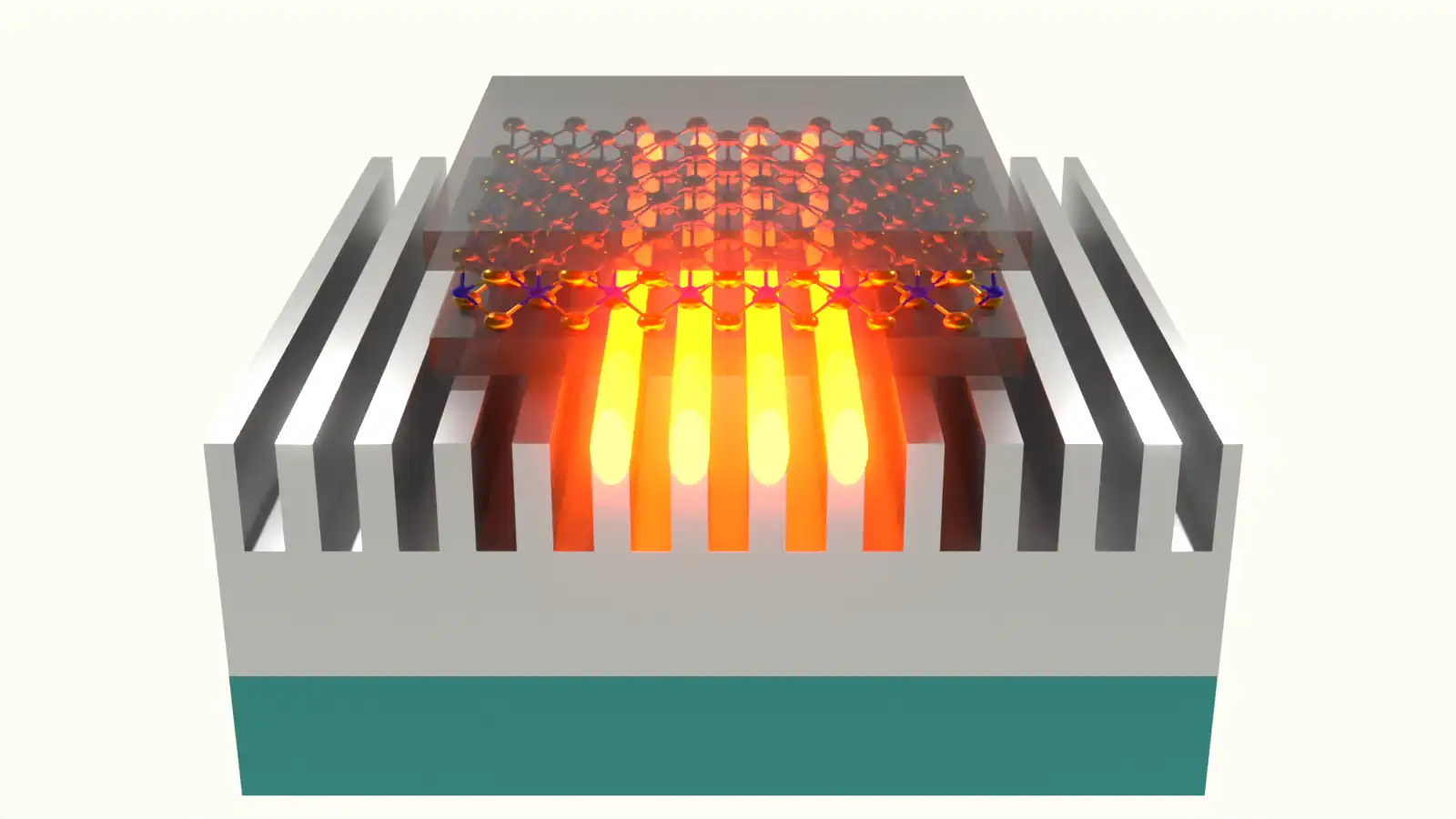
Laser light faces its own set of limits, which are a nuisance to scientists who want to use lasers to engineer new kinds of interactions between light and matter. In particular, there’s an annoying impediment called the diffraction limit, which restricts how tightly a lens can focus a laser beam. Because light travels as a wave of electric and magnetic fields, it has a characteristic size called a wavelength. Depending on the wavelength, diffraction causes waves to bend and spread after passing through an opening. If the opening is big compared to the wavelength, there’s little diffraction. But once the opening gets to be around the size of the wavelength, diffraction causes the wave to spread out dramatically.A new chip made from silver efficiently guides energy to an experimental sample via an array of meticulously sized grooves. The chip delivers the energy from laser light with a wavelength of 800 nanometers to a material sample at a resolution of just a few dozen nanometers, sidestepping a limit that physics puts on laser beams. (Credit: Mahmoud Jalali Mehrabad/JQI)A new chip made from silver efficiently guides energy to an experimental sample via an array of meticulously sized grooves. The chip delivers the energy from laser light with a wavelength of 800 nanometers to a material sample at a resolution of just a few dozen nanometers, sidestepping a limit that physics puts on laser beams. (Credit: Mahmoud Jalali Mehrabad/JQI)
This behavior means that you can’t really squeeze a laser beam down to a spot smaller than its own wavelength—around a micron in the case of off-the-shelf optical lasers. The atoms that make up solid matter are 1,000 times smaller than these optical wavelengths, so it’s impossible to focus optical lasers down to the size of atoms and deliver their power with the surgical precision that researchers often seek. Ordinarily experiments just bathe a sample of matter in a wide beam, wasting most of the power carried by the laser.

One approach to overcoming this waste is to accept the limitations of the diffraction limit and increase the effective size of the matter, which researchers at JQI reported on in a result last year. The other approach is to defy the diffraction limit and figure out a way to cram the energy of the light into a smaller space anyway.

In a paper published earlier this year in the journal Science Advances, JQI Fellow Mohammad Hafezi, who is also a Minta Martin professor of electrical and computer engineering and a professor of physics at UMD, and his colleagues showed a new way to sidestep the diffraction limit. They created a chip with a grooved layer of pure silver that accepts laser power in one spot and ferries it with high efficiency to a sample attached to the grooves a short distance away. Importantly, the power ends up being delivered along the chip in peaks spaced just a few dozen nanometers apart—defeating the diffraction limit by producing features much smaller than the wavelength of light that initially hits the chip. The authors say it promises to be a boon for researchers investigating light-matter interactions.

“Light-induced phenomena are a gigantic toolbox,” says Mahmoud Jalali Mehrabad, a former postdoctoral researcher at JQI who is now a research scientist at the Massachusetts Institute of Technology. “There’s photonic switches, light-induced superconductivity, light-induced magnetism—light-induced this, light induced-that. It's very common to use light to create a phenomenon or to control it.”

The silver grooves in the new chip are 60 nanometers wide and 160 nanometers deep, and they are each spaced 90 nanometers apart. At one end of the array of grooves, the silver has a grid pattern cut into it forming a photonic coupler—a pattern that takes laser light hitting the chip from above, bends it into the plane of the chip, and sends it into the grooves. Once the light reaches the grooves, it excites what the researchers call metasurface plasmon polaritons (MPPs), which are combined excitations of photons (particles of light) and electrons in the silver. It’s the MPPs that end up spaced just a few dozen nanometers apart as they travel down the grooves, delivering the laser power with a resolution far below the diffraction limit set by the wavelength of the laser light.

The size of the grooves was carefully calculated to ensure that the power from the laser traveled without leaking out. Even so, it was hard to fabricate chips that had the optimal power delivery at the right wavelength.

“Getting good quality chips that actually give you the peak transmission at the correct wavelength and the correct spatial diffraction pattern—that was very challenging,” says Supratik Sarkar, a graduate student in physics at JQI and the lead author of the paper. 

Sarkar designed scores of chips and worked closely with You Zhou, an assistant professor of materials science and engineering at UMD, and colleagues, who fabricated the chips. Sarkar then did the grunt work of testing them all to find the handful that worked well with the 800-nanometer laser in their experiment.

To show off the capabilities of their new design, Sarkar and the team performed a benchmark experiment, recreating the observation of a shift in the energy spectrum of an atomically thin material called molybdenum diselenide (MoSe2). MoSe2 contains quasiparticles called excitons, which are combinations of a free-moving electron and a hole—an electron vacancy in the material’s structure that acts like a mobile positively charged particle. It takes a little bit of energy to bind an electron to a hole, and, in the presence of an electric field, that energy can shift. The shift can be detected by shining a light and measuring the reflection to determine how much energy the excitons absorbed.

The researchers attached an MoSe2 sample across the top of several grooves on their silver chip, pulsed their 800-nanometer laser into the photonic coupler for a fraction of a second, and probed the sample by flashing a separate pulsed laser. They collected the light reflected by the MoSe2 sample using a microscope and a camera. They showed that—as expected—the exciton energy shifted by a small amount.

They performed the same experiment in the conventional way by pointing both the 800-nanometer laser and the probe laser directly at another MoSe2 sample, which was placed on a smooth sheet of silver. To make the comparison fair, they used a sheet of silver produced in the same way by Zhou’s lab, just without the grooves. They observed the same small energy shift in the excitons, validating their result with the grooved chip. Crucially, though, the conventional method required nearly 100 times more laser power than the method using their chip.

As another demonstration of the advantages of the new chip, the researchers also measured a clear signature that the MPPs traveling down the grooves could deliver more targeted power than the laser. The MPPs in neighboring grooves generated peaks and valleys where the electric field was stronger and weaker. This rolling landscape—which varied over dozens of nanometers instead of hundreds—altered the behavior of the excitons in the MoSe2 sample, causing their energy to shift. Since different excitons had different experiences of the modulated electric field, the energies of excitons across the sample varied slightly. Measurements with the new chip showed that this modulation broadened the set of energies that the excitons had—a feature that was absent from a similar experiment without the grooved chip.

The new chip also has some additional advantages. By separating where the input light is pumped into the chip from where the output light is collected from a sample, the new device can avoid two problems that plague typical experiments.

One problem is heating. When the pumped-in light hits a material sample directly, it tends to heat it up. The new chips require less pump power, which introduces less heat into the experiment. They also keep the power delivery far away from the sample—so distant that during a typical experiment any heat that is introduced to the chip won’t have enough time to reach the sample and interfere with its behavior.

The other problem in conventional experiments has to do with the pump light scattering off a sample and reflecting back into the camera used for measurement. It’s a bit like trying to see the stars during the day—like the sun, the reflected pump laser is so bright that it washes out all the pinprick details. Overcoming this glare normally requires tediously characterizing the pump light so that it can be subtracted from the measured light. But because the pump light is injected into the new chip far away from the sample, it significantly reduces the noise that ends up in the camera.

The authors say that they are now working with other groups who are interested in putting their samples onto one of the grooved chips. They also have plenty of ideas of their own for how to play with the new tool.

“This is very cool, because now you can have periodicity of light in a sub-diffraction sort of regime experienced by matter,” says Mehrabad, who was a co-lead author of the paper. “You can engineer lattice physics. You can open a band gap. You can do scattering. There is a lot of cool physics to be done with this.”

Original story by Chris Cesare: Researchers Identify Groovy Way to Beat Diffraction Limit | Joint Quantum Institute

In addition to Hafezi, Mehrabad, Sarkar, and Zhou the paper had several additional authors: Daniel Suárez-Forero, a co-lead author and former postdoctoral researcher at JQI who is now an assistant professor of physics at the University of Maryland, Baltimore County; Liuxin Gu, a co-lead author and a graduate student in materials science and engineering at UMD who helped fabricate the chips used in the experiments reported in the paper; Christopher Flower, a former physics graduate student at JQI; Lida Xu, a physics graduate student at JQI; Kenji Watanabe, a materials scientist at the National Institute for Materials Science (NIMS) in Japan; Takashi Taniguchi, a materials scientist at NIMS; Suji Park, a staff scientist at Brookhaven National Laboratory (BNL) in New York; and Houk Jang, a staff scientist at BNL.

This work was supported by the Army Research Office, the Defense Advanced Research Projects Agency, the National Science Foundation, and the Department of Energy.
สล็อตเว็บตรง

Written on 29 September 2025. Posted in Department News.

Jaron E. Shrock Cited for Outstanding Thesis

Jaron E. Shrock has been named the 2025 recipient of the American Physical Society’s Marshall N. Rosenbluth Outstanding Doctoral Thesis Award. Shrock was cited for the first demonstration of multi-GeV laser wakefield acceleration using a plasma waveguide in an all-optical scheme.

After graduating from Swarthmore College in 2018, Jaron joined Distinguished University Professor Howard Milchberg’s Intense Laser Matter Interactions lab, where The accelerator in action. The accelerator in action. his research has focused on using lasers to accelerate electrons to multi-GeV energies over meter-scale distances. The laser intensities needed to do this are extremely high, and the key element that keeps them high is a plasma waveguide—first realized by Dr. Milchberg at the University of Maryland in the 1990’s. The plasma waveguide is analogous to a glass fiber optic cable, but it can confine laser intensities more than 7 orders of magnitude higher than would destroy the glass fiber. “Shrinking  a km-long machine to fit inside a university lab, manufacturing facility, or hospital has enormous potential to bring advanced light and radiation sources to a variety of applications, and provides a possible path towards developing compact high energy colliders for probing fundamental physics”, said Shrock.

Dr. Shrock defended his thesis, Multi-GeV Laser Wakefield Acceleration in Optically Generated Plasma Waveguides, in 2023, and has also been recognized with the John Dawson Thesis Prize at the 2025 Laser Plasma Accelerators Workshop in Ischia, Italy. The success of the Maryland platform for laser acceleration has led to its installation for collaborative experiments at leading high power laser facilities in the US and Europe. Jaron is continuing his work at UMD as a postdoc, both helping to install the UMD platform at the other facilities and doing experiments on UMd’s new 100 terawatt laser system.  In thinking about the future of this research, Jaron says “It’s been thrilling (and exhausting!) to see this platform grow from ideas developed by our small team to the centerpiece of international research efforts, and I believe we’re only scratching the surface of what these accelerators can do.”

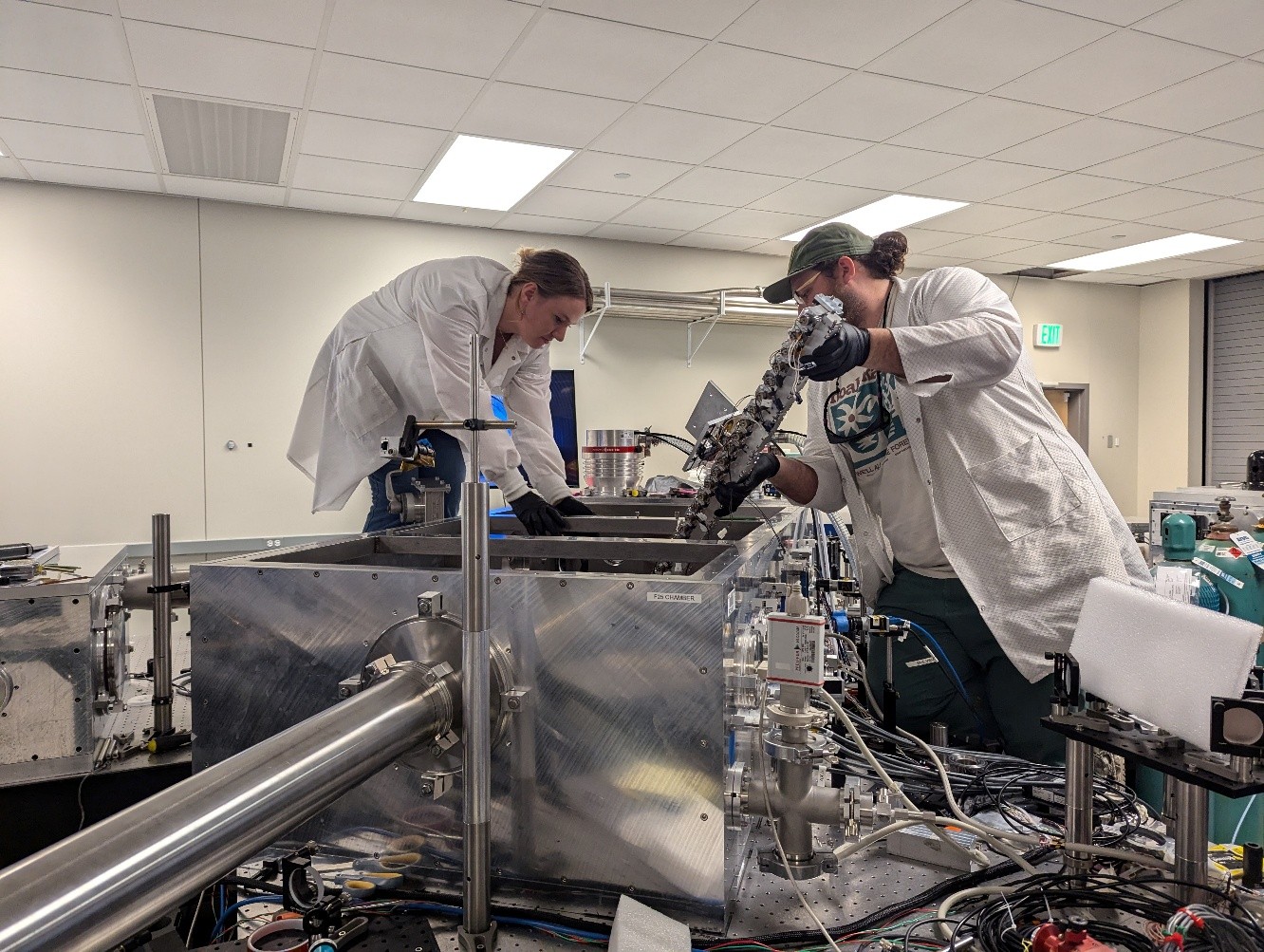
Shrock (right) with Ela Rockafellow (left) installing a prototype 1 meter gas jet on the ALEPH laser system at Colorado State University.Shrock (right) with Ela Rockafellow (left) installing a prototype 1 meter gas jet on the ALEPH laser system at Colorado State University.Jaron is the fourth of Milchberg’s students to win the award, joining Thomas Clark (1999), Ki-Yong Kim (2004) and Yu-Hsin Chen (2012).

“Congratulations to Jaron for this outstanding achievement,” said physics chair Steve Rolston. “And kudos to Howard Milchberg for establishing such a constructive and creative atmosphere.”

The award consists of $2,000, a certificate, and an invitation to speak at the November 2025  Meeting of the APS Division of Plasma Physics (DPP) in Long Beach, California.

Written on 26 September 2025. Posted in Department News.

When Physics and Math Go Viral

With more viruses on Earth than stars in the observable universe, researchers like Raunak Dey may never run out of work.

As a physics Ph.D. student at the University of Maryland, Dey designs theoretical and mathematical models to understand how viruses interact in vast microbial communities. Part of the challenge is that these communities are crowded: A drop of water, a gram of soil and the human gut each harbors millions or billions of microbes and viruses.

“Some viruses can be useful, and some viruses can be harmful,” Dey said. “The beauty of it is that the knowledge you learn from these model systems can be translated into applications.”

Dey’s research intersects with a growing interest in phage therapy, which uses phages—viruses that only infect and replicate in bacterial cells—to treat antibiotic-resistant infections in humans. Much is still unknown about how phages interact with bacteria, but Dey’s problem-solving research fuses math, biology and computational physics to help demystify these processes.

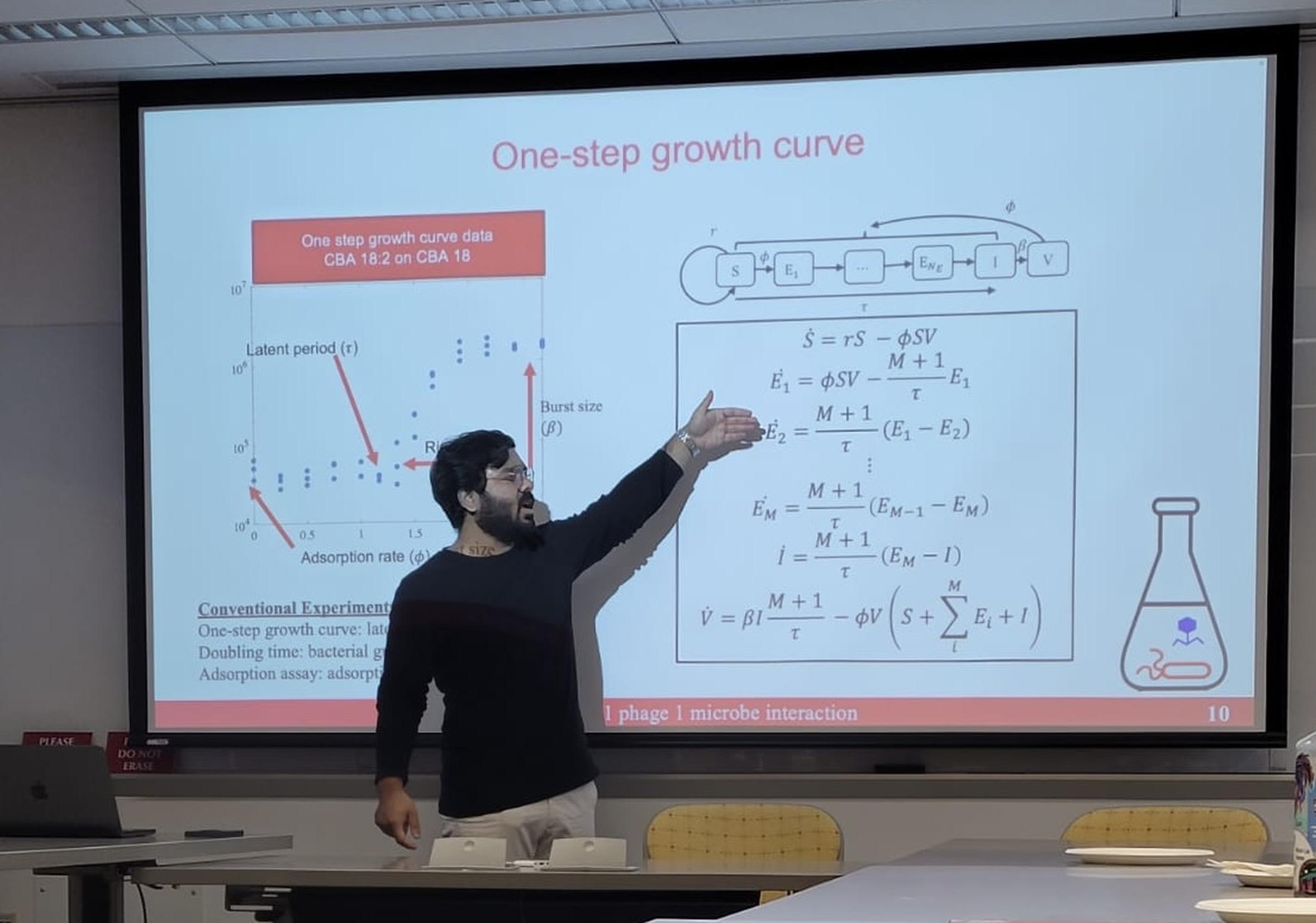
“I don’t see myself as a physics or biology person,” Dey said. “I only see myself as a scientist who will use all the tools at our disposal to solve challenging problems.”Raunak Dey gesturing to a screen with information about one-step growth curve.  He seeks to solve inverse and optimization problems using time series data. Image courtesy of Raunak Dey.Raunak Dey's research aims to solve inverse and optimization problems using time series data. Image courtesy of Raunak Dey.

‘Mathematical modeling for good’

Driven by a desire to “understand how things work,” Dey enrolled in a dual bachelor’s and master’s degree program in physical sciences at the Indian Institute of Science Education and Research Kolkata, where he studied the random motions of tiny particles. 

After graduating in 2020, Dey moved to the U.S. to pursue a physics Ph.D. at Georgia Tech. As he watched the global pandemic unfold, he realized he wanted to conduct research that would directly benefit people.

“I had this philosophical feeling that the frontline workers were working so hard,” Dey said, “and I wanted to be doing research where I could apply my math aptitude to something useful to society.”

That’s when Dey started using “mathematical modeling for good” to study COVID-19 and its health implications with Joshua Weitz, now a professor in UMD’s Department of Biology and the University of Maryland Institute for Health Computing.

“The same class of models—compartmental differential equations—that we use to describe how viruses like COVID spread in the human population can be used to describe how viruses infect microbes,” Dey explained.

When Weitz moved to UMD in 2023, Dey followed. He wanted to continue what he started, and he also valued the interdisciplinary collaborations happening at UMD and the proximity to federal agencies like the National Institutes of Health. 

“I'm very appreciative of the environment UMD has provided,” Dey said. “There are a lot of projects with professors across departments that allowed me to make connections, which I'm grateful for.”

Capturing complexity

While working with Weitz, Dey also joined a national research project called the Simons Collaboration on Ocean Processes and Ecology (SCOPE) that’s aimed at understanding marine microbial processes. In his work with SCOPE, Dey helps quantify the role of phages in ocean ecosystems, where “good” viruses might help maintain balance by killing microbes and recycling nutrients back into the ocean.

Dey’s ongoing research uses models to understand how different species of viruses and microbes might interact—a process that reveals just how complex these microbial communities can be. 

“One of the fundamental things I’ve learned is that things in biology are really complicated, and we don’t know all the knobs that are turning to make something happen—you just see the output,” Dey said. “In our modeling framework, we try to capture a lot of these complexities, but it's not possible to capture everything.”

Viruses that live in the gut microbiome can be just as complex, but, if harnessed or managed well, can help to improve human health. As a fellow with UMD’s Center of Excellence in Microbiome Sciences, Dey said he’s looking for ways to “translate microbiome science research into policies” that will have an impact on people’s lives. 

In recognition of his research collaborations, Dey received the 2024 Thomas G. Mason Interdisciplinary Physics Fund award from UMD’s Department of Physics, which supports doctoral students who work with professors in other departments.

“Interdisciplinary science is necessary and hard, and sometimes it's frustrating because of how long it takes,” Dey said, “but it’s also rewarding and hopefully useful.”

Making science accessible

When he isn’t conducting research, Dey is passionate about making science accessible to more people—especially budding scientists in his home country, India.

“Many people from underrepresented communities never get a fair shot at trying science,” he said. “This needs to change, and I want to be a part of that positive change by reducing the barrier of entry for science.”

Over the last two years, Dey has been writing tutorials and gathering resources to provide a “good starting point” for students interested in learning more about his area of research. He also mentors other Ph.D. and undergraduate students, adding that this “fulfilling experience” has helped him tailor his teaching to different audiences.

In the future, Dey wants to dive deeper into biomedical research that leverages artificial intelligence (AI) and machine learning. While he doesn’t know exactly where his career might take him after graduation, he feels that UMD has prepared him for whatever challenges await. 

“I don’t know what the future holds, but I want to keep working on innovative and challenging problems that directly contribute to society,” Dey said. “That’s why I wanted to do science in the first place.”

Original story: https://cmns.umd.edu/news-events/news/raunak-dey-makes-physics-and-math-go-viral

Written on 19 September 2025. Posted in Department News.

UMD-Led Team Wins Major NSF Grant to Pioneer “High-Entropy” Quantum Materials

A University of Maryland–led research team has been awarded a highly competitive grant from the National Science Foundation’s Designing Materials to Revolutionize and Engineer our Future (DMREF) program to launch a bold new frontier in quantum materials science: High-Entropy Quantum Materials.

The $2 million, four-year award brings together scientists from UMD, the University of British Columbia (UBC), the University of North Texas (UNT), and national labs including NIST and the National High Magnetic Field Laboratory. Their mission is to harness “configurational entropy”—the mixing of multiple elements in a single crystal structure—to discover and control new forms of magnetism, superconductivity, and topological states of matter.

“Traditionally, materials scientists try to eliminate disorder when making new compounds,” said Johnpierre Paglione, UMD physics professor and director of the Maryland Quantum Materials Center, who is leading the project. “We’re flipping that idea around—embracing disorder as a way to stabilize entirely new phases of matter.”Approach of high entropy materials stabilization.Approach of high entropy materials stabilization.

High-entropy materials, first discovered in metallic alloys, contain five or more elements randomly distributed across a lattice site. This chemical “chaos” can give rise to surprising stability and novel properties. The UMD-UBC team aims to extend this concept into the quantum realm, coining a new class: High-Entropy Quantum Materials.

“As a chemist, I’m excited by the chance to explore how we can use entropy as a new design principle for building quantum materials,” said co-lead Efrain Rodriguez, UMD professor of chemistry and biochemistry and co-lead on the project. “By mixing multiple elements into a single structure, we’re creating an almost limitless playground for discovering unexpected electronic and magnetic behaviors. It’s a fundamentally new way to think about how chemistry can drive quantum science forward.”

The project will integrate theory, machine learning, and high-throughput synthesis to rapidly identify promising compounds, guided by the AFLOW computational platform and sped up by the use of combinatorial thin-film libraries. “This award allows us to couple cutting-edge computation with rapid experimentation, giving us a chance to accelerate discovery on an unprecedented scale,” said Ichiro Takeuchi, UMD materials scientist and co-lead on the project.

Beyond research, the team will contribute to quantum workforce development by expanding UMD’s Quantum Materials Winter School and Machine Learning for Materials Boot Camp, training the next generation of scientists in synthesis, computation, and quantum technologies.

The collaboration also includes building a public data repository in collaboration with the NSF-funded UC Santa Barbara Quantum Foundry to share results with the broader scientific community, amplifying the project’s impact through the Materials Genome Initiative.

“With this effort, we’re opening a whole new landscape for discovery,” said Paglione. “High-entropy quantum materials could unlock fundamental properties and quantum technologies we haven’t even imagined yet—we are excited to launch this new field of research.”

Written on 15 September 2025. Posted in Department News.

Maryland Quantum-Thermodynamics Hub Secures Funding for Three More Years

Watch housingResearchers at the pioneering Maryland Quantum-Thermodynamics Hub meld 19th century physics with the modern techniques and tools of quantum information science. Since 2022, they have plumbed the intriguing depths of this disciplinary fusion, uncovering a deeper understanding of how the everyday world emerges from the quantum realm of tiny particles.

Now, new funding will catapult the hub into the next three years, enabling the addition of new team members and a renewed focus on answering open research questions that might lead to better quantum computers and even alter our fundamental understanding of the nature of time.

The hub launched three years ago with a $2 million grant from the John Templeton Foundation. New funding for the next three years includes a recommitment from Templeton that will match support from the state via Gov. Wes Moore’s Capital of Quantum Initiative and University of Maryland campus sponsors like the National Quantum Laboratory, the Brin Mathematics Research Center and the Institute for Physical Science and Technology. Several private companies, including Fidelity Investments and Normal Computing, will provide additional support. Altogether the new funding totals more than $5 million and will support team members at UMD as well as the University of Maryland, Baltimore County (UMBC); the University of Southern California; the University of Arizona; Los Alamos National Laboratory in New Mexico; the University of Rochester in New York; and University College Dublin.

“The intention is to make Maryland a lodestone for quantum thermodynamics in North America,” says Nicole Yunger Halpern, an adjunct assistant professor of physics at UMD and a co-leader of the hub who is also a physicist at the National Institute of Standards and Technology and a Fellow of the Joint Center for Quantum Information and Computer Science.

Hub researchers mix the old with the new, combining three fields of physics from different centuries. The oldest is thermodynamics, which emerged from the industrial revolution in the 19th century and investigates, among other things, how machines transform energy into work and heat. Next is quantum physics, which was founded in the 20th century and provides our most fundamental understanding of nature at the level of atoms, electrons and other tiny constituents of matter and energy. Finally, quantum information science, which has become a major field in the early 21st century, applies the rules of quantum physics to information processing and has led to new applications like quantum computing, quantum networking and quantum sensing. Quantum thermodynamics seeks to combine the best tools and insights from all these areas to answer both deep and practical questions about the physical world. While fusing these fields together over the past three years, researchers at the hub have published more than 60 journal articles, conference papers and preprints, and the hub has supported five Ph.D. theses.

“I'm excited that we've obtained funding to build on the success of our first three years,” says Distinguished University Professor Christopher Jarzynski, a co-leader of the hub who is also a professor of physics and a professor of chemistry and biochemistry at UMD. “The hub has firmly placed Maryland on the map as a center for innovative quantum thermodynamics research, education and outreach.”

Research at the hub broadly investigates how quantum systems, such as collections of atoms, interact with their environments and the variety of ways that quantum features either frustrate or facilitate thermodynamic processes like energy or information exchange. Energy exchange between a system and its environment helps explain how physical systems thermalize, or end up at a shared temperature. Information exchange explains how the values of quantum measurements—typically of just a few quantum particles—are imprinted in much larger measurement devices.

One particular mystery energizes many scientists at the hub—a nagging problem at the heart of physics that researchers refer to as the arrow of time. The gist of the problem is that although the detailed microscopic theories of physics look the same whether time is running forwards or backwards, the much larger scale of everyday reality seems to have an unmistakable direction. We never see an egg unscramble itself or smoldering ash and smoke reassemble into a log. Somewhere between the reversible rules of microscopic physics and our common experience of the world, there is a transition, an emergent effect that causes time to flow toward the future.

“The big goal of the hub has been to identify how, from microscopic quantum physics, our classical objective reality emerges thermodynamically,” says Yunger Halpern. “Thermodynamics traditionally has addressed large numbers of particles, and it stems from the actions of many, many small particles. So thermodynamics kind of bridges scales and helps us understand how large-scale macroscopic phenomena emerge, such as the arrow of time.”

Some hub researchers have been motivated by questions about which quantum phenomena hinder quantum systems from experiencing the arrow of time. One example turned out to be the exchange of incompatible quantities between a quantum system and its environment. These incompatible quantities are quantum properties that, thanks to the uncertainty principle, cannot be simultaneously known.

For instance, researchers can check if the quantum spin of a particle is pointing up or down along any direction, but the spin along some other direction is an incompatible quantity. If a quantum system is exchanging spin with its environment along two incompatible directions, it hinders certain features of thermalization and impedes the system’s experience of time. Understanding more about which quantum phenomena interact with time’s arrow could have applications to error correction in quantum computing, which fights against the march of time and preserves quantum information by monitoring for and removing heat and disorder.

“We found some tensions in this, though,” says Yunger Halpern. “We found some ways that this exchange of incompatible quantities hinders some facets of thermalization, but also some ways that it enhances some facets. In the next three years, we hope to get a unified picture.”

The hub will use its next three years to refine the questions it has been asking, seeking to clarify the tensions that cropped up during the first three years. In addition to investigating how certain quantum phenomena impact the arrow of time, they will also consider new models of information exchange between quantum systems and their environments. They even plan to add an entirely new kind of question to the mix: How might the continuous fabric of space and time in Einstein’s general theory of relativity emerge from a microscopic network of discrete quantum systems?

Beyond research, the hub has also become a nexus for community building and outreach in the field, hosting an annual gathering to foster collaboration and innovation and organizing a short story contest in 2023. Part of the hub’s mission, Yunger Halpern says, is to share the adventure of quantum thermodynamics with the general public and inspire the next generation of quantum thermodynamicists.

The new funding will allow the hub to expand its team, adding new spokes. New team members will join from UMD, UMBC, and the University of Rochester, but the hope is that the growth won’t stop there.

“If anyone else would like to partner with us, we’d be happy to hear from them,” says Yunger Halpern.

Story by Chris Cesare

More Articles …

  1. Srinivasan Named NIST Co-Director of JQI
  2. From Lab Bench to Launch Pad
  3. Researchers Imagine Novel Quantum Foundations for Gravity
  4. Solving a Decades-long Solar Flare Mystery

Page 12 of 207

  • 7
  • 8
  • 9
  • 10
  • 11
  • 12
  • 13
  • 14
  • 15
  • 16
  • Physics Administration
  • Directions
  • Awards
  • Student Awards
  • Make a Donation
  • News
    • Research News
    • Department News
    • Newsletters
  • PTK Policy

College and Department Links

Department of Physics

Physical Sciences Complex
4296 Stadium Dr
College Park, MD 20742
Phone: 301.405.3401

Information

  • Campus Directory
  • Undergraduate Research
  • Scholarships
  • Prospective Undergraduates
  • Directions & Transit
  • Web Accessibility
© 2026 University of Maryland - Department of Physics
Top
  • Home
  • About Us
    • Physics Administration
    • Directions
    • Awards
    • Student Awards
    • Make a Donation
    • News
      • Research News
      • Department News
      • Newsletters
    • PTK Policy
  • People
    • All
    • Faculty
      • Current
      • Emeritus
      • Adjunct
      • Affiliate
      • Research Professors
    • Research Scientists
    • Postdocs
    • Staff
    • Lecturers
    • Visitors
    • Graduate Students
  • Research
    • Research Areas
      • AI and Physical Sciences
      • Astro Metrology
      • Atomic, Molecular & Optical
      • Biophysics
      • Chemical Physics
      • Condensed Matter Experiment
      • Condensed Matter Theory
      • Cosmic Ray Physics
      • Elementary Particles
      • Gravitation Experiment
      • Gravitational Theory
      • High Energy Physics
      • Nonlinear Dynamics, Chaos and Complex Systems
      • Nuclear Physics
      • Particle Astrophysics
      • Physics Education Research
      • Plasma Physics
      • Plasma Theory
      • Quantum Science and Technology
      • Quarks, Hadrons and Nuclei
      • Space Physics
    • Centers & Institutes
  • Academics
    • OSES Home (Student Services)
    • OSES News
    • Undergraduate Program
      • Prospective Students
      • Apply Now
      • Degree Requirements and Policies
      • Scholarships
      • Undergraduate Research
      • Advising
      • Undergraduate Forms
      • Undergraduate Events
      • Departmental Honors
      • Society of Physics Students
      • FAQ
      • Undergraduate Student Committee
    • Graduate Program
      • Prospective Students
      • Open House
      • Degree Requirements
      • Graduate Resources
      • Deadlines and Forms
      • PhD Defenses
        • PhD Defenses 2026
        • PhD Defenses 2025
        • PhD Defenses 2024
        • PhD Defenses 2023
        • PhD Defenses 2022
        • PhD Defenses 2021
        • PhD Defenses 2020
        • PhD Defenses 2019
        • PhD Defenses 2018
        • PhD Defenses 2017
        • PhD Defenses 2016
      • Events
      • Scholarships & Awards
      • Qualifier
      • Graduate Student Organizations
      • FAQ
    • Student Opportunities
      • GRAD-MAP
      • Graduate Student Organizations
      • Outreach Volunteering
      • Society of Physics Students
      • NSF S-STEM Program
      • Undergraduate Research
      • The Noether Physics Society
      • Undergraduate Quantum Association
    • Courses
    • Academic Support
    • NSF S-STEM Program
    • Teaching Assistants
  • Events
    • Calendar
    • Physics Colloquia
    • W.J. Carr Lecture
    • Research Interaction Team (RIT) Math/Physics
    • Mechanick Quantum Biology Lecture
    • Irving and Renee Milchberg Endowed Lectureship
    • Charles W. Misner Endowed Lectureship in Gravitational Physics
    • Charles W. Misner Memorial Symposium
    • John S. Toll Endowed Lecture
    • Prange Prize Lecture
    • Maryland Day
    • Outreach
      • Outreach Home
      • Physics is Phun
      • Discovery Days
    • Summer Programs
      • Physics Makers Camp
      • Physics of Quidditch
      • Science Discovery Camp
      • Advanced Physics Summer Program
      • Toolkit for Success
    • CUWiP
    • Vortex Makerspace
    • QURiSE Conference
  • Services
    • Building Access Requests
    • Computing Services
    • Conference Room Reservations
    • Department Operations Directory
    • Electronic and Mechanical Development
    • Hiring Procedures
    • Lecture Demo
    • Mental Health Resources
    • Parking
    • Physics Ombudspersons
    • Printing Services
      • Poster Print Request
    • Proposal Submissions
    • Purchase Order
    • Suggestion Box
    • Textbook Information
  • Give