Das Sarma and Greene Elected to the National Academy of Sciences

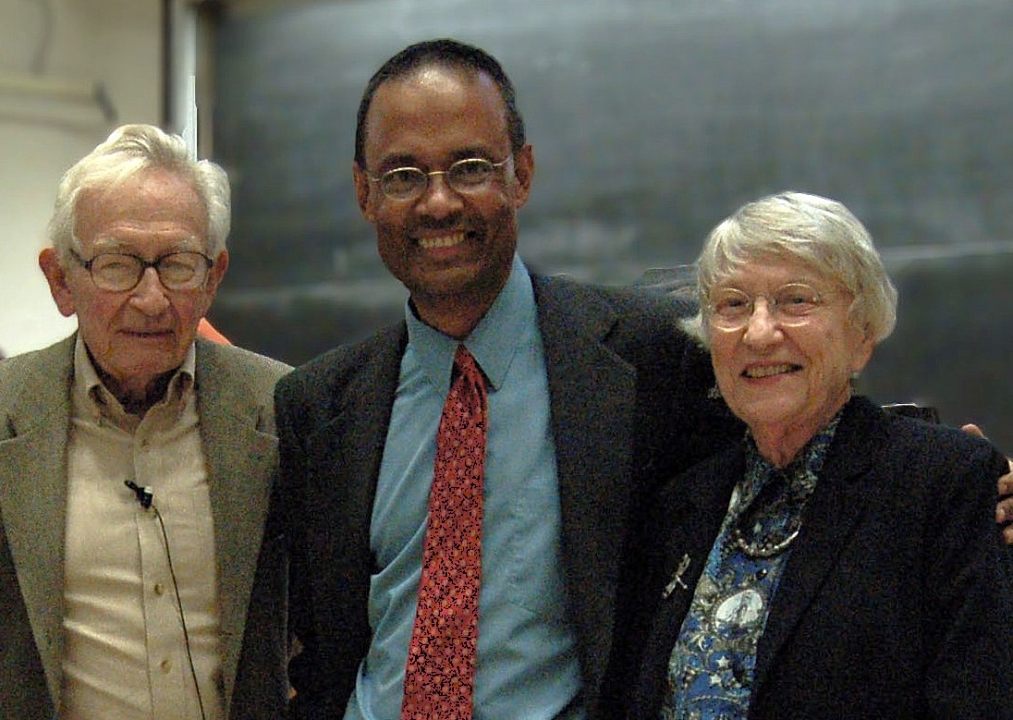
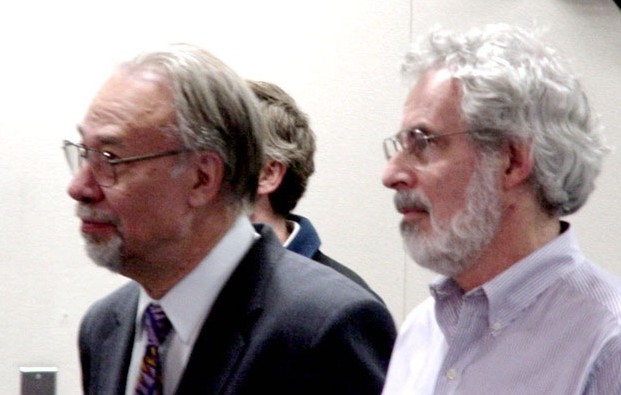
Two Distinguished University Professors in the University of Maryland’s Department of Physics have been elected to the National Academy of Sciences for outstanding accomplishments in quantum science.

Sankar Das Sarma and Richard L. Greene were among the 120 American and 25 international scientists selected this year “in recognition of their distinguished and continuing achievements in original research.”

They join fewer than 2,800 American scientists from all disciplines who have been chosen by academy members for outstanding contributions. Their election brings the total number of Terps in the academy to 27; UMD faculty memberships in national academies now stand at more than 110. 

“The dedication of Sankar Das Sarma and Richard Greene to excellence exemplifies the intellectual leadership of our faculty, and we are proud to see their contributions be recognized among the most impactful in science today,” said Amitabh Varshney, dean of the College of Computer, Mathematical, and Natural Sciences.

The recognition underscores UMD’s position as a leading global center of quantum science and technology, with more than 200 dedicated researchers, key partnerships with the National Institute of Standards and Technology and other federal agencies, and several on-campus research institutes.

“To have two of our finest researchers recognized by one of the highest honors in American science is a fitting testament to their pathfinding work, and it reflects the commitment to excellence in the Department of Physics and the university as a whole,” said Steven Rolston, chair of the Department of Physics.  

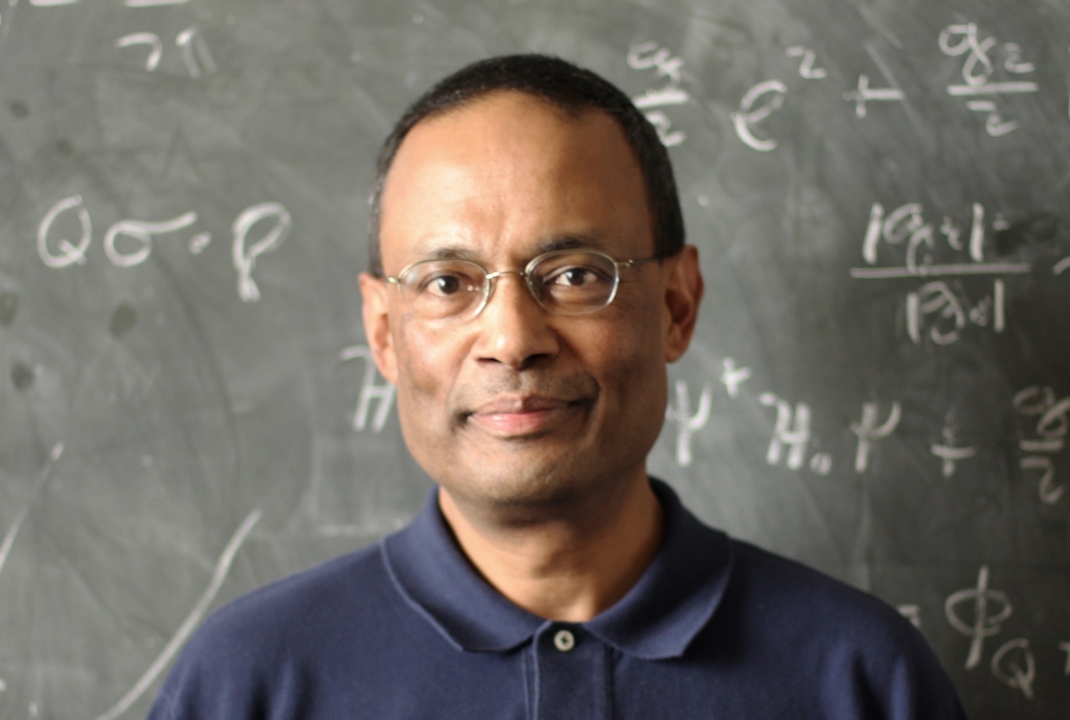
Das Sarma—the Richard E. Prange Chair of Physics, fellow of the Joint Quantum Institute and director of the Condensed Matter Theory Center—is internationally known for groundbreaking work on the theory of topological quantum computation, a field that is poised to dramatically expand the capabilities of future designs and devices.

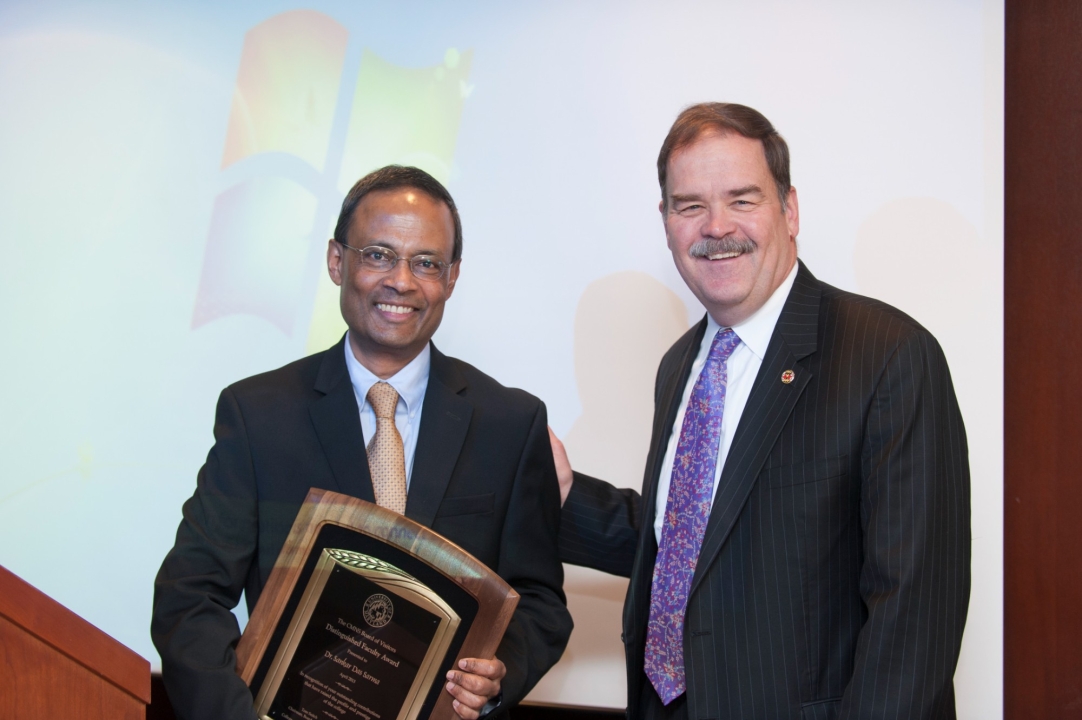
He earned his Ph.D. in physics from Brown University, studying under the late UMD alum John Quinn (Ph.D. ’58, physics). Das Sarma has been a faculty member at UMD since 1980. He was elected fellow of the American Physical Society (APS) in 1992, was named a Distinguished University Professor in 1995, and received the College of Computer, Mathematical, and Natural Sciences’ Board of Visitors Distinguished Faculty Award in 2013. 

His research explores the quantum properties of condensed matter systems and theoretical predictions for how those properties could be used to create a stable, fault-tolerant basis for a quantum computer.

Conventional computers are based on the on-off, 0-or-1, switch-like electrical nature of transistors; they store and process data in the form of binary digits (bits). Quantum computers, by contrast, exploit a “superposition” of many states at once. That is, a quantum bit (qubit) can have a value of 0, 1 or some combination of the two.

Qubits can be stored in quantum states of superconductors, ions, atoms or photons. In each case, however, those fragile states are notoriously prone to errors (decoherence) even if carefully protected from their environment.

More than 20 years ago, Das Sarma, with others, theorized that robust qubits could emerge in the form of braids of unusual collective excitations in certain solid-state materials.

These braids are pinned in place (“topologically protected”) and thus less vulnerable to decoherence. In much the same way, the basic shape of a donut remains unchanged even if stretched or twisted.

That research, first published in 2005 in the journal Physical Review Letters as “Topologically Protected Qubits from a Possible Non-Abelian Fractional Quantum Hall State,” in effect created the theoretical basis for the entire field of topological computing and proposed a way to test it.

This is just one aspect of Das Sarma’s extensive work in virtually all areas of condensed-matter physics.  He has published over 750 papers, garnering more than 100,000 citations.

Greene, the founding director of UMD’s Center for Superconductivity Research (now the Quantum Materials Center), has made fundamental breakthroughs in understanding and measuring superconductivity—a condition in which an electrical current can flow without any resistance.

The phenomenon was first observed early in the 20th century, when Dutch physicist Heike Kamerlingh Onnes cooled helium to a liquid state near absolute zero. He then discovered that certain metals lost all resistance to the flow of electrical current at this temperature. Superconductivity has since been exploited for numerous uses, including superconducting magnets for medical imaging, maglev trains and controlled nuclear fusion.

Because the temperature of liquid helium (4 degrees above absolute zero) is hard to reach without specialized equipment, there has been global interest in producing superconductivity in much more accessible conditions, perhaps as warm as room temperature.

Over decades of research, Greene made major advances toward this goal. He discovered superconductivity in polythiazyl, (SN)x, the only known polymer superconductor. He discovered that certain novel materials—notably organic (carbon-based) formulations and specially doped copper oxides—could become superconducting, and he developed new methods to measure their electrical properties. 

In the process, he became one of the world’s leading experts in an area with profound potential: If achieved, low-resistance electrical transmission would have a transformational impact on modern industry and human quality of life.

Greene has made significant contributions to other areas of materials physics, including the study of novel materials that exhibit a dramatic decrease in electrical resistance upon the application of a magnetic field. He helped develop the “relaxation” technique for specific heat measurements, a method that is now widely used in the Quantum Design Physical Property Measurement System. He has published about 450 papers, with over 36,000 citations.

Greene earned his B.S. in physics from the Massachusetts Institute of Technology and his Ph.D. from Stanford University. He is a fellow of the American Association for the Advancement of Science and the APS; the APS's dissertation award in experimental condensed matter physics bears his name. He was cited by the Philip Merrill Presidential Scholars Program at UMD in 2019 for his mentorship and was named a Distinguished University Professor in 2022. He was awarded the prestigious 2026 Heike Kamerlingh Onnes Prize for extraordinary experimental research in superconductivity, and retired earlier this year as a Distinguished University Professor Emeritus.
22 Science Terps Awarded 2026 National Science Foundation Graduate Research Fellowships

Sonja Hakala, Yash Anand and Nathan Constantinides are among 22 current students and recent graduates of the University of Maryland’s College of Computer, Mathematical, and Natural Sciences (CMNS) to receive prestigious 2026 National Science Foundation (NSF) Graduate Research Fellowships, which recognize outstanding graduate students in science, technology, engineering and mathematics.

Since 2014, 174 current students and recent alums from CMNS have been awarded NSF Graduate Research Fellowships. 

This year’s awardees are:

  • Anirud Aggarwal (B.S. ’25, computer science; B.S. ’25, mathematics)
  • Yash Anand (B.S. ’25, physics; B.S. ’25, mathematics), Massachusetts Institute of Technology
  • Vatsal Baherwani (B.S. ’25, computer science), New York University
  • Hannah Cairo, Ph.D. student in mathematics
  • Nathan Constantinides (B.S. ’25, computer science), senior physics major
  • Owen Deen, Ph.D. student in applied mathematics and statistics, and scientific computation
  • Darsh Gandhi, Ph.D. student in applied mathematics and statistics, and scientific computation
  • Sonja Hakala (B.S. ’24, physics)
  • Erin Hopper, computer science and mathematics double-degree student
  • Theodore Hsiao (B.S. ’25, computer science), senior bioengineering major
  • Jeremy Kuznetsov (B.S. ’25, mathematics), senior aerospace engineering major, Princeton University
  • Pauline Lawrence, Ph.D. student in marine estuarine environmental sciences
  • Siobhan Light (B.S. ’23, geology; B.S. ’23, astronomy), University of California, Santa Cruz
  • Gary Peng, computer science and mathematics double-degree student
  • Savannah Phillips, computer science and mathematics double-degree student
  • Rishi Pradeep (B.S. ’25, computer science and mathematics)
  • Samantha Smith (B.S. ’22, biochemistry), University of California, Berkeley
  • Pablo Stilwell, Ph.D. student in entomology
  • Yujing Tang, Ph.D. student in mathematics
  • Lani Tran (B.S. ’24, neuroscience; B.S. ’24, philosophy), University of Pennsylvania
  • Isha Vashee (B.S. ’24, biochemistry)
  • Eric Xu, computer science major

The NSF Graduate Research Fellowship Program helps ensure the quality, vitality and strength of the United States' scientific and engineering workforce. The five-year fellowships provide three years of financial support, including an annual stipend of $37,000.

Since 1952, NSF has funded over 70,000 Graduate Research Fellowships out of more than 500,000 applicants. More than 40 Fellows have gone on to become Nobel laureates, and more than 450 have become members of the National Academy of Sciences.

UMD Physics, Computer Science and Mathematics Graduate Programs Rank in Top 25

The University of Maryland’s College of Computer, Mathematical, and Natural Sciences (CMNS) earned six top-25 placements in the 2027 Best Graduate Schools list released by U.S. News & World Report.

Several CMNS programs improved in their 2027 rankings, including computer science, which rose four spots to No. 12, and physics, which rose three spots to No. 14. Other highlights include mathematics at No. 21 and three computer science specialties ranked in the top 20.

“I’m very pleased to see CMNS graduate programs continue to be recognized among the nation’s very best,” said CMNS Dean Amitabh Varshney. “This recognition reflects the outstanding work and dedication of our department chairs, graduate program directors, faculty members and students who strive for excellence every day.”Logo for U.S. News Best Grad Schools rankings.

U.S. News occasionally changes the number of categories it ranks and doesn’t rank all graduate programs or specialties annually. In 2027, the physics and mathematics programs were ranked, but their specialties were not ranked.

Current CMNS graduate program and specialty rankings include:

  • Computer science at No. 12 (7th among public institutions)
    • Artificial intelligence at No. 16
    • Systems at No. 17
    • Theory at No. 19
  • Physics at No. 14 (5th among public institutions)
    • Atomic/molecular/optical at No. 6
    • Quantum at No. 9
    • Condensed matter at No. 17
  • Mathematics at No. 21 (7th among public institutions)
    • Applied math at No. 15
    • Analysis at No. 24
  • Earth science at No. 40 (26th among public institutions)
  • Chemistry at No. 48 (26th among public institutions)
  • Biological sciences at No. 50 (25th among public institutions)
  • Statistics at No. 53 (35th among public institutions)

“These latest graduate school rankings show the University of Maryland’s strength across a wide variety of scholarly domains and specialties, from the physical and social sciences to business and education,” said UMD President Darryll J. Pines. “We’re proud that our graduate programs are providing students with the vital knowledge and inspiration to address the most important challenges facing the world today.”

The only CMNS undergraduate program ranked by U.S. News is computer science, which climbed three spots this year to No. 16 overall, and ranks No. 9 for cybersecurity and No. 17 for artificial intelligence.

The U.S. News rankings are based on reputational surveys and widely used by prospective students when considering where to apply.

In 2025, the University of Maryland Department of Physics was ranked No. 19 globally in U.S. News & World Report’s list of 2025-26 Best Global Universities. Of U.S. campuses, only three public universities--and 10 overall--ranked higher in physics.

Quantum For All: World Quantum Day @ UMD

Read President Darryll J. Pines' summary of World Quantum Day at UMD here: https://view.email.umd.edu/?vawpToken=3Y2JCAAYT2OEZADPNFOKMUBT7E.110049

Tuesday, April 14, 2026
11:30 a.m. - 4:00 p.m.
Adele H. Stamp Student Union, Atrium

Come connect with campus stakeholders and learn how UMD is driving the second quantum revolution, a multidisciplinary wave promising massive economic impact and transforming national security. This event is for all faculty and staff—whether you're a quantum expert or interested in the future of innovation more generally. Learn about our vision and your role in positioning UMD, the state, the region and the nation to be global leaders in these critical emerging technologies.
Let’s build the future of quantum together.

Agenda Highlights:

  • 11:30 AM: Welcome by President Darryll J. Pines
  • 11:45 AM: UMD: A Global Leader in Quantum
  • 12:05 PM: Quantum & National Security 
  • 12:20 PM: Capital of Quantum Initiative
  • 12:30 PM: Working Lunch
    • Lunch Speaker: Innovation & Entrepreneurship
  • 1:30 PM: Quantum Breakout Sessions    
    • Quantum Experts “Retreat”
    • Quantum for Non-Experts
  • 3:00 PM: Networking Event and Demos
Link to register

For general questions or to request disability accommodations, please email This email address is being protected from spambots. You need JavaScript enabled to view it..

Spielman Named AAAS Fellow

Adjunct Professor and JQI Fellow Ian Spielman has been named a fellow of the American Association for the Advancement of Science (AAAS) in recognition of his research that uses ultracold atoms to study a broad range of topics. 

Each year, AAAS selects scientists, engineers and other innovators to be fellows in recognition of their significant contributions to science.

“It was a complete surprise,” says Spielman, who is also a National Institute of Standards and Technology (NIST) Fellow and a Senior Investigator at the National Science Foundation Quantum Leap Challenge Institute for Robust Quantum Simulation. “I'm super honored to have been selected.”

Spielman leads a research group that studies many-body physics, which describes the complex results of hundreds or more quantum particles interacting. In particular, the group studies gases of atoms at ultracold temperatures—cooling them to just fractions of a degree above absolute zero. Spielman and his colleagues use their experiments with ultracold atoms to simulate and study a variety of topics, from the quantum properties of materials to waves stretching in an expanding one-dimensional universe.Ian SpielmanIan Spielman

“We take some of the coldest stuff in the universe, ultracold, ultra-quantum, and use that to study stuff relevant to anyone else,” Spielman says. “So we cherry-pick what's interesting and try to study physics which is hard to study in the other system.”

The AAAS acknowledged Spielman for his experiments using ultracold atoms to study four topics: synthetic magnetic and gauge fields, topological band structures, zitterbewegung and cosmological expansion. These diverse phenomena occur in drastically different circumstances in nature, but, working with a variety of collaborators, Spielman has recreated and studied them using ultracold atoms.

“Ian has done pioneering research at the intersection of condensed matter and atomic physics, in showing how many-body systems can be realized using ultracold atoms,” says Kartik Srinivasan, the NIST Co-Director of JQI. “His election is richly deserved.”

Spielman began using ultracold atoms to study synthetic magnetic and gauge fields early in his career. He and his colleagues used lasers to make the atoms behave as if there was a field—like a magnetic field­—that isn’t actually present in the experiment. In other experiments, Spielman and his colleagues mirrored the effect of spin-orbit coupling, where a quantum particle’s property of spin—a property closely related to its behavior in a magnetic field­—is tied to its motion.

Being able to recreate these effects on demand opened the door to studying a variety of naturally occurring phenomena that generally occur in situations that are challenging to study. For instance, Spielman used clouds of ultracold atoms to study topological band structures, which describe how electrons behave when moving through certain materials. Topological physics underpins how scientists define measurements of electrical resistance and is the foundation of several proposals for error correction in quantum computing. 

To understand the properties of materials with topological band structures, researchers need to consider the simultaneous behavior of all the electrons in the material to properly understand how they contribute to its properties. Spielman created experiments where ultracold atoms can be described using topological band structures similar to those that occur for electrons in topological materials. It can be difficult for researchers to study topological phenomena occurring inside a solid material, but by recreating the behaviors with ultracold atoms, Spielman has helped tease out the underlying physics.

Spielman went on to repurpose the techniques he used to produce synthetic fields and spin-orbit coupling to explore the ways individual quantum particles are predicted to behave when they have a lot of energy, specifically the phenomenon of zitterbewegung (a German word for jittery motion). Zitterbewegung is a theorized rapid oscillation over a very small distance. Scientists have predicted electrons and other particles will experience it when traveling near the speed of light or in other extremely energetic situations. However, researchers haven’t been able to observe the subtle jittering in any fundamental particles. Spielman and his colleagues used ultracold atoms to create an equivalent situation and observe the zitterbewegung jittering of clouds of atoms.

Spielman has also used ultracold atoms to study physics that plays out on a completely different scale: the expansion of the universe. In experiments with JQI Fellow Gretchen Campbell and other colleagues, Spielman trapped a ring of ultracold atoms in a two-dimensional plane and made it either expand or contract. While this bears little resemblance to our universe, the researchers studied sound waves passing through the atoms to learn about the similar behaviors of waves of light traveling in a one-dimensional universe as it changes size.

In these experiments, Spielman and his colleagues investigated the ways waves are stretched and compressed by the universe changing around them. They also studied Hubble damping, an effect that is believed to have helped our actual universe cool down from its initial hot state.

Moving forward, Spielman plans to explore these topics further and to use his ultracold atoms to study additional areas of physics. He credits his collaborators for contributing to his success in his diverse research projects.

“I've benefited greatly from working with a lot of senior colleagues, both just in extended discussions and collaboration,” Spielman says. “That's been super important to me.”

Original story by Bailey Bedford: https://jqi.umd.edu/news/spielman-named-aaas-fellow