When Physics and Math Go Viral
- Details
- Published: Friday, September 26 2025 01:34
With more viruses on Earth than stars in the observable universe, researchers like Raunak Dey may never run out of work.
As a physics Ph.D. student at the University of Maryland, Dey designs theoretical and mathematical models to understand how viruses interact in vast microbial communities. Part of the challenge is that these communities are crowded: A drop of water, a gram of soil and the human gut each harbors millions or billions of microbes and viruses.
“Some viruses can be useful, and some viruses can be harmful,” Dey said. “The beauty of it is that the knowledge you learn from these model systems can be translated into applications.”
Dey’s research intersects with a growing interest in phage therapy, which uses phages—viruses that only infect and replicate in bacterial cells—to treat antibiotic-resistant infections in humans. Much is still unknown about how phages interact with bacteria, but Dey’s problem-solving research fuses math, biology and computational physics to help demystify these processes.
“I don’t see myself as a physics or biology person,” Dey said. “I only see myself as a scientist who will use all the tools at our disposal to solve challenging problems.”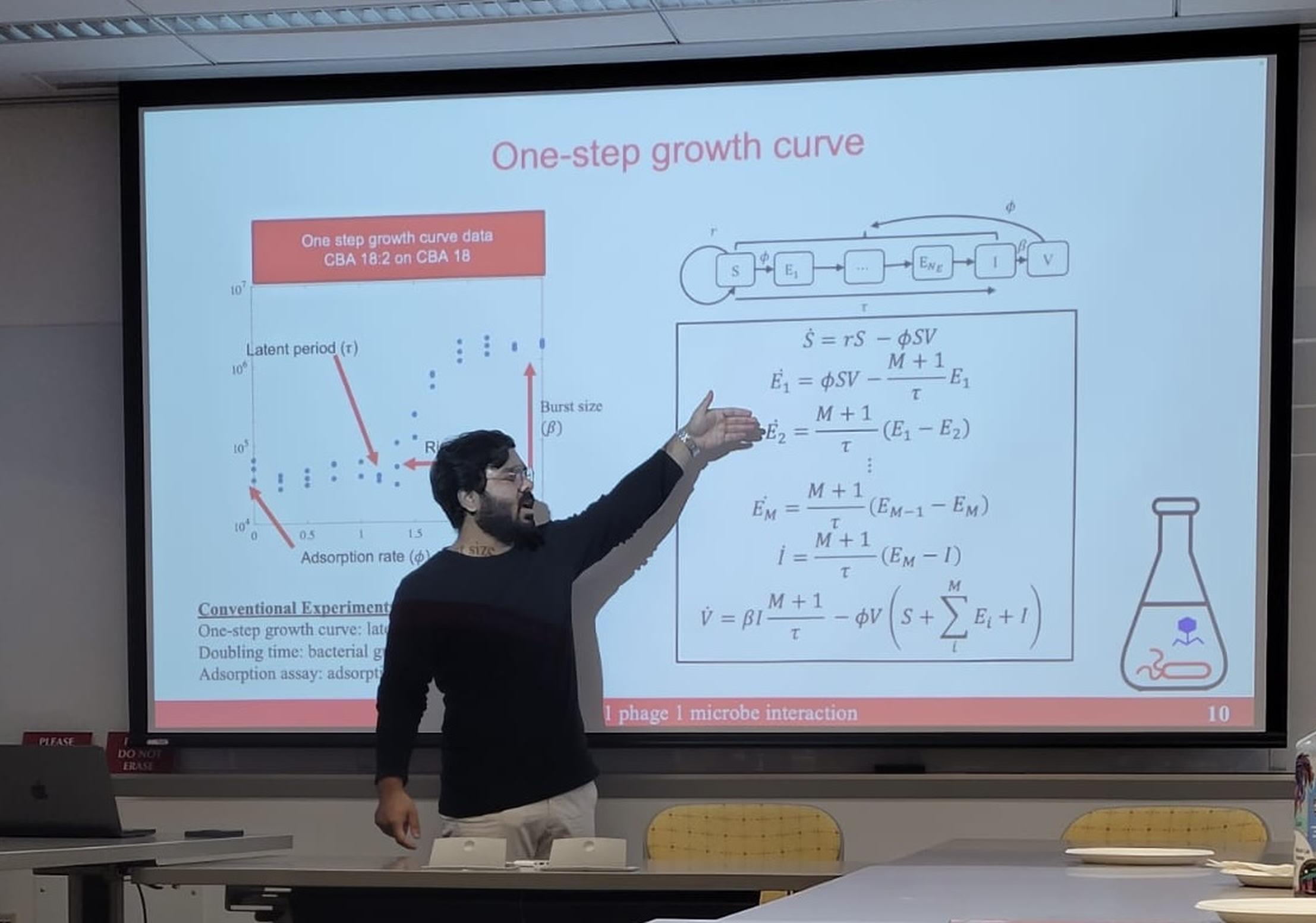 Raunak Dey gesturing to a screen with information about one-step growth cruve data Raunak Dey's research aims to solve inverse and optimization problems using time series data. Image courtesy of Raunak Dey.
‘Mathematical modeling for good’
Driven by a desire to “understand how things work,” Dey enrolled in a dual bachelor’s and master’s degree program in physical sciences at the Indian Institute of Science Education and Research Kolkata, where he studied the random motions of tiny particles.
After graduating in 2020, Dey moved to the U.S. to pursue a physics Ph.D. at Georgia Tech. As he watched the global pandemic unfold, he realized he wanted to conduct research that would directly benefit people.
“I had this philosophical feeling that the frontline workers were working so hard,” Dey said, “and I wanted to be doing research where I could apply my math aptitude to something useful to society.”
That’s when Dey started using “mathematical modeling for good” to study COVID-19 and its health implications with Joshua Weitz, now a professor in UMD’s Department of Biology and the University of Maryland Institute for Health Computing.
“The same class of models—compartmental differential equations—that we use to describe how viruses like COVID spread in the human population can be used to describe how viruses infect microbes,” Dey explained.
When Weitz moved to UMD in 2023, Dey followed. He wanted to continue what he started, and he also valued the interdisciplinary collaborations happening at UMD and the proximity to federal agencies like the National Institutes of Health.
“I'm very appreciative of the environment UMD has provided,” Dey said. “There are a lot of projects with professors across departments that allowed me to make connections, which I'm grateful for.”
Capturing complexity
While working with Weitz, Dey also joined a national research project called the Simons Collaboration on Ocean Processes and Ecology (SCOPE) that’s aimed at understanding marine microbial processes. In his work with SCOPE, Dey helps quantify the role of phages in ocean ecosystems, where “good” viruses might help maintain balance by killing microbes and recycling nutrients back into the ocean.
Dey’s ongoing research uses models to understand how different species of viruses and microbes might interact—a process that reveals just how complex these microbial communities can be.
“One of the fundamental things I’ve learned is that things in biology are really complicated, and we don’t know all the knobs that are turning to make something happen—you just see the output,” Dey said. “In our modeling framework, we try to capture a lot of these complexities, but it's not possible to capture everything.”
Viruses that live in the gut microbiome can be just as complex, but, if harnessed or managed well, can help to improve human health. As a fellow with UMD’s Center of Excellence in Microbiome Sciences, Dey said he’s looking for ways to “translate microbiome science research into policies” that will have an impact on people’s lives.
In recognition of his research collaborations, Dey received the 2024 Thomas G. Mason Interdisciplinary Physics Fund award from UMD’s Department of Physics, which supports doctoral students who work with professors in other departments.
“Interdisciplinary science is necessary and hard, and sometimes it's frustrating because of how long it takes,” Dey said, “but it’s also rewarding and hopefully useful.”
Making science accessible
When he isn’t conducting research, Dey is passionate about making science accessible to more people—especially budding scientists in his home country, India.
“Many people from underrepresented communities never get a fair shot at trying science,” he said. “This needs to change, and I want to be a part of that positive change by reducing the barrier of entry for science.”
Over the last two years, Dey has been writing tutorials and gathering resources to provide a “good starting point” for students interested in learning more about his area of research. He also mentors other Ph.D. and undergraduate students, adding that this “fulfilling experience” has helped him tailor his teaching to different audiences.
In the future, Dey wants to dive deeper into biomedical research that leverages artificial intelligence (AI) and machine learning. While he doesn’t know exactly where his career might take him after graduation, he feels that UMD has prepared him for whatever challenges await.
“I don’t know what the future holds, but I want to keep working on innovative and challenging problems that directly contribute to society,” Dey said. “That’s why I wanted to do science in the first place.”
Original story: https://cmns.umd.edu/news-events/news/raunak-dey-makes-physics-and-math-go-viral

 Researchers at the pioneering Maryland Quantum-Thermodynamics Hub meld 19th century physics with the modern techniques and tools of quantum information science. Since 2022, they have plumbed the intriguing depths of this disciplinary fusion, uncovering a deeper understanding of how the everyday world emerges from