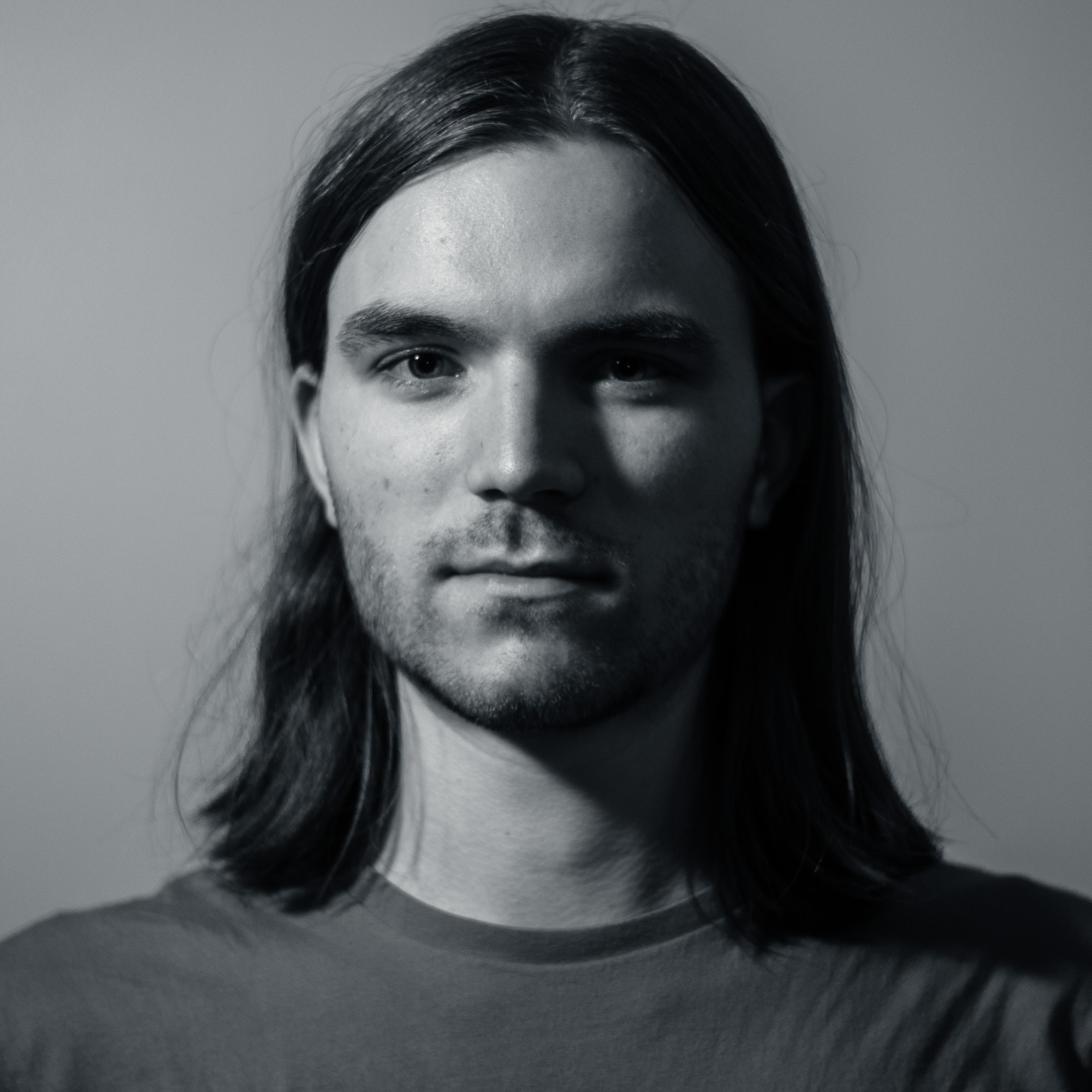
Norbert M. Linke to Return to UMD

The National Quantum Laboratory at Maryland (QLab) welcomes a renowned expert in quantum physics, computing and networking to serve as its new director, effective September 1, 2025. Norbert Linke, Ph.D., brings a decade of experience running a quantum computer user facility and conducting research on the applications of trapped atomic ions.Norbert LinkeNorbert Linke
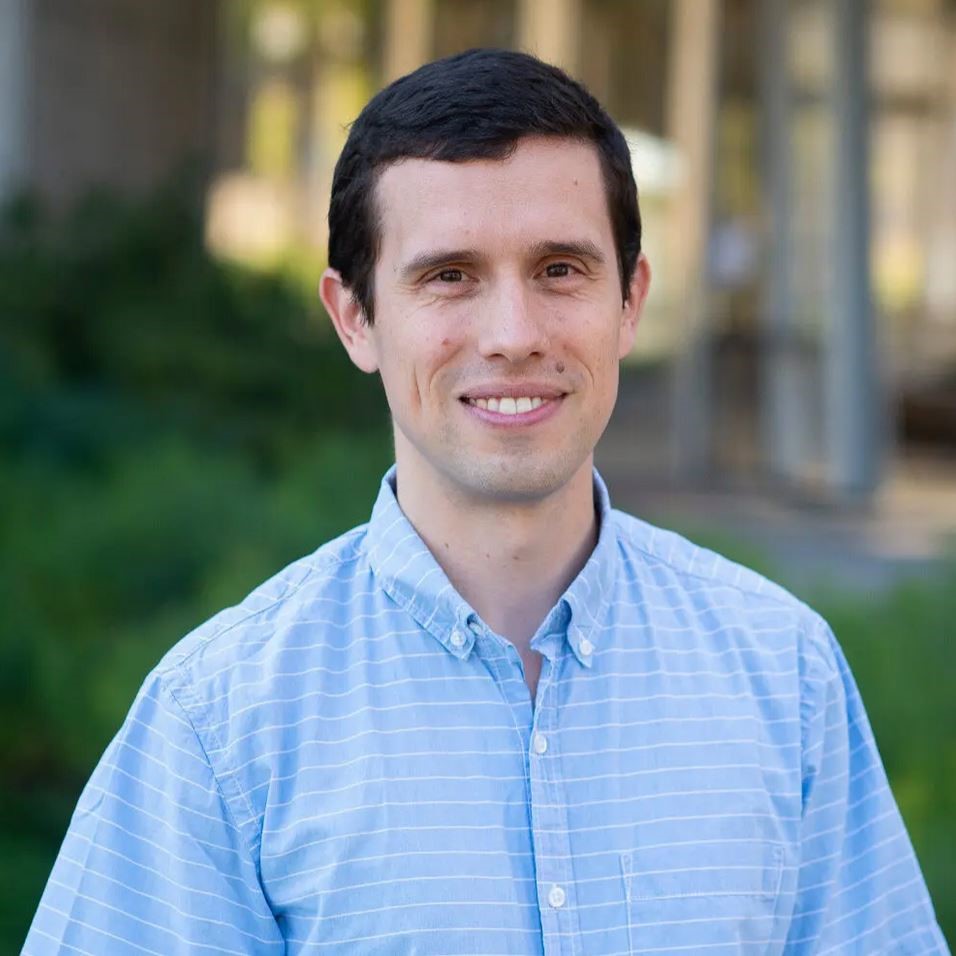
With this appointment, Linke will return to the University of Maryland’s Department of Physics, where he worked as a faculty member from 2019 to 2022, and he will hold the first IonQ Professorship, an endowed position designed to support faculty focused on quantum computing research and advancing quantum strategy in Maryland and beyond. The IonQ Professorship was established with a $1 million gift from quantum computing firm IonQ and fully matched by the Maryland Department of Commerce. The match was made through the Maryland E-Nnovation Initiative Fund (MEIF), a state program created to spur basic and applied research in scientific and technical fields at colleges and universities.

Linke, who is currently a professor of physics at Duke University, co-invented several of the original patents that enabled the launch of IonQ, born out of UMD research and headquartered in College Park. The QLab was established in 2021 through a partnership between IonQ and UMD as the nation's first user facility to provide the global scientific community with hands-on access to a commercial-grade quantum computer. Housed in the Division of Information Technology and located in the Capital of Quantum in College Park, the QLab is dedicated to advancing quantum research and education.

"I'm honored to lead the QLab in its mission to make quantum computing accessible and drive innovation. I'm excited to work with the talented team here to push the boundaries of what's possible with this technology," Linke said. “President Pines gave QLab a motto, which is ‘Quantum for All.’ Following this, my vision for QLab is to provide broad access to the latest quantum resources for researchers, commercial stakeholders, as well as students and educators.”

The QLab fosters a vibrant quantum community, through its QLab Fellows and Global User Programs, as well as the QLab Collaboration Space, a dedicated hub for innovation that opened in 2023. The QLab also supports groundbreaking research through seed grants and collaborations with companies in the Quantum Startup Foundry, resulting in numerous publications and software development.

“Linke’s expertise and leadership will be invaluable as we continue to push the boundaries of quantum computing and foster a collaborative environment for innovation,” said Jeffrey K. Hollingsworth, vice president of information technology and chief information officer at UMD.

Linke's appointment comes at a time of rapid growth and development in the field of quantum computing, especially in the state of Maryland, where Gov. Wes Moore recently announced a $1 billion Capital of Quantum Initiative anchored by UMD and built on a landmark public-private partnership, in which the QLab is poised to play a key role.


Original story: https://umdrightnow.umd.edu/university-of-maryland-names-new-director-of-national-quantum-laboratory

About the QLab:
The National Quantum Laboratory at Maryland (QLab) is a national user facility that provides the scientific community with access to a commercial-grade quantum computer. Established through a partnership between IonQ and the University of Maryland, the QLab is dedicated to advancing quantum research and education and is housed in the Division of Information Technology.
  

Powered by Physics

Leonard Campanello (Ph.D. ’20, physics) spent the last three years on an ambitious mission—helping billions of Google Maps users find exactly what they’re looking for.

“I worked on the search function for Google Maps: you move the screen to a section of the map where you want to look for restaurants or hotels or things to do, add filters or attributes, like it has to be dog friendly or have a waterfront view,” Campanello explained. “And you want Google Maps to give you the best answer every time.”

As a Senior Data Scientist at Google, Campanello’s work brought science to the search process, applying the interdisciplinary physics training he received as a Ph.D. student in Professor Wolfgang Losert’s lab at the University of Maryland. Working on the Google Maps team, Campanello put his experience with models, algorithms, and analytics to work to better understand Maps users and optimize their search results.

“So, when you first issue a search, there's a list of places in a particular order. That order is carefully controlled,” Campanello explained. “We’ve proven that changing ranking algorithm has a material impact on the user's experience, and, at the end of the day, we need to know, did we have a net positive or a net negative effect on users? And we always strive to go in the net positive direction.”

As a scientist, Campanello has always been passionate about finding the stories hidden in data and building statistical models that capture the essence of the data, putting his physics skill set to work to answer a question or solve a problem.

“At the core of many problems in both physics and data science, I think we are trying to understand the data generating process so that we can better explain the fundamental physical phenomena driving what we see,” Campanello explained. “We observe that applying a force results in some change in a measurable quantity, whether the subject is a Google Maps user or a cell under the microscope. What's going on in the background that's fundamentally causing that change? How can we use this information to better understand our world? That’s what we want to find out.”

All in on physics

Campanello was a strong student who went all in on science and math since high school and earned a bachelor’s degree in physics from St. John’s University in 2013. Then, still unsure about how physics would translate into a future career, Campanello decided to pursue his Ph.D. at UMD, where he would have access to various options.

“I didn't know that what I wanted to do with enough certainty that I could commit to a graduate school that was kind of one dimensional,” Campanello recalled. “UMD had a massive physics department with a diversity of people in experiment and theory, whether it was condensed matter or high energy or biophysics or whatever, and that range of options was what ultimately kind of pulled me to UMD.”

After spending his first year working in condensed matter theory, a class with Physics Professor Michelle Girvan gave Campanello a whole new perspective.

“The class was nonlinear dynamics of extended systems and to this day it's probably the most influential class I ever took,” Campanello said. “Her problem-solving approach, including using graph theory and complex systems models, which I was never exposed to before, was eye-opening. We could actually create mathematical representations of all of these phenomena that we see in the world. And I was just wowed.”

At Girvan’s suggestion, Campanello joined Losert’s lab and began his Ph.D. research quantifying and modeling different dynamic processes, specifically complex interactions in biological systems.

“We already knew what some of the interactions were, so we knew that if we put this immune cell in the presence of some material, the immune cell would react in a specific way, which we could also measure under a microscope,” Campanello explained. “So given this set of biochemical information on the way these things behave short-term, medium-term and long-term, we said, how can we fit mathematical models to the microscope data and then use this to make inferences about this system as a whole?”

Opportunities, collaborations and simulations

Campanello took advantage of many opportunities at UMD, from teaching multiple MATLAB Boot Camps on image processing, computer vision and data analysis to coaching teams of data science students for the annual university-wide Data Challenge competition. Meanwhile, his continuing work in Losert’s lab exposed him to a world of possibilities.

“Wolfgang gave me and everyone in his lab the opportunity to work on so many different projects and collaborations with the National Institutes of Health and others, whether it was fundamental cell biology to projects on the interface of immunotherapies and autoimmune diseases to cancer, it's just crazy how much exposure we had,” Campanello noted. “He would help us identify opportunities to apply our analysis and modeling tools, give us guidance on the projects, and then let us to run with it. I really appreciated that.”

Campanello earned his Ph.D. in August 2020 and continued to do research at UMD for about six months before landing a job at Citibank in early 2021, applying his experience in modeling and analytics to consumer banking. 

Later that same year, he accepted a very different kind of opportunity at Google, working with the team that supports Google Maps to evaluate, advance and improve its ever-expanding search functions and, later, new capabilities, thanks to the addition of artificial intelligence.  

“The team is like 30 or so engineers, product managers, designers, user-experience researchers, and I was the one data scientist,” Campanello explained. “One of my primary responsibilities when I first joined was to create metrics or measurements that were absolute—meaning not open to interpretation—and I spent a lot of time doing research in that area to ensure that those measurements aligned with what we wanted for the user. What do we measure to know if we made the experience better?”

A new opportunity

In February 2025, after more than three years at Google, Campanello left to join Optiver, an Amsterdam-based global market maker that buys and sells securities to provide liquidity to markets. In this new position, he’ll again leverage his physics skill set, this time as a quantitative researcher.

“Part of my role will be to help improve the team's predictions in order to make better trading decisions. Can we make predictions right now about what will happen later today or later this hour or even just one minute from now?” Campanello explained. “If we can put numbers to these things and build models that accurately predict outcomes, then we can ultimately use those models to improve liquidity for all market participants.”

Fascinated by finance—and still inspired by the power of physics—Campanello looks forward to this next opportunity to grow.

“I've always had an interest in finance and what I'm looking forward to the most in this new role is the ability to really further my skill set,” Campanello said. “I want to get more exposure to what's happening at the bleeding edge of modeling and data science in quantitative finance. And I think this will be a good avenue for me to do that.”

Written by Leslie Miller

Kiyong Kim Elected as a Fellow of Optica

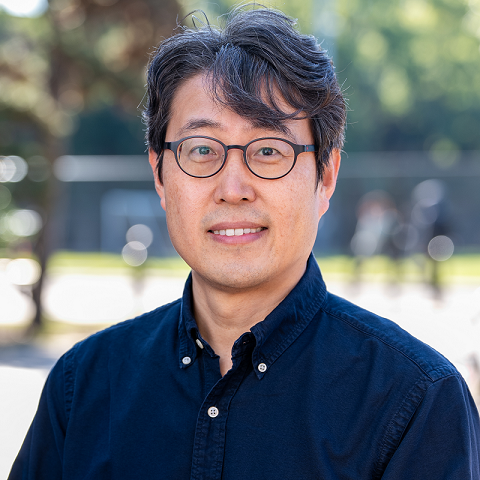
Kiyong Kim has been selected as a 2025 Optica Fellow for his pioneering contributions to the generation and understanding of terahertz radiation from strong laser field interactions with matter.  He is one of 121 members, from 27 countries, selected for their significant contributions to the advancement of optics and photonics through education, research, engineering, business leadership and sKiyong KimKiyong Kimervice.

Kim received his B.S. from Korea University and his Ph.D. from the University of Maryland. His graduate research focused on measuring ultrafast dynamics in the interaction of intense laser pulses with gases, atomic clusters, and plasmas. This work earned him the Marshall N. Rosenbluth Outstanding Doctoral Thesis Award from the American Physical Society.

Following his doctoral studies, Kim moved to Los Alamos National Laboratory as a Director’s Postdoctoral Fellow and while there received a Distinguished Performance Award. After accepting a position as an Assistant Professor at the University of Maryland in 2008, he received a DOE Early Career Research Award and an NSF Faculty Early Career Development Award. Kim also received the departmental Richard A. Ferrell Distinguished Faculty Fellowship in 2014.

From 2021 to 2022, Kim held appointments at Gwangju Institute of Science and Technology (GIST) and the Center for Relativistic Laser Science (CoReLS) at the Korean Institute for Basic Science, leading experiments on petawatt laser-driven electron acceleration, nonlinear Compton scattering of petawatt laser pulses and GeV electrons, and high-power terahertz generation.

With colleagues in physics and the Institute for Research in Electronics & Applied Physics (IREAP), he is co-PI on a $1.61M Major Research Instrumentation (MRI) award from the National Science Foundation (NSF) to upgrade high-power laser systems at UMD.


Finding the Beauty in Physics

Phoebe Hamilton’s (M.S. ’11, Ph.D. ’13, physics) research career at the University of Maryland could have ended when she earned her Ph.D. Instead, it marked the start of an exciting challenge—for Hamilton and her fellow high-energy physics researchers in UMD’s Department of Physics.
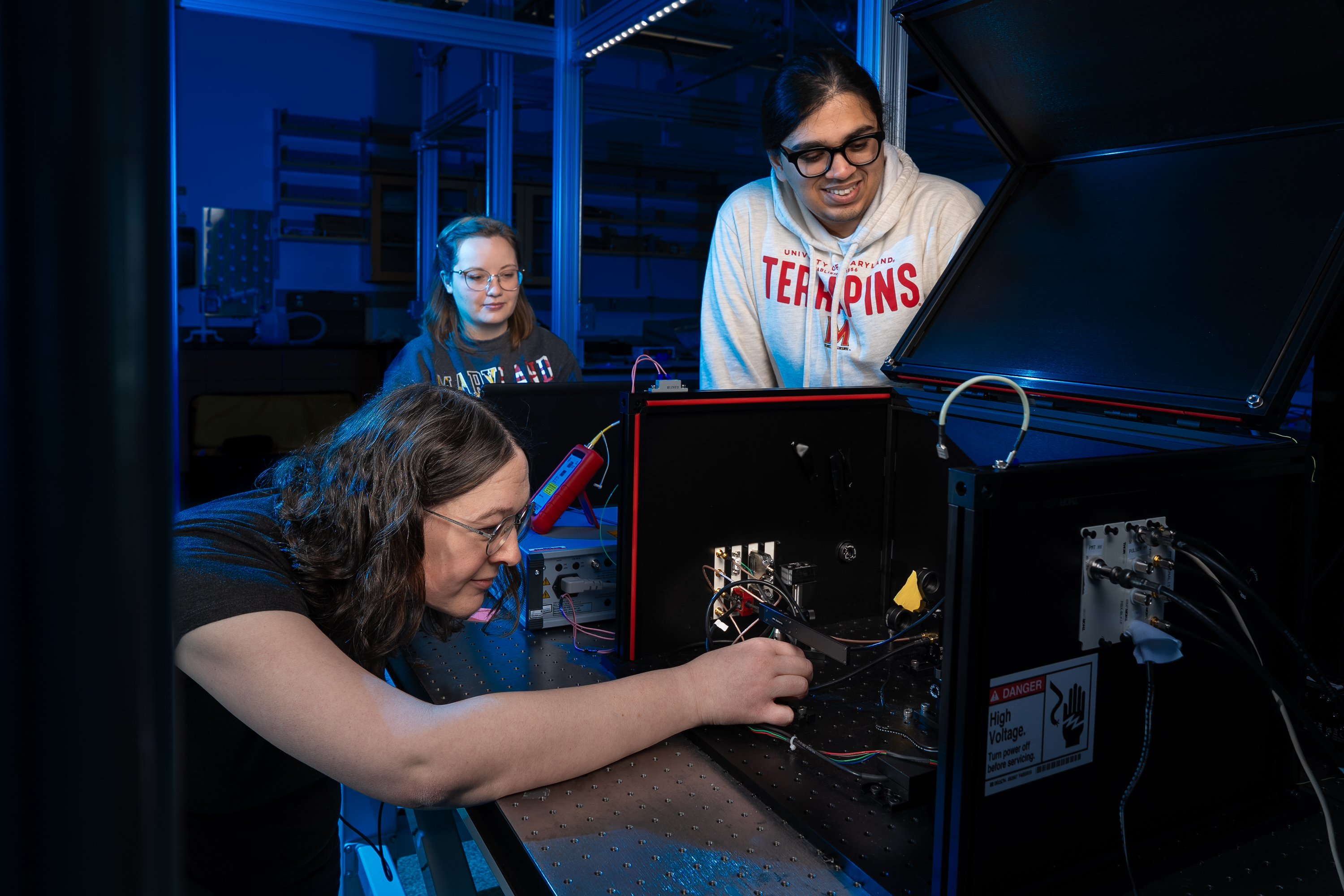
Phoebe Hamilton, Elizabeth Kowalczyk and Othello Gomes check a photodetector.Phoebe Hamilton, Elizabeth Kowalczyk and Othello Gomes check a photodetector.In fall 2012, Distinguished University Professor and Gus T. Zorn Professor Hassan Jawahery eyed a new opportunity after his research group wrapped up with BaBar, a collider experiment in California.

“BaBar had finished collecting new data and we were looking for the next gig for the group,” Hamilton recalled. “Hassan was my Ph.D. advisor and we talked about how exciting it would be to move to the Large Hadron Collider beauty—LHCb—experiment.”

Just two months before Hamilton defended her dissertation, Jawahery’s group learned that they had been formally accepted into the LHCb experiment, which is named after its primary research subject: a particle called the beauty quark, also known as a bottom quark or b quark. By studying bottom quarks produced by proton-proton collisions at the Large Hadron Collider located near Geneva, Switzerland, researchers hope to come closer to understanding why there is so much matter but so little antimatter in the universe.

Excited by the opportunity to discover new physics at the world’s most powerful particle accelerator, Hamilton stayed at UMD. As a postdoctoral researcher from 2012 to 2020 and a faculty specialist from 2020 to 2023, she developed tools that enabled the LHCb to take measurements previously thought “impossible” by some scientists.

Now, as an assistant professor of physics, her contributions continue to level up the LHCb’s abilities, improving its chances of making groundbreaking findings.

“Getting to stay a postdoc as long as I did at Maryland was a real blessing,” Hamilton said. “I wasn’t sure I’d actually have the chance to become an assistant professor, but I'm very happy to get to do it. Maryland is such a home and such a family to me.”

Raising the BaBar

Hamilton’s interest in physics began in high school and she nurtured it with books about string theory by physicist Brian Greene. After graduating, she enrolled at Youngstown State University to pursue computer science, another one of her interests, but switched to physics after realizing that it inspired and challenged her more than any other subject.

“I like knowing how things work,” said Hamilton, who also enjoys learning new musical instruments for similar reasons. “The fact that physics is orderly and follows these predictable rules has always been fascinating to me.”

Hamilton quickly took to particle physics, and after earning her bachelor’s degree in 2007, she decided to pursue particle theory research in UMD’s graduate program. She chose UMD because of its wide range of research possibilities, which allowed her to try out different specializations before committing.

“I thought I knew what I wanted to do, but there was doubt,” she said. “With UMD, I thought to myself, ‘This is where I’m going to be able to thrive no matter what I do.’”

Hamilton soon discovered she enjoyed the experimental side of particle physics much more than theory. So when Associate Professor Doug Roberts put up flyers seeking student researchers for the BaBar experiment, Hamilton jumped at the chance.

BaBar was Hamilton’s introduction to experimental studies of CP violation, which occurs when two conservation laws of particle physics—charge conjugation and parity—are broken. By measuring CP violation at experiments like BaBar, researchers can begin to understand the differences between matter and antimatter.

“I fell in love with it very quickly,” Hamilton said of BaBar. “It was a fantastic machine and a fantastic experiment.”

Hamilton’s research contributed to the first measurement of how Bs mesons, a family of subatomic particles called mesons that contain a bottom quark and a strange antiquark, are produced at different collision energies. Ultimately, the BaBar experiment shed light on how antimatter is produced and set the stage for Hamilton’s participation in an even bigger—but messier—collider.

“The beautiful thing at BaBar was that you would get two hadrons containing bottom quarks and nothing else, so it was very clean and very easy to measure what was going on,” Hamilton said. “Here [at the LHCb], colliding protons is like colliding handfuls of rock salt. You get 100 reconstructed particles in every event and you have to sort through it.”

Achieving the ‘impossible’

For the last 12 years, Hamilton has been working to make those messy collisions a little easier to interpret. UMD’s contribution to the LHCb experiment falls within the realm of lepton flavor universality: a physics principle stating that the only difference between different “flavors,” or types, of leptons—including electrons, muons and tau leptons—is their mass. 

The LHCb is a good fit for this type of research because it analyzes a large number of particles containing b quarks, which transform, or decay, into leptons. In the beginning, though, some scientists thought that lepton flavor universality couldn’t be done at the LHCb because either one or three neutrinos escape undetected during collisions, making it difficult to determine all of the energies and momenta needed to distinguish muons from tau leptons. 

“Because of the messy nature of these proton-proton collisions, the consensus was that this was too hard for LHCb to do,” Hamilton said. “But Jawahery and I worked together on a technique to make some wild approximations and figure out a way to do it anyway.”

And they did figure out a way. Developed from 2013 to 2015 in collaboration with LHCb researcher Greg Ciezarek, their method of analyzing decays led to measurements of lepton flavor universality between muons and tau leptons that were previously thought impossible. 

“It was interesting to go from ‘This is probably another dead-end’ to ‘Oh, this might actually be worth something’ to ‘This is actually the star of the experiment right now,’” Hamilton said. “This is still an active area of research for us. We extended and superseded the 2015 measurement in 2023 and are working on the next generation of this in the data from the second run of the LHC.”

Cracking the K-pi puzzle

Over the years, Hamilton has also played a key role in making the LHCb’s equipment more durable and better at discerning different particles. She helped develop electronics for the Upstream Tracker sub-detector for the experiment’s first upgrade from 2022 to 2023 and is now testing new photodetectors in her lab. These new detectors would measure the light produced in upgraded modules for the LHCb’s calorimeter, which stops particles as they pass through and enables researchers to measure the energy deposited. 

This planned upgrade to the calorimeter aims to make energy measurements more precise, which can ultimately help researchers determine which particles were produced in a collision event.

“One of the big motivations for upgrading the calorimeter is making some of the granularity smaller so that you can tell different particles apart,” Hamilton explained. “Along with the ability to precisely measure the time different particles arrive, it should in principle be able to cope with five times the collision rate.”

Whether Hamilton is toiling in the lab or analyzing data from the LHCb, she continues to find inspiration in physics’ most puzzling questions. She recently submitted a research proposal to dive deeper into matter-antimatter asymmetries and continues to work on developing new and improved techniques for her research. 

From 2014 to 2015, she and her colleagues at UMD developed a way to study b-hadron decays with only one reconstructed trajectory, meaning that certain key information is missing. She believes this technique can now be applied to a persistent challenge in physics called the K-pi puzzle.

“The K-pi puzzle is the possibility that the Standard Model fails to explain the pattern of matter-antimatter asymmetry in b-hadron decays to two pseudo-stable mesons, pions or kaons—or one of each. The Standard Model predicts specific patterns to their CP asymmetries, which we can use to check the Standard Model’s validity, but theorists need measurements of them all,” Hamilton explained. “Some of these involve two trajectories to reconstruct and identify the b-hadron but many do not, and these tend to be the less understood ones.”

Going forward, Hamilton hopes to make more “impossible measurements”—and perhaps challenge or reshape the Standard Model of physics in the process.

“We have an opportunity to contribute to understanding this puzzle in some of the areas that are fuzziest right now,” Hamilton said, “and I think there's exciting things to be tried there.”


Written by Emily Nunez

Malcolm Maas Named 2025-26 Churchill Scholar

University of Maryland senior Malcolm Maas has been awarded a 2025-26 Churchill Scholarship, joining only 15 other science, engineering and mathematics students nationwide in winning the prestigious honor. 

“We could not be prouder of how Malcolm Maas represents the University of Maryland to the world,” said Amitabh Varshney, dean of UMD’s College of Computer, Mathematical, and Natural Sciences. “Malcolm is a phenomenal student researcher who is driven to understand complex world problems like climate change and provide innovative solutions to them.”Malcolm Maas. Photo courtesy of same.Malcolm Maas. Photo courtesy of same.

Maas, who plans to graduate in three years with bachelor’s degrees in atmospheric and oceanic science (AOSC) and physics, will receive full funding to pursue a one-year master’s degree at the University of Cambridge’s Churchill College in the United Kingdom. The scholarship covers full tuition, a competitive stipend, travel costs and the chance to apply for a special research grant. 

Maas plans to pursue a Master of Philosophy degree in mathematics.

“I feel incredibly honored to have received this scholarship, and I’m very grateful to everyone who has supported me on my way here,” Maas said. “I’m excited for the opportunity to explore atmospheric dynamics further and to experience Cambridge next year.”

A total of 127 nominations this year came from 82 participating institutions. Ten UMD students have been nominated in the past seven years—and nine of them have been named Churchill Scholars.

“The University of Maryland’s remarkable success in racking up Churchill Scholarships testifies to the excellence of the research opportunities and mentorship our undergraduates receive,” said Francis DuVinage, director of UMD’s National Scholarships Office. “Malcolm Maas’ record of accomplishment as a third-year senior puts him in a class by himself.”

Since 2022, Maas has been working with AOSC Associate Professor Jonathan Poterjoy on fundamental challenges associated with environmental prediction and validation of atmospheric modeling systems. Specifically, he is quantifying the degree to which commonly used data assimilation methods shift models away from physically plausible solutions due to commonly adopted but incorrect assumptions. Maas presented their work in January 2025 at the American Meteorological Society Annual Meeting.

“Malcolm initiated our research collaboration on his own and I fully expect him to draft a first-author paper that we submit for publication this year,” Poterjoy said. “I feel that Malcolm can succeed in virtually any field, and I am pleased to see that he chose a research career in atmospheric science where his talents can have broad human impact.” 

Maas’ research interests and experiences extend beyond his work with Poterjoy and currently range from weather time scales to climate time scales. 

In summer 2024, Maas interned at the University of Chicago with Geophysical Sciences Professor Tiffany Shaw, where he assessed extreme heat and atmospheric circulation trends associated with Arctic sea ice loss in climate models and observational datasets. He presented this work at the American Geophysical Union’s Annual Meeting in 2024.

In summer 2023, Maas participated in the undergraduate summer intern program at the Lamont-Doherty Earth Observatory and worked on a project with Kostas Tsigaridis, a research scientist at Columbia University and the NASA Goddard Institute for Space Studies. Maas used a large dataset of Earth system model simulations to explore the effects of volcanoes on climate and atmospheric sulfur. He used machine learning to develop a tool that estimates where unidentified historical eruptions happened based on ice core data. Maas presented this work at the European Geosciences Union’s General Assembly in 2024 in Austria.

When Maas arrived at UMD in 2022, he joined a group of AOSC students installing and managing a micronet—a small-scale network of weather sensors—across the university’s campus. Five weather stations now provide minute-by-minute updates on the temperature, wind speed, pressure, dew point and rain rate on campus. Maas helped create the data collection system and user-friendly graphs to visualize the data, which are displayed on the UMD Weather website.

When the university and the Maryland Department of Emergency Management installed their first weather tower as part of the Maryland Mesonet in 2023, they asked Maas to quickly adapt his micronet visualization tools to work with the mesonet data. The 23 towers operational around the state—with more than 70 planned—help to advance localized weather prediction and ensure the safety of Maryland's residents and visitors.

For his Gemstone honors research project, Maas and 10 teammates have been working with UMD Mechanical Engineering Professor Johan Larsson to optimize the shape of marine propellers.

In high school, Maas helped build the first global tornado climatology database. He gathered and processed historical data for over 100,000 tornadoes that occurred around the world. The project’s website raked in 160,000 page views during its first year, and the work was published in the Bulletin of the American Meteorological Society in 2024.

Outside of class, Maas plays the pipe organ, represents the Ellicott Community on the Student Government Association, tutors with the Society of Physics Students and is a member of the Ballooning Club. He received a Barry M. Goldwater Scholarship, National Merit Scholarship, President’s Scholarship and the Department of Physics’ Angelo Bardasis Scholarship.

After his time at the University of Cambridge, Maas plans to pursue a Ph.D. in atmospheric science.