

If gamblers, investors and quantum experimentalists could bend the arrow of time, their advantage would be significantly higher, leading to significantly better outcomes.
Adjunct Assistant Professor and JQI affiliate Nicole Yunger Halpern and her colleagues at the University of Cambridge have shown that by manipulating entanglement—a feature of quantum theory that causes particles to be intrinsically linked—they can simulate what could happen if one could travel backwards in time. If such an experiment can be performed, it will be as if the quantum experimentalists are gamblers that can retroactively change their past actions to improve their outcomes in the present.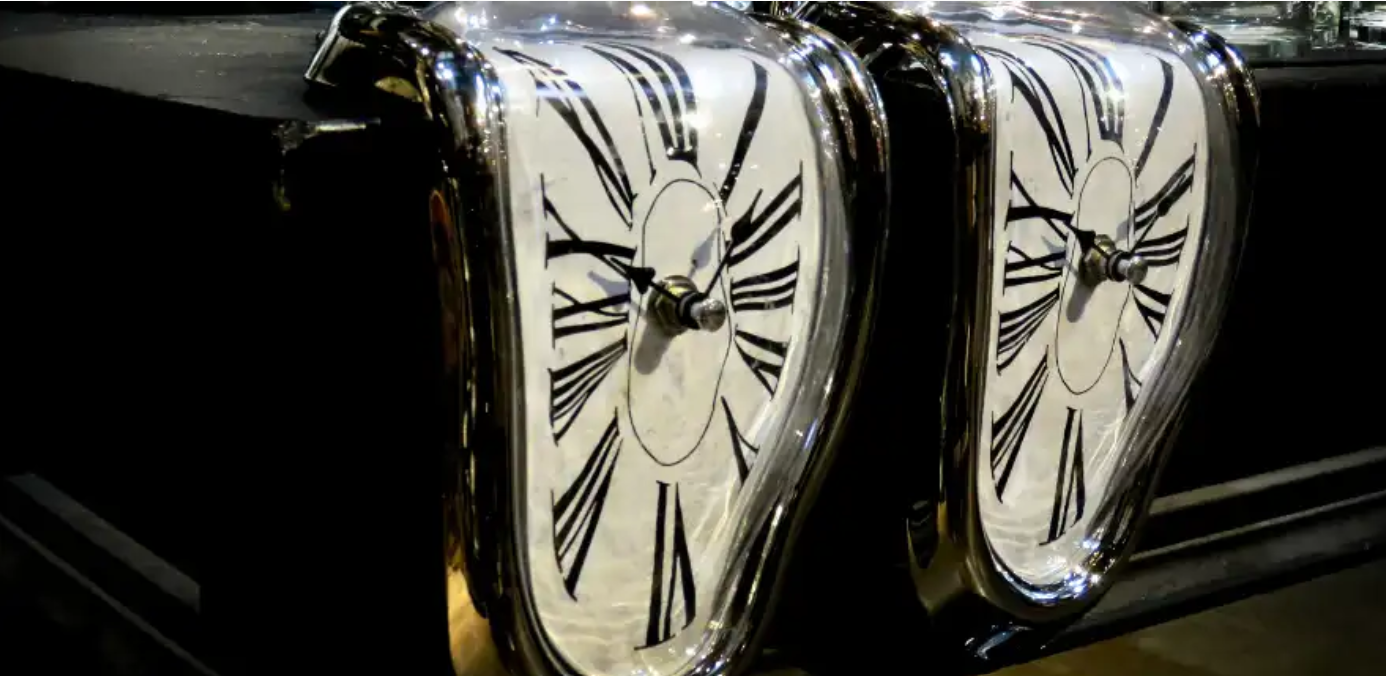 (Credit: Time is Slipping Away (cropped) from Bennilover on Flick under CC BY-ND 2.0 DEED)
Whether particles can travel backwards in time is a controversial topic among physicists, but scientists have previously simulated models of how such spacetime loops could behave if they did exist. By connecting their new theory to quantum metrology, which uses quantum theory to make highly sensitive measurements, the Cambridge team has shown that entanglement can solve problems that otherwise seem impossible. The study appears in the journal Physical Review Letters.
“Imagine that you want to send a gift to someone: You need to send it on day one to make sure it arrives on day three,” says lead author David Arvidsson-Shukur, from the Cambridge Hitachi Laboratory. “However, you only receive that person’s wish list on day two. So, in this chronology-respecting scenario, it’s impossible for you to know in advance what they will want as a gift and to make sure you send the right one.
“Now imagine you can change what you send on day one with the information from the wish list received on day two. Our simulation uses quantum entanglement manipulation to show how you could retroactively change your previous actions to ensure the final outcome is the one you want.”
The simulation is based on quantum entanglement, where the fates of quantum particles are intrinsically linked in a way that never occurs in the physics of relatively large items like people or even grains of sand. Entanglement plays an essential role in quantum computing—the harnessing of connected particles to perform computations too complex for classical computers.
“In our proposal, an experimentalist entangles two particles,” says co-author Yunger Halpern, who is also a Fellow of the Joint Center for Quantum Information and Computer Science and a physicist at the National Institute of Standards and Technology. “The first particle is then sent to be used in an experiment. Upon gaining new information, the experimentalist manipulates the second particle to effectively alter the first particle’s past state, changing the outcome of the experiment.”
“The effect is remarkable, but it happens only one time out of four!” said Arvidsson-Shukur. “In other words, the simulation has a 75% chance of failure. But the good news is that you know if you have failed. If we stay with our gift analogy, one out of four times, the gift will be the desired one (for example a pair of trousers), another time it will be a pair of trousers but in the wrong size, or the wrong colour, or it will be a jacket.”
To give their model relevance to technologies, the theorists connected it to quantum metrology. In a common quantum metrology experiment, photons—small particles of light—are shone onto a sample of interest and then registered with a special type of camera. If this experiment is to be efficient, the photons must be prepared in a certain way before they reach the sample. The researchers have shown that even if they learn how to best prepare the photons only after the photons have reached the sample, they can use simulations of time travel to retroactively change the original photons.
To counteract the high chance of failure, the theorists propose to send a huge number of entangled photons, knowing that some will eventually carry the correct, updated information. Then they would use a filter to ensure that the right photons pass to the camera, while the filter rejects the rest of the ‘bad’ photons.
“Consider our earlier analogy about gifts,” says co-author Aidan McConnell, who carried out this research during his master’s degree at the Cavendish Laboratory in Cambridge and is now a PhD student at ETH, Zürich. “Let’s say sending gifts is inexpensive and we can send numerous parcels on day one. On day two we know which gift we should have sent. By the time the parcels arrive on day three, one out of every four gifts will be correct, and we select these by telling the recipient which deliveries to throw away.”
“That we need to use a filter to make our experiment work is actually pretty reassuring,” says Arvidsson-Shukur. “The world would be very strange if our time-travel simulation worked every time. Relativity and all the theories that we are building our understanding of our universe on would be out of the window.
“We are not proposing a time travel machine, but rather a deep dive into the fundamentals of quantum mechanics. These simulations do not allow you to go back and alter your past, but they do allow you to create a better tomorrow by fixing yesterday’s problems today.”
Story by Vanessa Bismuth
This story was prepared by the University of Cambridge and adapted with permission.