A New Kind of Entanglement Helps Quantum Sensors Tune Out Noise

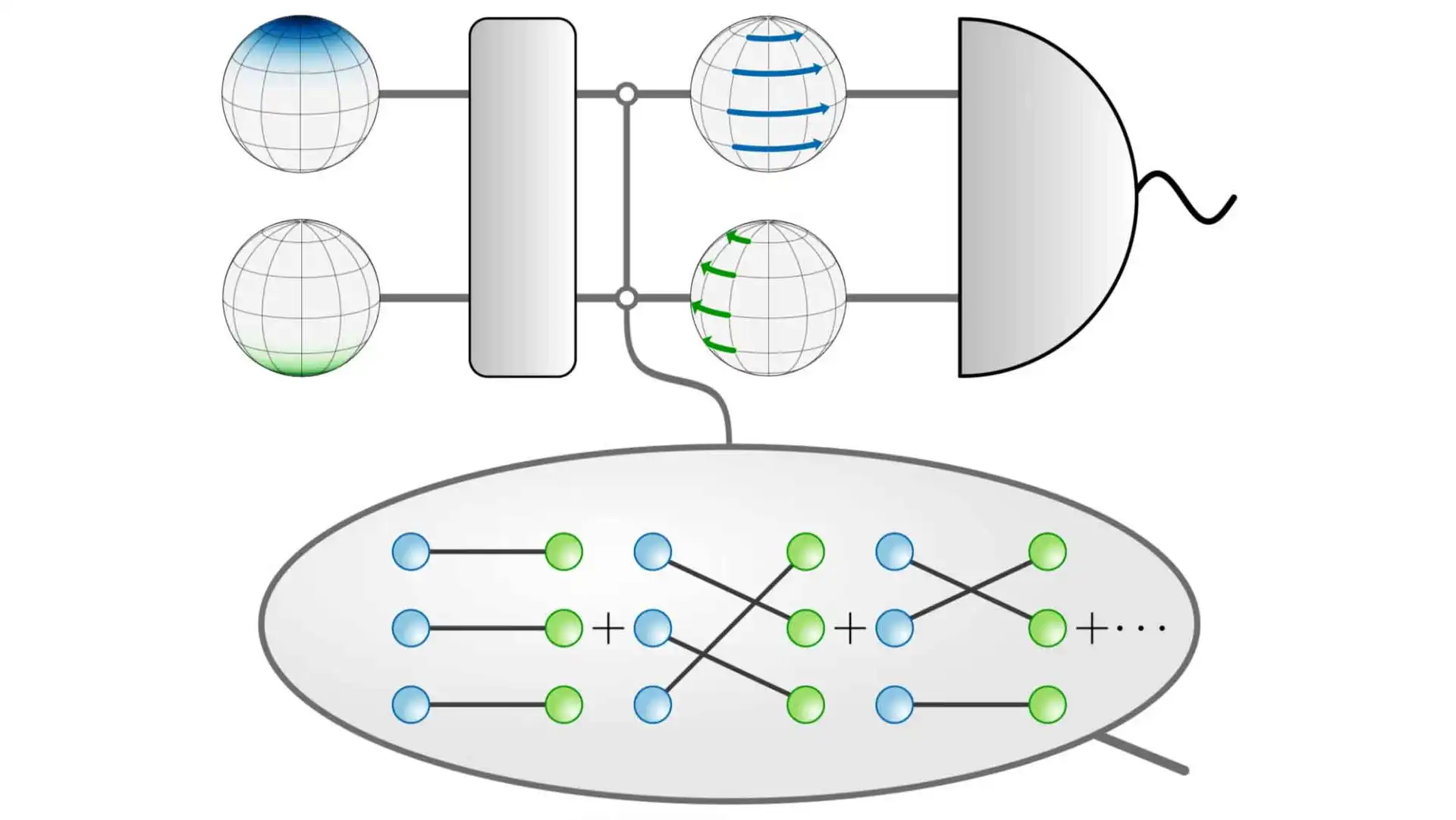
In a quest to build the most accurate sensors in the world, scientists are constantly improving their performance. Making them more precise, stable and reliable. Photon exchange through an optical cavity links two atomic ensembles, creating a shared entangled state. This entanglement is designed to be insensitive to common noise while remaining highly sensitive to differential signals. (Credit: Raphael Kaubruegger, JILA)Photon exchange through an optical cavity links two atomic ensembles, creating a shared entangled state. This entanglement is designed to be insensitive to common noise while remaining highly sensitive to differential signals. (Credit: Raphael Kaubruegger, JILA)

But eventually, physical constraints will prevent further improvements. 

“By fully embracing the laws of quantum physics, one can expand the performance limits imposed by these constraints,” says JQI Fellow Alexey Gorshkov, who is also a Physicist at the National Institute of Standards and Technology (NIST), a Fellow of the Joint Center for Quantum Information and Computer Science and an Associate Professor in the Department of Physics at the University of Maryland. “And it's very exciting to come up with protocols that come as close as possible to saturating these limits for different sensing tasks.”

Even the most precise sensors in the world are not fully isolated and are limited by noise—subtle disturbances from the environment like vibrations, electromagnetic fields or temperature changes. 

So, Gorshkov, JILA Fellows Ana Maria Rey and James K. Thompson and their colleagues from the Niels Bohr Institute and the Indian Institute of Technology Madras, asked, how can we improve the next generation of sensors despite these limitations? 

One promising idea is to use quantum entanglement, so atoms are connected to each other and working together as a system to form a quantum sensor. When atoms are entangled, they share properties even when separated by distance. In principle, this allows for more precise measurements. But entangled atoms are still subject to noise. “Entangled states are well understood for estimating a single parameter, but our goal was to create an entangled state that is highly sensitive to a parameter difference between two nodes of a sensor network,” says Raphael Kaubruegger, a research associate at JILA and the lead author of the article. 

The researchers set out to identify a new class of entangled states that could filter out noise affecting both sensors. They then developed two ways to create these states inside an optical cavity, a pair of mirrors about one inch apart that bounce photons back and forth. They describe the state and two methods to create it in a recent paper published in Physical Review X

The entangled state they identified uses decoherence-free subspaces which are protected from certain types of disturbances to quiet noise affecting both sensors. 

Lasers are used to create coherent superposition between two internal states of an atom, but to accomplish that, the laser’s frequency needs to exactly match the atomic transition. 

The challenge, as Rey explains, is that even the most precise lasers cannot maintain a stable frequency for long enough. These laser frequency instabilities generate noise which is equally experienced by both sensors and is currently one of the most detrimental errors in state-of-the-art clocks. “Ideally, one would like to prepare the atoms in a state that is insensitive to this type of noise,” says Rey, who is also a NIST fellow and professor adjoint of physics at the University of Colorado Boulder. 

“The state we create is entanglement between these atoms, but in a way that you cannot distinguish which atom is in which ensemble,” Rey says. “They are fully symmetrized.” 

“After the fact, we realized this was the same kind of state people were thinking about to describe antiferromagnets, or quantum magnets,” says Thompson, who is also NIST fellow and professor adjoint of physics at the University of Colorado Boulder. 

In condensed matter physics, the Lieb-Mattis state describes a quantum version of an antiferromagnet, where two groups of atoms act like they point in opposite directions, but without the system picking one fixed direction in space. 

One method the team developed to prepare the desired state involves entangling two nodes of a sensor network by engineering a “spin exchange,” by having the atoms send photons back and forth through an optical cavity. This leads to a state where each atom in one node is perfectly anticorrelated with an atom in the other. If one atom is “up,” the other atom is “down.” 

Thompson likens this approach to baseball, where each ensemble is a baseball team. The teams are throwing balls, or in this case photons, to each other. Every time a ball is thrown, the other team catches it. Thompson adds that it’s important that we don’t know which player threw the ball or who caught it. 

“That’s what builds these links,” Thompson says. “If a ball is thrown, it is definitely caught.” 

The approach produces Heisenberg scaling, or the best possible precision scaling where all the atoms act as one quantum object. 

Optical cavities are not perfect. As Rey explains, sometimes you may lose a photon. The team’s second approach takes this into account. 

Inside the optical cavity, photons can bounce back and forth between very reflective mirrors about 100,000 times before they accidentally slip through to the other side. 

“We are losing photons, but the important part is that the photons are lost in a collective way,” Rey says. 

Because it’s impossible to tell which atom is to blame, this can create entanglement—driving them into a state where they cannot lose more photons. 

“At some point they get really good at not dropping the ball anymore,” Thompson says. 

“They go into a ‘dark state,’ or a state where the phases of the emitted photons completely cancel out, leading to what it is known as destructive interference,” Rey adds. 

The team was initially trying to understand the detrimental effect of losing those photons. But as Rey explains, ultimately this type of dissipation actually led them to a state they wanted. 

“The state we initially wanted to prepare was one in which half the atoms are excited, but the system cannot collectively emit a photon,” Kaubruegger adds. 

The team’s proposed states can be created quickly, and more importantly, faster as the system gets larger, making them practical for scaling quantum sensors. 

“People have thought about this kind of state when you only have two atoms, which is cool, but you’d like to use more,” Thompson says. “It turns out, the more atoms you have, the better!” 

By making quantum sensors more precise, these entangled states could one day help guide navigation when GPS is unavailable or reveal hidden underground resources such as minerals, oil or gas. 

Close collaborations between theorists and experimentalists have been key to this work. The groups inspire each other—and keep each other in check. Because they work so closely together, Kaubruegger says they have a deeper understanding of the challenges experimentalists face. 

And now, the ball, so to speak, is in Thompson’s group’s hands; to demonstrate the state in experiment.

This text has been adapted with permission from a story written by Kirsten Apodaca and originally published by JILA. It has been adapted with minor changes here.


Lepton Flavor Universality Tests Using Bc+ Decays at LHCb

UMD graduate student Emily Jiang delivered a CERN seminar on May 19, 2026, unveiling an important new result on studies of Lepton Flavor Universality using decays of the heaviest B meson, Bc+, which has quark contents of a bottom-quark and anti-charm quark.   

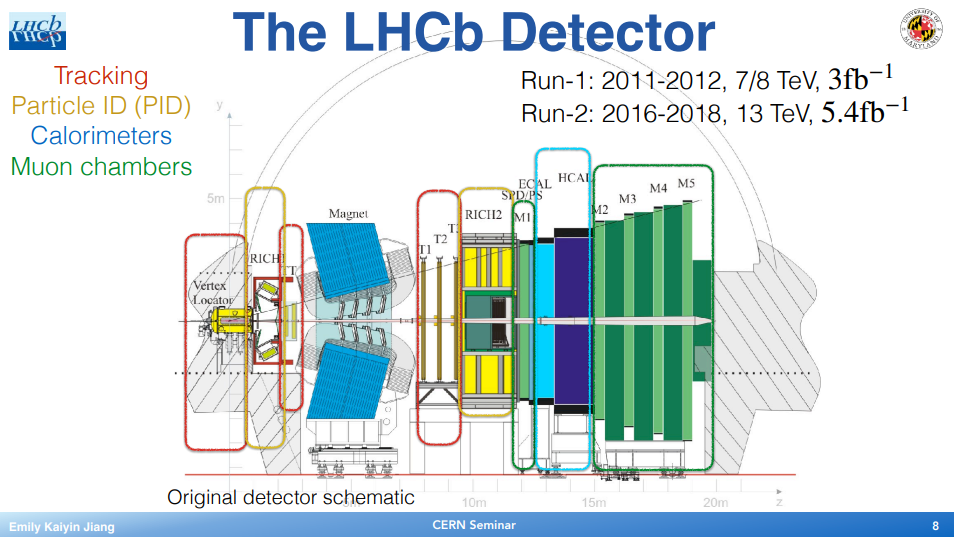
The result is primarily the work of Jiang, UMD alumnus Zishuo Yang (Ph.D., 2023), Phoebe Hamilton and Hassan Jawahery, members of the Large Hadron Collider beauty experiment (LHCb) at CERN in Geneva, Switzerland.  It was a seven-year effort undertaken while the UMD group was also working on the development and construction of the new LHCb detector.LHCbLHCb

These results are of significant interest in the field because they show deviation from the Standard Model predictions. Previous measurements of similar quantities using the light B mesons from the BaBar experiment at SLAC, Belle Experiment at the KEK laboratory in Japan and the LHCb experiment at CERN are also in tension with the Standard Model. The new results show a similar trend, reinforcing the effect and has been highly anticipated in the field.

Jiang’s presentation can be seen here: https://indico.cern.ch/event/1685950/attachments/3277204/5855756/26-04-23_ejiang_CERN_seminar.pdf

For further information:

https://bolek.web.cern.ch/RJpsi/

https://lhcb-outreach.web.cern.ch/2026/05/19/lepton-flavor-universality-tests-using-bc-decays-at-lhcb/

Sudden Breakups of Monogamous Quantum Couples Surprise Researchers

Quantum particles have a social life, of a sort. They interact and form relationships with each other, and one of the most important features of a quantum particle is whether it is an introvert—a fermion—or an extrovert—a boson.

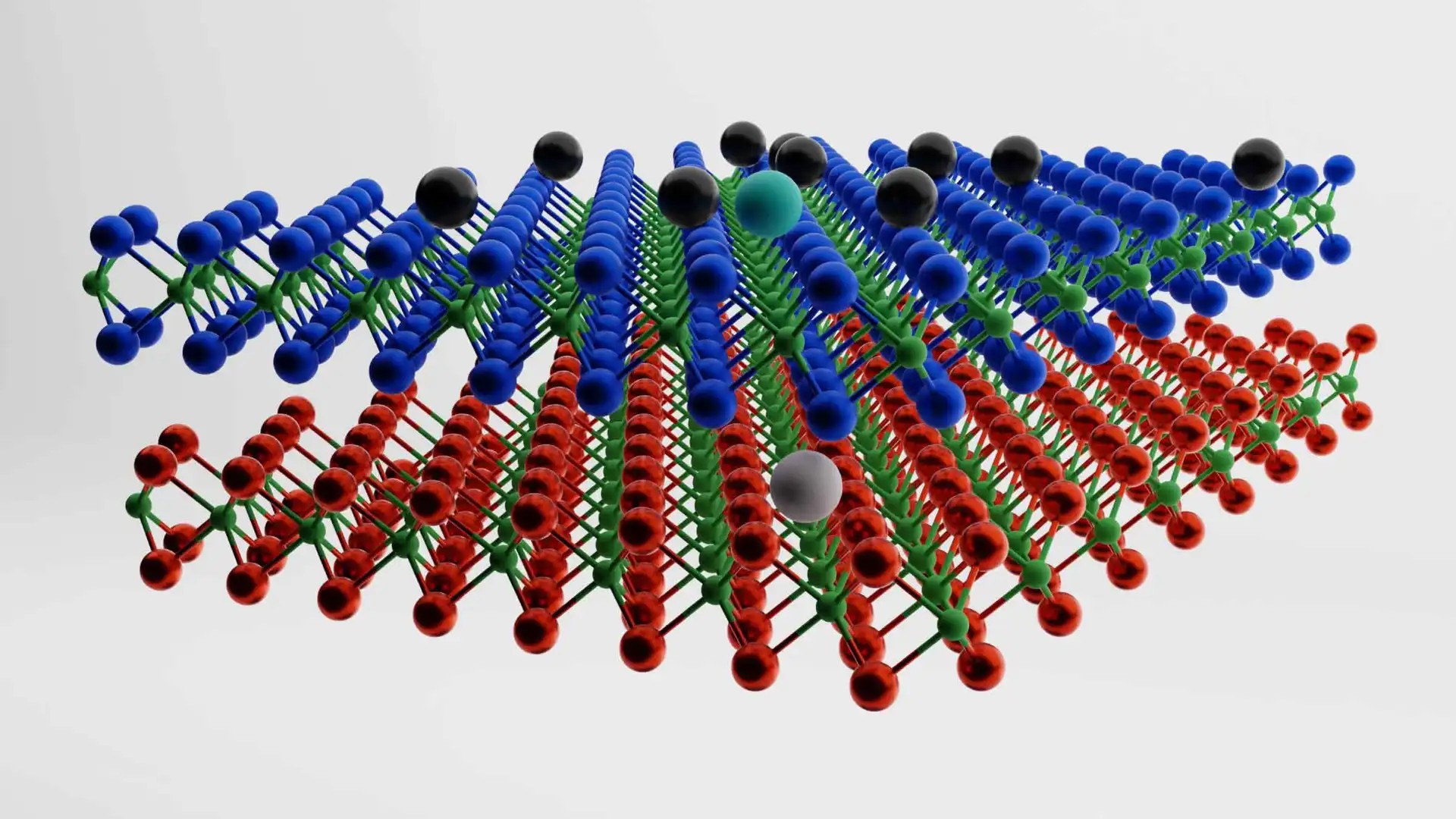
Extroverted bosons are happy to crowd into a shared quantum state, producing dramatic phenomena like superconductivity and superfluidity. In contrast, introverted fermions will not share their quantum state under any condition—enabling all the structures of solid matter to form.An exciton forms when an electron pairs up with a hole—a mobile particle-like void in a material where an electron is missing from an atom. When paired up as an exciton, a hole and electron normally travel around together as an exclusive couple, but a new experiment probes what happens when conditions in a material break up the pair. In the image, a hole (grey sphere) resides in the bottom layer of a stacked material and is paired to an electron in the top layer (cyan sphere). None of the electrons present in the top layer (black spheres) are willing to share a spot in the material with each other or the electron in the exciton. (Credit: Mahmoud Jalali Mehrabad/JQI)An exciton forms when an electron pairs up with a hole—a mobile particle-like void in a material where an electron is missing from an atom. When paired up as an exciton, a hole and electron normally travel around together as an exclusive couple, but a new experiment probes what happens when conditions in a material break up the pair. In the image, a hole (grey sphere) resides in the bottom layer of a stacked material and is paired to an electron in the top layer (cyan sphere). None of the electrons present in the top layer (black spheres) are willing to share a spot in the material with each other or the electron in the exciton. (Credit: Mahmoud Jalali Mehrabad/JQI)

But the social lives of quantum particles go beyond whether they are fermions or bosons. Particles interact in complex ways to produce everything we know, and interactions between quantum particles are key to understanding why materials have their particular properties. For instance, electrons are sometimes tightly locked into a relationship with a specific atom in a material, making it an insulator. Other times, electrons are independent and roam freely—the hallmark of a conductor. In special cases, electrons even pair up with each other into faithful couples, called Cooper pairs, that make superconductivity possible. These sorts of quantum relationships are the sources of material properties and the foundations of technologies from the simplest electrical wiring to cutting-edge lasers and solar panels.

Professor and JQI Fellow Mohammad Hafezi and his colleagues set out to investigate how adjusting the ratio of fermionic particles to bosonic particles in a material can change the interactions in it. They expected fermions to avoid each other as well as the bosonic counterparts chosen for the experiment, so they predicted that large crowds of fermions would get in the way and prevent bosons from moving far. The experiment revealed the exact opposite: When the researchers attempted to freeze the bosons in place with a barricade of fermions, the bosons instead started traveling quickly.

“We thought the experiment was done wrong,” says Daniel Suárez-Forero, a former JQI postdoctoral researcher who is now an assistant professor at the University of Maryland, Baltimore County. “That was the first reaction.”

But they went on to thoroughly check their results and eventually came up with an explanation. The researchers shared their experiments and conclusions in an article published on Jan. 1, 2026 in the journal Science. They had stumbled onto a way to host a quantum party where the particles throw their social norms out the window, producing a dramatic—and potentially useful—change in behavior.

The group’s experiment explored the interactions electrons have with each other and with couples formed from an electron and a hole. Holes aren’t quite real particles like electrons. Instead, they are quasiparticles—they behave like particles but only exist as a disturbance of the surrounding medium. A hole is the result of a material missing an electron from one of its atoms, leaving an uncompensated positive charge. The hole can move around and carry energy like a particle within the material, but it can never leave the host material. And if an electron ever falls into a hole, the hole disappears. 

Sometimes, electrons and holes form an atom-like arrangement (with the hole playing the role of a proton). When this happens, the hole and electron move together and behave like a single quantum object that researchers call an exciton. It normally takes energy to break up the particles in an exciton, so as an exciton moves the hole and electron pretty much always stick together. This fact led physicists to label the exciton relationship as “monogamous.” 

The composite excitons are bosons, while individual electrons are fermions. Together, the two provided a suitable cast for the group’s experiments on fermion and boson interactions.

“At least this was what we thought,” said Tsung-Sheng Huang, a former JQI graduate student of the group who is now a postdoctoral researcher at the Institute of Photonic Sciences in Spain. “Any external fermion should not see the constituents of the exciton separately; but in reality, the story is a little bit different.”

To get the particles they needed and a suitable way to control them, the researchers created a material with the qualities they needed for their experiment by carefully aligning a layer of one thin material on another thin material with just the right alignment. The material’s properties allowed them to easily create excitons that live for a relatively long time, while its structure kept things orderly by providing a neat grid of spots where an exciton or an unpartnered electron need to reside.

Because of the structure, the electrons and excitons don’t see the material as a standing-room-only concert venue but, instead, as a restaurant set up for Valentine’s Day—all the floor space is crammed with small, intimate tables. In the material, every exciton and lone electron needs to be sat at a table, and the introverted solo electrons won’t share—either with each other or with an exciton. 

However, excitons generally aren’t content to stay in their original seats. They tend to move around. But instead of brazenly walking across the room, an exciton surreptitiously hops from one adjacent empty table to the next—sometimes resulting in an inefficient detour around a cluster of occupied tables.

During an experiment, the researchers can host trillions of particles in the material’s seating plan, and they can control the number of excitons and electrons that are free to move through the room. To add or remove electrons, the researchers apply different electrical voltages, which can force electrons into or out of the material. To add excitons, they summon them from the existing material. The researchers can shine a specific color of laser on the material, and its atoms will absorb the light. The energy from the laser knocks electrons loose from the atoms and creates excitons. 

The top half of the image shows the layered structure of a material that can host free-moving electrons (the black spheres) and excitons made of a hole (white sphere) partnered with a particular electron (cyan sphere). The bottom of the image shows the quantum landscape created by the material for the electrons and excitons. It contains many distinct locations where the electrons and excitons want to reside. The exciton can move to nearby empty spots but not one already occupied by an electron. (Credit: Mahmoud Jalali Mehrabad/JQI)

The researchers were able to track where the excitons they created end up; they just watched for the signs of their eventual destruction. When an exciton’s electron and hole eventually combine, the extra energy it carried must go somewhere, and it is commonly emitted as light. The researchers collected this light and used it as a marker of the final positions of the excitons. This let them determine how much each cluster of excitons diffused through the material even though they don’t watch their individual journeys.

“We can basically do any ratio,” Suárez-Forero says. “We can populate the system with only bosons, only fermions, or any ratio. And the diffusivity, the way in which the bosons move, changes a lot depending on the number of particles of each species.”

In the experiment, the researchers systematically adjusted the electron density and deduced what they could from the resulting changes in the diffusion of the bosons. They used the movement of the excitons as an indication of their interactions with the electrons and each other, turning each group of excitons into an experimental sensor.

When there were very few electrons, the researchers expected electrons to essentially never come across each other and thus to not have much influence on each other or the excitons. In contrast, abundant electrons are expected to avoid each other and to get in the way of the excitons.

Things started out as expected with the excitons traveling shorter and shorter distances as the electron population was dialed up. The excitons increasingly had to find a winding path around electrons instead of taking a mostly straight path.

Eventually, the experiment reached the point where almost every table was occupied by an electron. The researchers expected this to essentially halt exciton diffusion, but instead, they observed a sudden jump in the mobility of the excitons. Despite the fact that the excitons should have had their paths blocked, the distance they moved dramatically increased.

“No one wanted to believe it,” says Pranshoo Upadhyay, a JQI graduate student and the lead author of the paper. “It’s like, can you repeat it? And for about a month, we performed measurements on different locations of the sample with different excitation powers and replicated it in several other samples.”

They even tried the experiment in a different lab when Suárez-Forero concluded his postdoctoral work at JQI and spent some time as a research scientist at the University of Geneva.

“We repeated the experiment in a different sample, in a different setup, and even in a different continent, and the result was exactly the same,” Suárez-Forero says.

They also had to check that they weren’t misinterpreting the results. They were only seeing the exciton diffusion, not actually watching the interactions. They were relying on mathematical theories to explain the results, and they needed to make sure a mistake wasn’t hiding in their math.

The team formed a strong theoretical and experimental collaboration to figure out what was going on. 

“We spent months going back and forth with theorists, trying out different models, but none of them captured all our experimental observations,” Upadhyay says. “Eventually we realized that the excitons sit differently than the free electrons and holes in our system. That was the turning point—when we began thinking of the exciton beyond monogamy.”

The team concluded that the very crowded conditions were making the excitons give up on monogamy, so the researchers described the phenomenon as “non-monogamous hole diffusion.” Essentially, the surprising result occurred when the experimenters flooded the material—the metaphorical restaurant—with a bunch of electrons, each claiming a table to itself. The researchers determined that when the population of available electrons got sufficiently lopsided, the holes in each exciton saw all the other electrons as identical to the one they were already with; the normal rule of exciton monogamy broke down.

The rapid diffusion was caused by holes suddenly ditching their long-term electron partners. Instead of each working its way from table to table with the same electron, the holes were doing a speed dating round with electron after electron—allowing each exciton to make a beeline to its destination. Without the normal winding path around all the single electrons, each exciton travelled much farther before giving off its signature flash of destruction.

All the researchers needed to do to trigger this lopsided dating pool and rapid travel was adjust the voltage. Controlling voltages is no problem for existing devices, so the technique has broad potential to be conveniently integrated into future experiments and technologies that exploit excitons, like certain solar panel designs.

The researchers are already using this insight into how excitons and electrons can interact to interpret other experiments. They are also working to apply their new understanding of these materials to achieve greater control of the quantum interactions that they can induce in experiments.

“Gaining control over the mobility of particles in materials is fundamental for future technologies,” Suárez-Forero says. “Understanding this dramatic increase in the exciton mobility offers an opportunity for developing novel electronic and optical devices with enhanced capabilities.”

Original story by Bailey Bedford: https://jqi.umd.edu/news/sudden-breakups-monogamous-quantum-couples-surprise-researchers 

In addition to Hafezi, who is also a Minta Martin professor of electrical and computer engineering and physics at the University of Maryland and a senior investigator at the National Science Foundation Quantum Leap Challenge Institute for Robust Quantum Simulation; Upadhyay; Suárez-Forero and Huang, co-authors of the paper include JQI graduate students Beini Gao and Supratik Sarkar; former JQI postdoctoral researcher Deric Session who is now a systems scientist at Onto Innovation; Mahmoud Jalali Mehrabad, a former JQI postdoctoral researcher who is now a research scientist at MIT; Kenji Watanabe and Takashi Taniguchi, who are researchers at the National Institute for Material Science in Japan; You Zhou, who is an assistant professor at the University of Maryland’s School of Engineering; and Michael Knap, who is a professor at the Technical University of Munich in Germany.

This research was funded in part by the National Science Foundation and the Simons Foundation.

When Superfluids Collide, Physicists Find a Mix of Old and New

Physics is often about recognizing patterns, sometimes repeated across vastly different scales. For instance, moons orbit planets in the same way planets orbit stars, which in turn orbit the center of a galaxy.

When researchers first studied the structure of atoms, they were tempted to extend this pattern down to smaller scales and describe electrons as orbiting the nuclei of atoms. This is true to an extent, but the quirks of quantum physics mean that the pattern breaks in significant ways. An electron remains in a defined orbital area around the nucleus, but unlike a classical orbit, an electron will be found at a random location in the area instead of proceeding along a precisely predictable path.

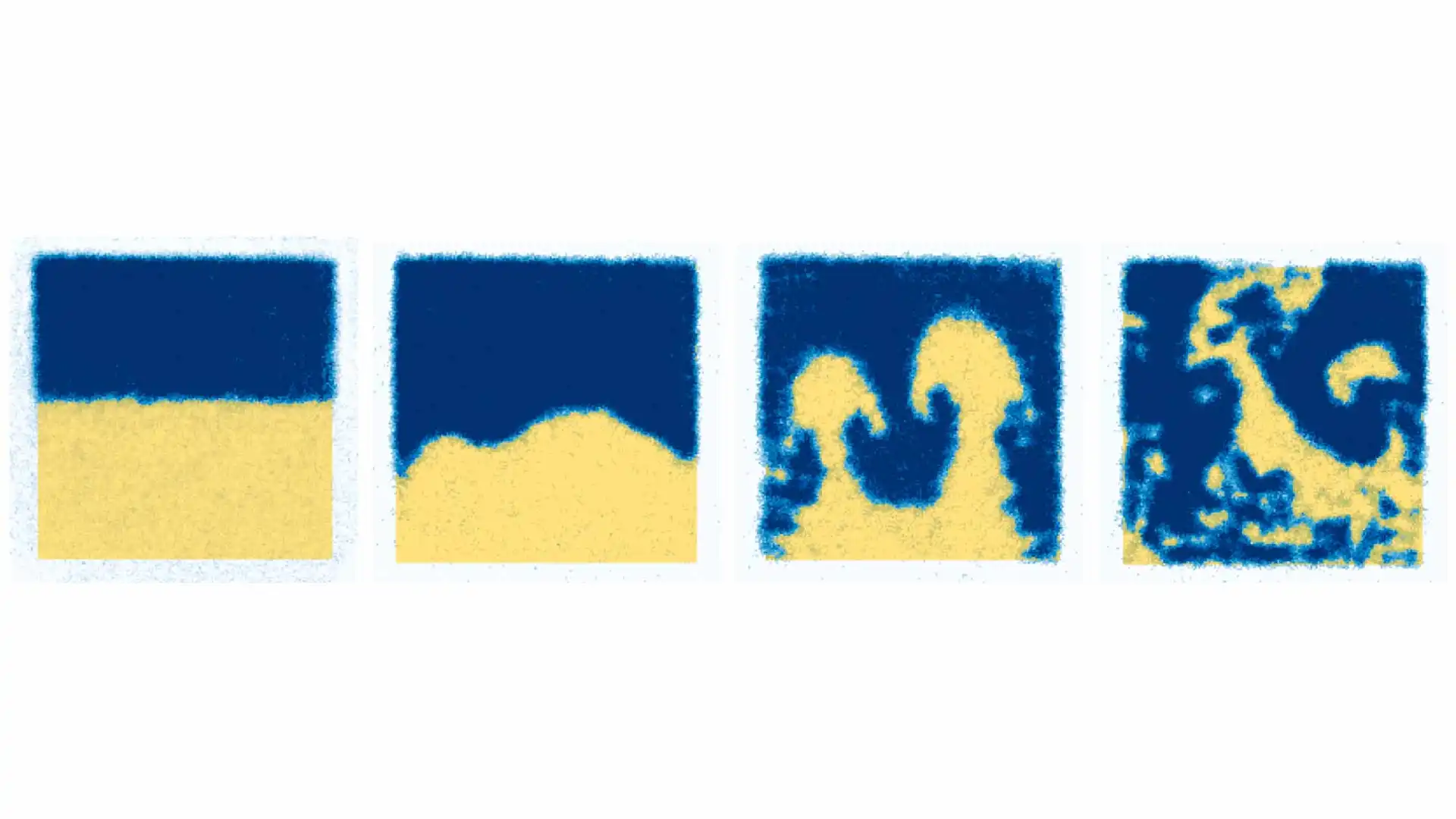
That electron orbits bear any similarity to the orbits of moons or planets is because all of these orbital systems feature attractive forces that pull the objects together. But a discrepancy arises for electrons because of their quantum nature. Similarly, superfluids—a quantum state of matter—have a dual nature, and to understand them, researchers have had to pin down when they follow the old rules of regular fluids and when they play by their own quantum rules. For instance, superfluids will fill the shape of a container like normal fluids, but their quantum nature lets them escape by climbing vertical walls. Most strikingly, they flow without any friction, which means they can spin endlessly once stirred up.A new experiment forces two quantum superfluids together and creates mushroom cloud shapes similar to those seen above explosions. The blue and yellow areas represent two different superfluids, which each react differently to magnetic fields. After separating the two superfluids (as shown on the left), researchers pushed them together, forcing them to mix and creating the recognizable pattern that eventually broke apart into a chaotic mess. (Credit: Yanda Geng/JQI)A new experiment forces two quantum superfluids together and creates mushroom cloud shapes similar to those seen above explosions. The blue and yellow areas represent two different superfluids, which each react differently to magnetic fields. After separating the two superfluids (as shown on the left), researchers pushed them together, forcing them to mix and creating the recognizable pattern that eventually broke apart into a chaotic mess. (Credit: Yanda Geng/JQI)

JQI Fellows Ian Spielman and Gretchen Campbell and their colleagues have been investigating the rich variety of quantum behaviors present in superfluids and exploring ways to utilize them. In a set of recent experiments, they mixed together two superfluids and stumbled upon some unexpected patterns that were familiar from normal fluids. In an article published in Aug. 2025 in the journal Science Advances, the team described the patterns they saw in their experiments, which mirrored the ripples and mushroom clouds that commonly occur when two ordinary fluids with different densities meet.

The team studies a type of superfluid called a Bose-Einstein condensate (BEC). BECs form by cooling many particles down so cold that they all collect into a single quantum state. That consolidation lets all the atoms coordinate and allows the quirks of quantum physics to play out at a much larger scale than is common in nature. The particular BEC they used could easily be separated into two superfluids that provide a convenient way for the team to prepare nearly smooth interfaces, which were useful for seeing mixing patterns balloon from the tiniest seeds of imperfection into a turbulent mess. And the researchers didn’t only find classical fluid behaviors in the quantum world; they also spied the quantum fingerprints hidden beneath the surface. Using the uniquely quantum features of their experiment, they developed a new technique for observing currents along the interface of two superfluids.

“It was really exciting to see how the behavior of normal liquids played out for superfluids, and to invent a new measurement technique leveraging their uniquely quantum behavior,” Spielman says.

To make the two superfluid BECs in the new experiment, the researchers used sodium atoms. Each sodium atom has a spin, a quantum property that makes it act like a little magnet that can either point with or against a magnetic field. Hitting the cooled down cloud of sodium atoms with microwaves produces roughly equal numbers of atoms with spins pointing in opposite directions, which forms two BECs with distinct behaviors. In an uneven magnetic field, the cloud of the two intermingled BECs formed by the microwave pulse will sort itself into two adjacent clouds, with one effectively floating on top of the other; adjusting the field can make the superfluids move around.

This process was old hat in the lab, but, together with a little happenstance, it inspired the new experiment. JQI graduate student Yanda Geng, who is the lead author of the paper, was initially working on another project that required him to smooth out variations of the magnetic field in his setup. To test for magnetic fluctuations, Geng would routinely turn his cloud of atoms into the two BECs and take a snapshot of their distribution. The resulting images caught the eye of JQI postdoctoral researcher Mingshu Zhao, who at the time was working on his own project about turbulence in superfluids. Zhao, who is also an author of the paper, thought that the swirling patterns in the superfluids were reminiscent of turbulence in normal fluids. The snapshots from the calibration didn’t clearly show mushroom clouds, but something about the way the two BECs mixed seemed familiar.

“This is what you call serendipity,” Geng says. “And if you have somebody in the lab who knows what could have happened, they immediately could say, ‘Oh, that's something interesting and probably worth pursuing scientifically.’”

The hints kept appearing as Geng’s original experiment repeatedly hit roadblocks. After months of working on the project, he felt like he was banging his head against a wall. One weekend, another colleague, JQI postdoctoral researcher Junheng Tao, encouraged Geng to mix things up and spend some time exploring the hints of turbulence. Tao, who is also an author of the paper, suggested they intentionally create the two fluids in a stable state and check if they could see patterns forming before the turbulence erupted.

“It was a Sunday, we went into the lab, and we just casually put in some numbers and programmed the experiment, and bam, you see the signal,” Geng says.

The magnetic responses of the two BECs gave Geng and Tao a convenient way to control the superfluids. First, they let magnetism pull the two BECs into a stable configuration in which they lie flush against each other, like oil floating on water. Then, by reversing the way the magnetic field varied across the experiment, the BECs were suddenly pulled in the opposite direction, instantly producing the equivalent of water balanced on top of oil.

After adjusting the field, Geng and Tao were able to take just a single snapshot of the mixing BECs. To get the image, they relied on the fact that the BECs naturally absorb different colors of light. They flashed a color that interacted with just one of the BECs, so they could identify each BEC based on where the light was absorbed. Inconveniently, absorbing the light knocked many atoms out of the BECs, so snapping the image ended the run of the experiment.

By waiting different amounts of time each run, they were able to piece together what was happening as the two BECs mixed. The results revealed the distinctive formation of mushroom clouds that ultimately degenerated into messy turbulence. The researchers determined that despite the many stark differences between BEC superfluids and classical fluids, the BECs recreated a widespread effect, called the Rayleigh-Taylor instability, that is found in normal fluids.

The Rayleigh-Taylor instability describes the process of two distinct fluids needing to exchange places, such as when a dense gas or liquid is on top of a lighter one with gravity pulling it down. The instability produces a pattern of growth of small imperfections in an almost stable state that devolves into unpredictable turbulent mixing. It occurs for water on top of oil, cool dense air over hotter air (as happens after a big explosion) and when layers of material explode out from a star during a supernova. The instability contributes to the iconic “mushroom clouds” observed in the air layers moving above explosions, and similar shapes were found in the BEC.

“At first it's really mind-boggling,” Geng says. “How can it happen here? They’re just completely different things.”

With a little more work, they confirmed they could reliably recreate the behavior and showed that the superfluids in the experiment had all the necessary ingredients to produce the instability. In the experiment, the researchers had effectively substituted magnetism into the role gravity often plays in the creation of the Rayleigh-Taylor instability. This made it convenient to flip the direction of the force at a whim, which made it easy to begin with a calm interface between the fluids and observe the instability balloon from the tiniest seeds of imperfection into turbulent mixing.

The initial result prompted the group to follow up on the project with another experiment exploring a more stable effect at the interface. Instead of completely flipping the force, they kept the “lighter” BEC on top—like oil, or even air, resting on water. By continuously varying the magnetic field at a particular rate, they could shake the interface and create the equivalent of ripples on the surface of a pond. Since the atoms in each BEC all share a quantum state, the ripples have quantum properties and can behave like particles (called ripplons).

But despite the clear patterns resembling mushroom clouds and ripples of normal fluids, the quantum nature of the BECs was still present throughout the experiment. After seeing the familiar behaviors, Geng began to think about the quantum side of the superfluids and turned his attention to something that is normally challenging to do with BECs—measuring the velocity of currents flowing through them.

Geng and his colleagues used the fact that the velocity of a BEC is tied toits phase—a wavelike feature of every quantum state. The phase of a single quantum object is normally invisible, but when multiple phases interact, they can influence what researchers see in experiments. Like waves, if two phases are both at a peak when they meet, they combine, but if a peak meets a trough, they instead cancel out. Or circumstances can produce any of the intermediate forms of combining or partially cancelling out. When different interactions occur at different positions, they create patterns that are often visible in experiments. Geng realized that at the interfaces in his experiment the wavefunctions of the two BECs met and gave them a unique chance to observe interfering BEC phases and determine the velocities of the currents flowing along the interface. 

When the two BECs came together in their experiments, their phases interfered, but the resulting interference pattern remained hidden. However, Geng knew how to translate the hidden interference pattern to something he could see. Hitting the BECs with a microwave pulse could push the sodium atoms into new states where the pattern could be experimentally observed. With that translation, Geng could use his normal snapshot technique to capture an image of the interference between the two phases.

The quantum patterns he saw provide an additional tool for understanding the mixing of superfluids and demonstrate how the familiar Rayleigh-Taylor instability pattern found in the experiment had quantum patterns hidden beneath the surface. The results revealed that despite BEC superfluids being immersed in the quantum world, researchers can still benefit from keeping an eye out for the old patterns familiar from research on ordinary fluids.

“I think it's a very amazing thing for physicists to see the same phenomenon manifest in different systems, even though they are drastically different in their nature,” Geng says.

Original story by Bailey Bedford: https://jqi.umd.edu/news/when-superfluids-collide-physicists-find-mix-old-and-new

In addition to Campbell, who is also the Associate Vice President for Quantum Research and Education at UMD; Spielman; Geng; and Zhao, co-authors of the paper include former JQI postdoctoral researcher Shouvik Mukhherjee and NIST scientist and former JQI postdoctoral researcher Stephen Eckel.

With Passive Approach, New Chips Reliably Unlock Color Conversion

Over the past several decades, researchers have been making rapid progress in harnessing light to enable all sorts of scientific and industrial applications. From creating stupendously accurate clocks to processing the petabytes of information zipping through data centers, the demand for turnkey technologies that can reliably generate and manipulate light has become a global market worth hundreds of billions of dollars.

One challenge that has stymied scientists is the creation of a compact source of light that fits onto a chip, which makes it much easier to integrate with existing hardware. In particular, researchers have long sought to design chips that can convert one color of laser light into a rainbow of additional colors—a necessary ingredient for building certain kinds of quantum computers and making precision measurements of frequency or time.

Now, researchers at JQI have designed and tested new chips that reliably convert one color of light into a trio of hues. Remarkably, the chips all work without any active inputs or painstaking optimization—a major improvement over previous methods. The team described their results in the journal Science on Nov. 6, 2025.

The new chips are examples of photonic devices, which can corral individual photons, the quantum particles of light. Photonic devices split up, route, amplify and interfere streams of photons, much like how electronic devices manipulate the flow of electrons.

“One of the major obstacles in using integrated photonics as an on-chip light source is the lack of versatility and reproducibility,” says JQI Fellow Mohammad Hafezi, who is also a Minta Martin professor of electrical and computer engineering and a professor of physics at the University of Maryland. “Our team has taken a significant step toward overcoming these limitations.”

The new photonic devices are more than mere prisms. A prism splits multicolored light into its component colors, or frequencies, whereas these chips add entirely new colors that aren’t present in the incoming light. Being able to generate new frequencies of light directly on a chip saves the space and energy that would normally be taken up by additional lasers. And perhaps more importantly, in many cases lasers that shine at the newly generated frequencies don’t even exist.

The ability to generate new frequencies of light on a chip requires special interactions that researchers have been learning to engineer for decades. Ordinarily, the interactions between light and a photonic device are linear, which means the light can be bent or absorbed but its frequency won’t change (as in a prism). By contrast, nonlinear interactions occur when light is concentrated so intensely that it alters the behavior of the device, which in turn alters the light. This feedback can generate a panoply of different frequencies, which can be collected from the output of the chip and used for measurement, synchronization or a variety of other tasks. 

Unfortunately, nonlinear interactions are usually very weak. One of the first observations of a nonlinear optical process was reported in 1961, and it was so weak that someone involved in the publication process mistook the key data for a smudge and removed it from the main figure in the paper. That smudge was the subtle signature of second harmonic generation, in which two photons at a lower frequency are converted into one photon with double the frequency. Related processes can triple the frequency of incoming light, quadruple it, and so forth.

Since that first observation of second harmonic generation, scientists have discovered ways to boost the strength of nonlinear interactions in photonic devices. In the original demonstration, the state of the art was to simply shine a laser on a piece of quartz, taking advantage of the natural electrical properties of the crystal. These days researchers rely on meticulously engineered chips tailored with photonic resonators. The resonators guide the light in tight cycles, allowing it to circulate hundreds of thousands or millions of times before being released. Each single trip through a resonator adds a weak nonlinear interaction, but many trips combine into a much stronger effect. Yet there are still tradeoffs when trying to produce a particular set of new frequencies using a single resonator. 

“If you want to simultaneously have second harmonic generation, third harmonic generation, fourth harmonic—it gets harder and harder,” says Mahmoud Jalali Mehrabad, the lead author of the paper and a former postdoctoral researcher at JQI who is now a research scientist at MIT. “You usually compensate, or you sacrifice one of them to get good third harmonic generation but cannot get second harmonic generation, or vice versa.”

In an effort to avoid some of these tradeoffs, Hafezi and JQI Fellow Kartik Srinivasan, together with Electrical and Computer Engineering Professor Yanne Chembo at the University of Maryland (UMD), have previously pioneered ways of boosting nonlinear effects by using a hoard of tiny resonators that all work in concert. They showed in earlier work how a chip with hundreds of microscopic rings arranged into an array of resonators can amplify nonlinear effects and guide light around its edge. Last year, they showed that a chip patterned with such a grid could transmute a pulsed laser into a nested frequency comb—light with many equally spaced frequencies that is used for all kinds of high-precision measurements. However, it took many iterations to design chips with the right shape to generate the precise frequency comb they were after, and only some of their chips actually worked.

The fact that only a fraction of the chips worked is indicative of the maddening hit-or-miss nature of working with nonlinear devices. Designing a photonic chip requires balancing several things in order to generate an effect like frequency doubling. First, to double the frequency of light, a nonlinear resonator must support both the original frequency and the doubled frequency. Just as a plucked guitar string will only hum with certain tones, an optical resonator only hosts photons with certain frequencies, determined by its size and shape. But once you design a resonator with those frequencies locked in, you must also ensure that they circulate around the resonator at the same speed. If not, they will fall out of sync with each other, and the efficiency of the conversion will suffer.

Together these requirements are known as the frequency-phase matching conditions. In order to produce a useful device, researchers must simultaneously arrange for both conditions to match. Unfortunately, tiny nanometer-sized differences from chip to chip—which even the best chip makers in the world can’t avoid—will shift the resonant frequencies a little bit or change the speed at which they circulate. Those small changes are enough to wash out the finely tuned parameters in a chip and render the design useless for mass production.

One of the authors compared the predicament to the likelihood of spotting a solar eclipse. “If you want to actually see the eclipse, that means if you look up in the sky the moon has to overlap with the sun,” says Lida Xu, a co-lead author and a graduate student in physics at JQI. Getting reliable nonlinear effects out of photonic chips requires a similar kind of chance encounter.

Small misalignments in the frequency-phase matching conditions can be overcome with active compensation that adjusts the material properties of a resonator. But that involves building in little embedded heaters—a solution that both complicates the design and requires a separate power supply.Researchers at JQI have designed and tested new chips that reliably convert one color of light (represented by the orange pulse in the lower left corner of the image above) into many colors (represented by the red, green, blue and dark grey pulses leaving the chip in the lower right corner). The array of rings—each one a resonator that allows light to circulate hundreds of thousands or millions of times—ensures that the interaction between the incoming light and the chip can double, triple and quadruple its frequency. (Credit: Mahmoud Jalali Mehrabad/JQI)Researchers at JQI have designed and tested new chips that reliably convert one color of light (represented by the orange pulse in the lower left corner of the image above) into many colors (represented by the red, green, blue and dark grey pulses leaving the chip in the lower right corner). The array of rings—each one a resonator that allows light to circulate hundreds of thousands or millions of times—ensures that the interaction between the incoming light and the chip can double, triple and quadruple its frequency. (Credit: Mahmoud Jalali Mehrabad/JQI)

In the new work, Xu, Mehrabad and their colleagues discovered that the array of resonators used in previous work already increases the chances of satisfying the frequency-phase matching conditions in a passive way—that is, without the use of any active compensation or numerous rounds of design. Instead of trying to engineer the precise frequencies they wanted to create and iterating the design of the chip in hopes of getting one that worked, they stepped back and considered whether the array of resonators produced any stable nonlinear effects across all the chips. When they checked, they were pleasantly surprised to find that their chips would generate second, third and even fourth harmonics for incoming light with a frequency of about 190 THz—a standard frequency used in telecommunications and fiber optic communication.

As they dug into the details, they realized that the reason all their chips worked was related to the structure of their resonator array. Light circulated quickly around the small rings in the array, which set a fast timescale. But there was also a “super-ring” formed by all the smaller rings, and light circulated around it more slowly. Having these two timescales in the chip had an important effect on the frequency-phase matching conditions that they hadn’t appreciated before. Instead of having to rely on meticulous design and active compensation to arrange for a particular frequency-phase matching condition, the two timescales provide researchers with multiple shots at nurturing the necessary interactions. In other words, the two timescales essentially provide the frequency-phase matching for free.

The researchers tested six different chips manufactured on the same wafer by sending in laser light with the standard 190 THz frequency, imaging a chip from above and analyzing the frequencies leaving an output port. They found that each chip was indeed generating the second, third and fourth harmonics, which for their input laser happened to be red, green and blue light. They also tested three single-ring devices. Even with the inclusion of embedded heaters to provide active compensation, they only saw second harmonic generation from one device over a narrow range of heater temperature and input frequency. By contrast, the two-timescale resonator arrays had no active compensation and worked over a relatively broad range of input frequencies. The researchers even showed that as they dialed up the intensity of their input light, the chips started to produce more frequencies around each of the harmonics, reminiscent of the nested frequency comb created in an earlier result.

The authors say that their framework could have broad implications for areas in which integrated photonics are already being used, especially in metrology, frequency conversion and nonlinear optical computing. And it can do it all without the hassle of active tuning or precise engineering to satisfy the frequency-phase matching conditions.

“We have simultaneously relaxed these alignment issues to a huge degree, and also in a passive way,” Mehrabad says. “We don't need heaters; we don't have heaters. They just work. It addresses a long-standing problem.”

Original story by Chris Cesare: With Passive Approach, New Chips Reliably Unlock Color Conversion | Joint Quantum Institute

In addition to Mehrabad, Hafezi, Srinivasan (who is also a Fellow of the National Institute of Standards and Technology), Chembo and Xu, the paper had several other authors: Gregory Moille, an associate research scientist at JQI; Christopher Flower, a former graduate student at JQI who is now a researcher at the Naval Research Laboratory; Supratik Sarkar, a graduate student in physics at JQI; Apurva Padhye, a graduate student in physics at JQI; Shao-Chien Ou, a graduate student in physics at JQI; Daniel Suarez-Forero, a former JQI postdoctoral researcher who is now an assistant professor of physics at the University of Maryland, Baltimore County; and Mahdi Ghafariasl, a postdoctoral researcher at JQI.

This research was funded by the Air Force Office of Scientific Research, the Army Research Office, the National Science Foundation and the Office of Naval Research.